Artwork
Untitled
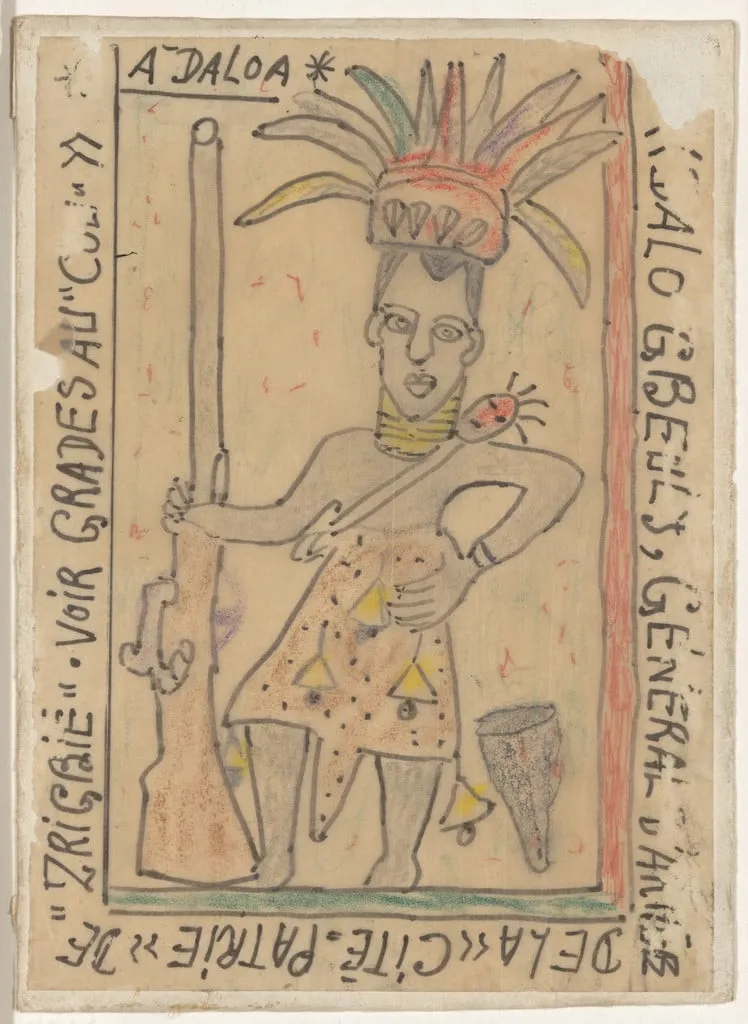
Untitled is a graphite drawing by Frédéric Bruly Bouabré. It dates from 1973 and is held in the collection of the Museum of Modern Art.
About this work
Overview
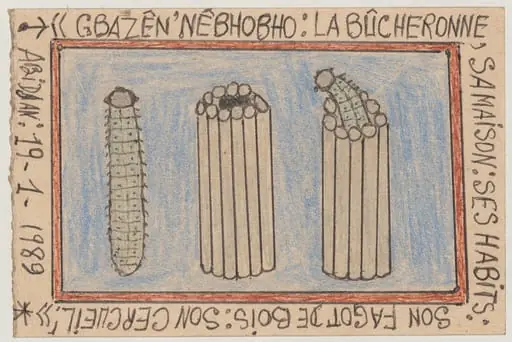
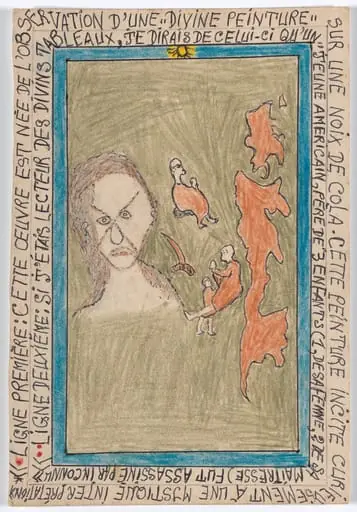
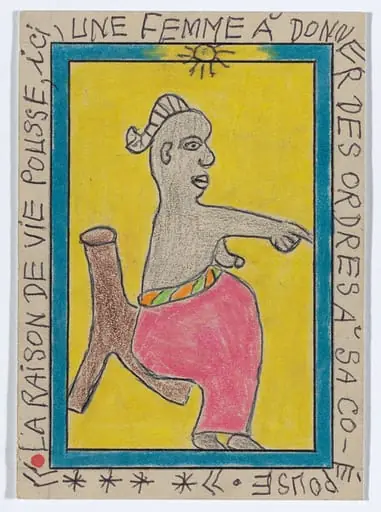
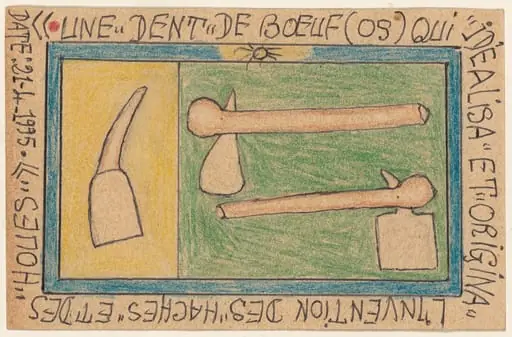
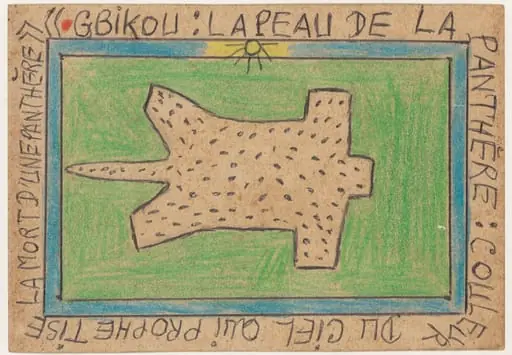
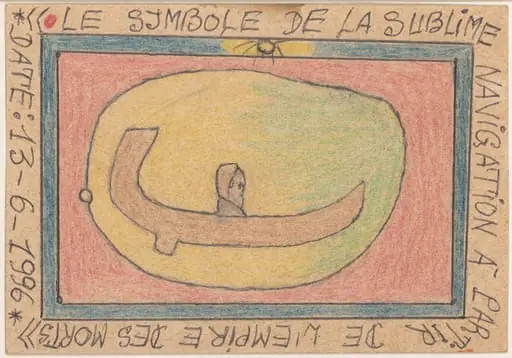
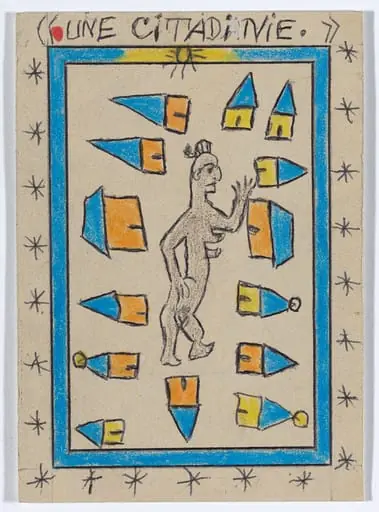
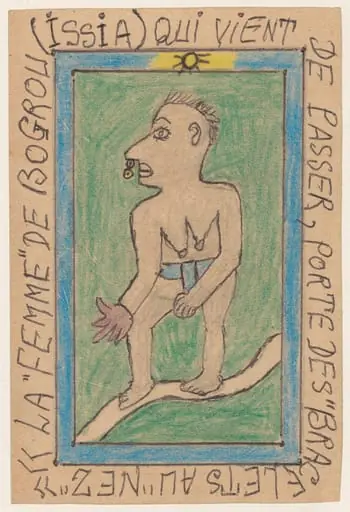
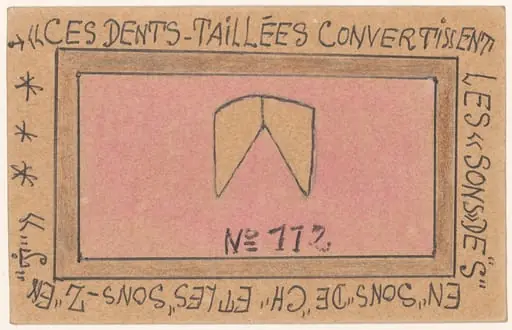
Created around 1973, this drawing by Frédéric Bruly Bouabré is executed in black ink, colored ballpoint pen, and pencil on tracing paper. It is part of the collection at The Museum of Modern Art. The work belongs to a broader series in which Bouabré documented knowledge systems from his native Bété culture, blending visual symbols with handwritten text to construct a personal lexicon of meaning.
Subject & Meaning
Dots and geometric patterns cover the body, possibly indicating social rank, spiritual protection, or clan affiliation.
The central figure wears a feathered headdress and a necklace with a red pendant, suggesting ceremonial status. Dots and geometric patterns cover the body, possibly indicating social rank, spiritual protection, or clan affiliation. Surrounding French inscriptions—such as 'A DALOA' and 'VOIR GRADÉS AU 'CULI''—appear to be annotations, perhaps referencing places, titles, or ritual observations, forming a visual archive of oral traditions.
Technique & Style
Bouabré used rapid, uneven strokes with ballpoint pen and pencil, creating a sense of immediacy. Tracing paper allowed for layering and transparency, enhancing the density of marks. Colors are applied with minimal refinement, prioritizing symbolic clarity over aesthetic polish. The handwritten text is integrated as a visual element, not merely a caption, reinforcing the work’s function as a coded record.
History & Provenance
This drawing emerged from Bouabré’s lifelong project to systematize Bété cosmology after a spiritual vision in 1948. He produced over 400 similar works, each a 'alphabetical' glyph in his invented script. The piece entered MoMA’s collection through the museum’s engagement with non-Western artistic practices in the late 20th century, reflecting a broader reevaluation of self-taught artists.
Context
Bouabré worked outside formal art institutions, developing his visual language independently. His drawings responded to colonial erasure of indigenous knowledge, offering an alternative archive rooted in oral culture. The use of French text reflects his bilingual environment, while the imagery preserves symbols from Bété rituals, cosmology, and social structure, resisting assimilation through visual autonomy.
Legacy
Bouabré’s drawings, including this one, have influenced contemporary discussions on decolonizing art history and expanding definitions of writing and literacy. His work is now recognized as a unique form of ethnographic documentation, where image and text merge to preserve cultural memory. Institutions increasingly treat his oeuvre as foundational to African modernism and the global canon of outsider art.
Artist & collection
Artist
Frédéric Bruly Bouabré (1923–2014) was an Ivorian artist, born in Idibouo-Zépréguhé.