Artwork
Don Quixote and Sancho Panza Witness the Attack on Rocinante
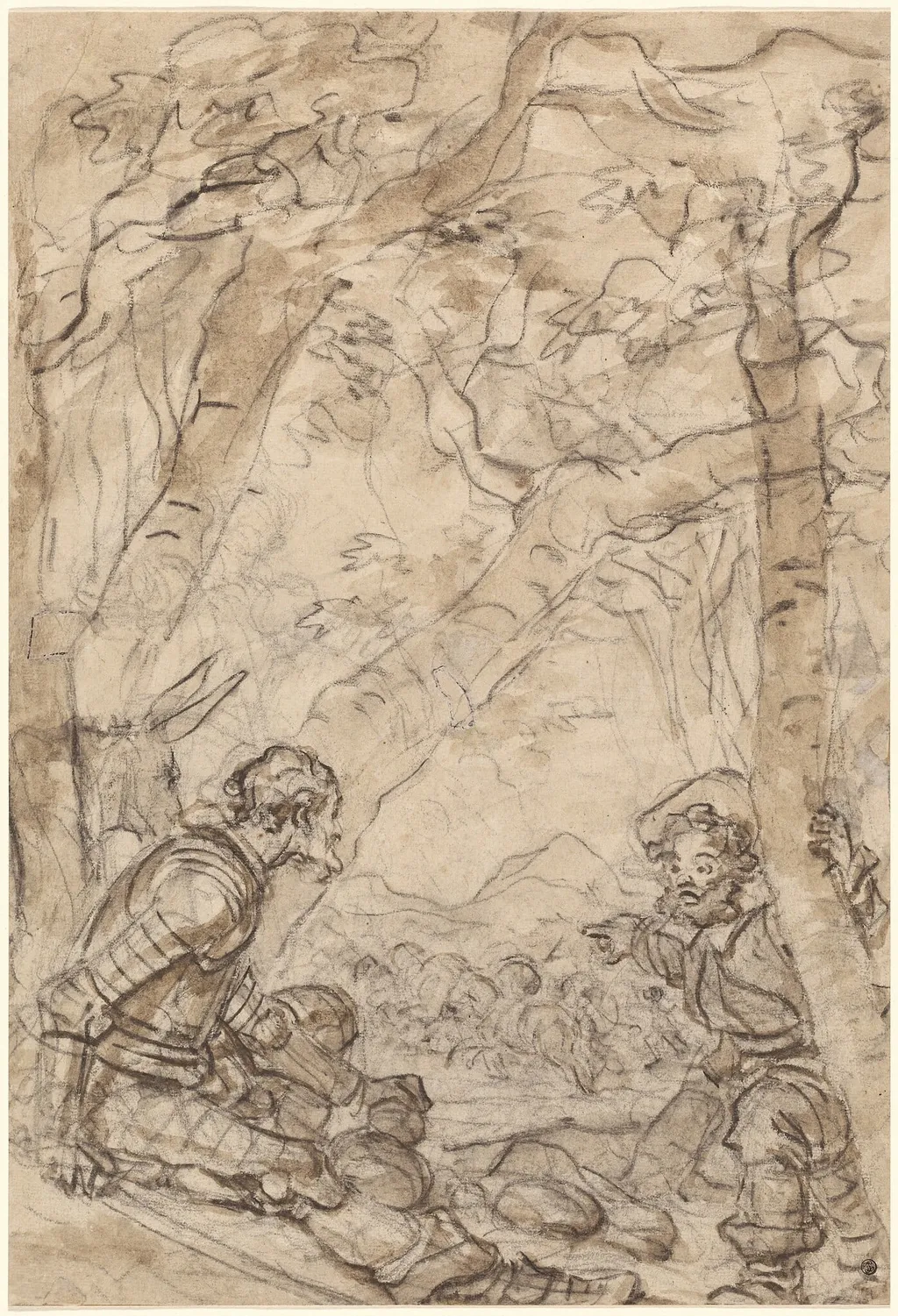
Don Quixote and Sancho Panza Witness the Attack on Rocinante is a chalk drawing by the Romanticist artist Jean Honoré Fragonard. It dates from 1784 and is held in the collection of the National Gallery of Art.
About this work
Overview
This drawing by Jean-Honoré Fragonard, dated around 1784, captures a moment from Cervantes’s novel in black chalk with gray and brown washes on laid paper.
This drawing by Jean-Honoré Fragonard, dated around 1784, captures a moment from Cervantes’s novel in black chalk with gray and brown washes on laid paper. It depicts Don Quixote and Sancho Panza reacting to an assault on Rocinante, the knight’s aging horse. The composition conveys urgency and emotional disarray, rendered with loose, energetic strokes that suggest rapid execution, possibly from direct observation or memory.
Subject & Meaning
The scene illustrates the vulnerability of idealism in the face of harsh reality. Don Quixote, slumped in defeat, embodies the collapse of his chivalric fantasy, while Sancho Panza, arms raised in helpless appeal, represents pragmatic concern. The chaotic landscape mirrors their inner turmoil, transforming nature into a hostile force that undermines their quest. The moment is not heroic but human—marked by exhaustion and futility.
Technique & Style
Fragonard employed swift, expressive lines and layered washes to evoke motion and emotional intensity. The chalk strokes are deliberately unrefined, with smudged shadows suggesting movement and depth without detail. The paper’s texture and slight wear reinforce the impression of spontaneity, as if drawn in real time. This approach prioritizes feeling over precision, aligning with late 18th-century sketch traditions that valued immediacy.
History & Provenance
Created circa 1784, the drawing likely originated as a preparatory study or personal exercise, not a commissioned work. It remained within Fragonard’s circle until entering public collections in the 19th century. Its survival reflects its value as a record of the artist’s engagement with literary themes, though its exact early ownership remains undocumented.
Context
Fragonard’s interest in Cervantes coincided with a broader European revival of literary illustration during the late Enlightenment. While Rococo aesthetics dominated his earlier work, this drawing reveals a shift toward emotional narrative and naturalistic tension. The turbulent landscape anticipates Romanticism’s fascination with nature as a psychological mirror, even as it retains the artist’s characteristic fluidity.
Legacy
Though not widely exhibited in Fragonard’s lifetime, this drawing is now recognized as a rare example of his literary engagement. It stands as a quiet counterpoint to his more ornate paintings, revealing a capacity for introspection and narrative restraint. Its rawness influenced later artists seeking to convey inner states through gesture and atmosphere rather than polished finish.
Artist & collection

Artist
Jean-Honoré Fragonard was born on 5 April 1732 in Grasse, the son of a glover, and moved with his family to Paris in 1738.

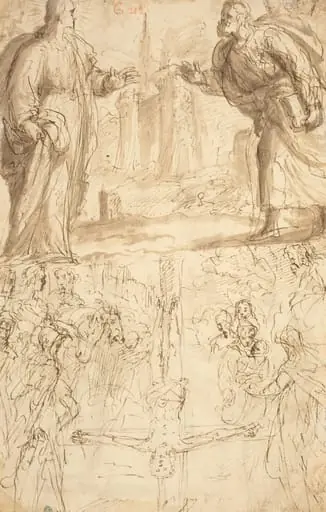 Crucifixion of Saint Peter
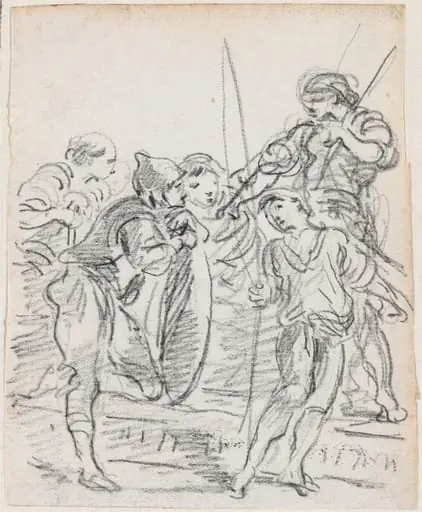 Group of Male Figures Conversing
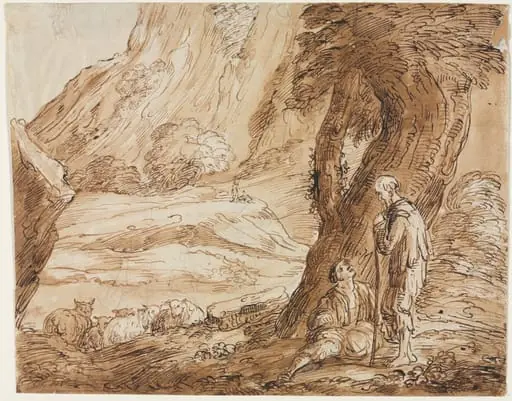 Landscape with Sheep and Two Shepherds
 Mercury and Argus (Ovid, Metamorphoses i.668–721)
 Two Figures Fishing in a Landscape
 A Hunting Party at Marly
 Shepherd in a Landscape
 Figures on a Winding Road
 Eliezer and Rebecca at the Well
 The Annunciation to Joachim