Artwork
Goddess of Chaste Love
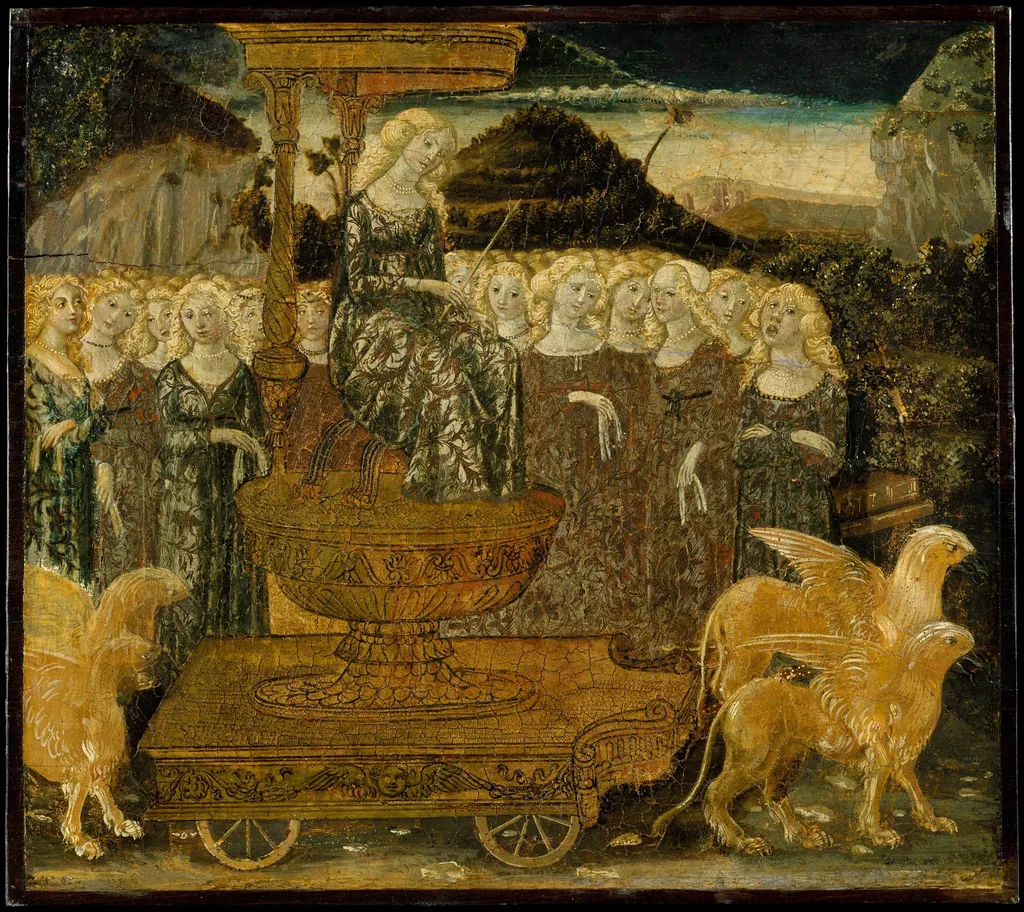
Goddess of Chaste Love is an unspecified painting by the Early Renaissance artist Francesco di Giorgio. It dates from 1471 and is held in the collection of the Metropolitan Museum of Art.
About this work
Overview
Francesco di Giorgio’s 1471 oil painting titled *Goddess of Chaste Love* is part of the Metropolitan Museum of Art’s collection.
Francesco di Giorgio’s 1471 oil painting titled *Goddess of Chaste Love* is part of the Metropolitan Museum of Art’s collection. The work presents a mythic tableau centered on a seated female figure on a throne‑like vehicle, accompanied by a group of similarly attired women and fantastical beasts. The composition combines a celestial backdrop with enigmatic symbols, creating a scene that balances reverence and mystery.
Subject & Meaning
The central figure, interpreted as a personification of pure love, holds a tall staff topped by a cross, suggesting a fusion of classical and Christian iconography. Around her, pale‑haired women kneel or stand in flowing garments, their nearly identical faces lending an ethereal, almost otherworldly quality. The winged lion‑eagle creatures pulling the chariot reinforce the painting’s allegorical nature, linking love with power and the divine.
Technique & Style
Di Giorgio employs a muted palette of pale skin tones and golden hair, contrasted with a dark, cloud‑filled sky. The figures are rendered with smooth, idealized contours, while the chariot’s wheels bear intricate, obscure symbols that hint at esoteric knowledge. The use of chiaroscuro accentuates the central throne, and the repetitive facial features create a dreamlike uniformity characteristic of late‑15th‑century Florentine allegorical works.
History & Provenance
Created in 1471, the painting entered the Metropolitan Museum of Art’s holdings through a 20th‑century acquisition, though earlier ownership records are sparse. Its attribution to Francesco di Giorgio, a noted architect and painter of the Italian Renaissance, aligns with his documented interest in symbolic and architectural motifs, reinforcing the work’s place within his broader oeuvre.
Context
The work reflects the Renaissance fascination with classical deities reinterpreted through contemporary religious lenses. By merging a chaste love figure with hybrid mythic beasts, di Giorgio participates in the period’s intellectual currents that sought to reconcile pagan allegory with Christian virtue, a theme prevalent in courtly commissions of the late Quattrocento.
Artist & collection

Artist
Francesco di Giorgio Martini (1439–1501) was an Italian architect, engineer, painter, sculptor, and writer.