Artwork
Untitled
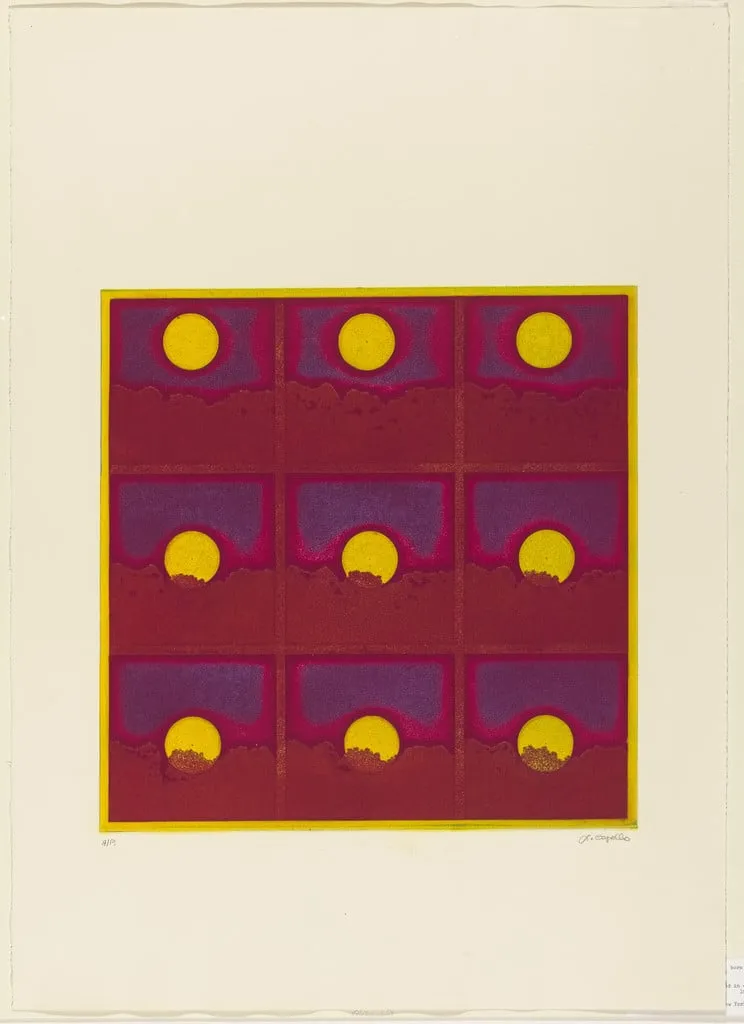
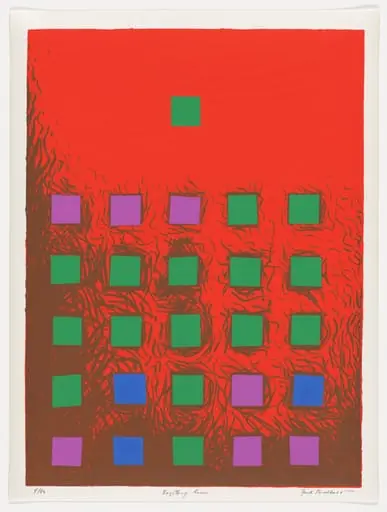
Untitled is an ink print by Francisco Copello. It dates from 1970 and is held in the collection of the Museum of Modern Art.
About this work
Overview
Created in 1970, this print by Francisco Copello combines etching and aquatint techniques to produce a restrained, geometric composition.
Created in 1970, this print by Francisco Copello combines etching and aquatint techniques to produce a restrained, geometric composition. It consists of nine uniform squares arranged in a 3x3 grid, each bearing a minimal arrangement of abstract forms. The work is part of the collection at The Museum of Modern Art, where it is cataloged as a singular example of late 20th-century printmaking focused on subtle variation within repetition.
Subject & Meaning
The image presents no literal narrative but evokes elemental motifs: a sunlike yellow circle and a sinuous horizontal line beneath it. These recurring symbols suggest natural phenomena—sky and earth, light and horizon—without depicting them literally. The slight positional shifts of the circles across the grid imply rhythm or variation within order, inviting contemplation of pattern and imperfection rather than symbolic meaning.
Technique & Style
Copello employed etching to define precise lines and aquatint to achieve rich, velvety fields of deep red and purple. The yellow circles, rendered with clean, untextured ink, contrast sharply against the granular backgrounds. The wavy lower line varies subtly in thickness and curvature, demonstrating careful control of acid biting and ink application. The overall aesthetic is methodical, emphasizing materiality and process over expressive gesture.
History & Provenance
The work was produced in 1970 and entered The Museum of Modern Art’s collection shortly thereafter. No record of prior ownership or exhibition history beyond the museum’s acquisition is publicly documented. Its inclusion in the institution’s print department reflects an interest in postwar Latin American artists working with abstraction and serial forms during a period of expanding global printmaking practices.
Context
Made during a time when artists across Latin America were exploring minimalism and conceptual approaches, Copello’s work aligns with regional movements that prioritized formal inquiry over political messaging. While contemporaries in Argentina and Brazil engaged with social themes, this piece reflects a quieter, more meditative strand of abstraction, rooted in the material possibilities of printmaking rather than ideological expression.
Legacy
Though not widely reproduced or exhibited outside institutional settings, the work contributes to a broader understanding of printmaking’s capacity for quiet experimentation. Its restrained vocabulary and systematic structure have influenced later artists interested in seriality and the limits of visual language. It remains a quiet reference point in studies of 20th-century Latin American printmaking.
Artist & collection