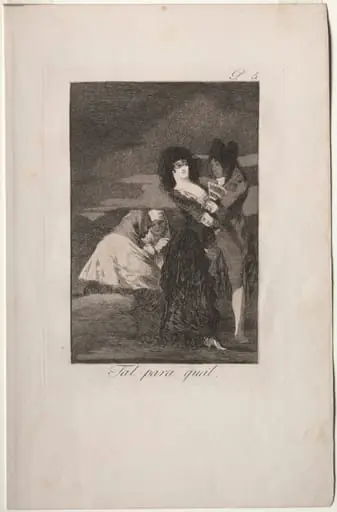
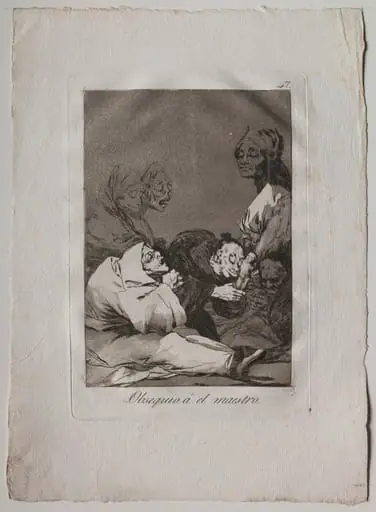
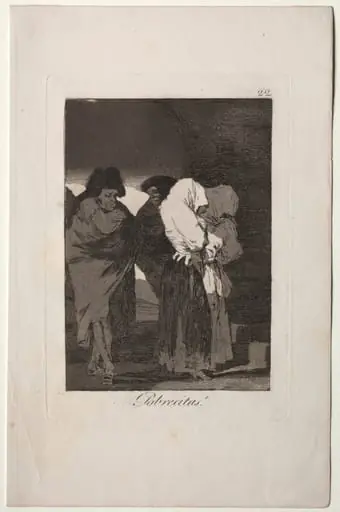
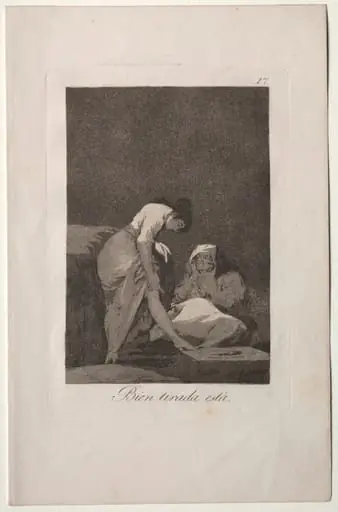
Artwork
Hush!, Plate 28
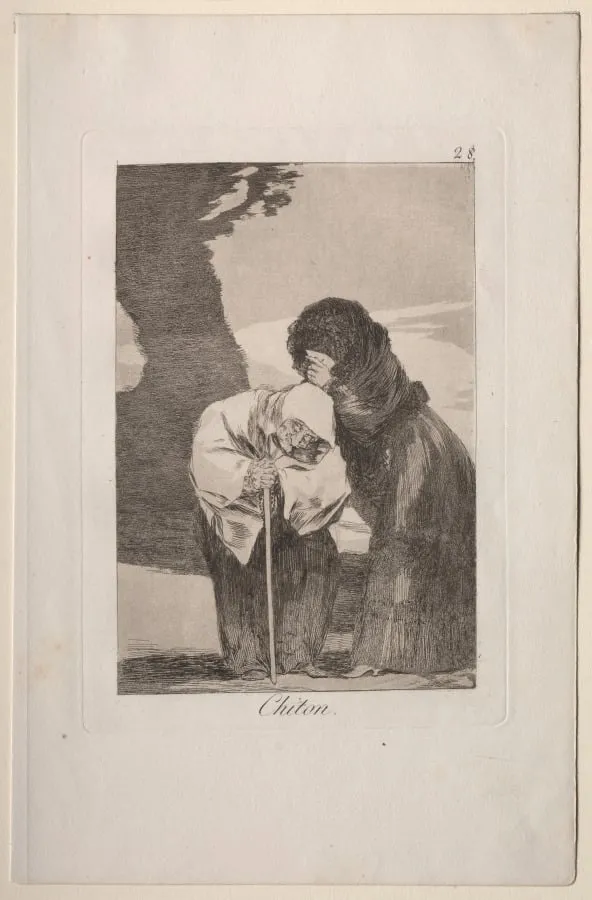
Hush!, Plate 28 is a print by the Romanticist artist Francisco Goya. It dates from 1799 and is held in the collection of the Cleveland Museum of Art. Hush!
About this work
Overview
The work belongs to a larger body of prints that critique social and political norms through symbolic imagery, blending realism with dark, introspective themes.
Hush!, Plate 28 is one of eighty-five etchings from Francisco de Goya’s series Los Caprichos, produced around 1799. It is a single-plate print, executed in etching and aquatint, and is currently held in the collection of The Cleveland Museum of Art. The work belongs to a larger body of prints that critique social and political norms through symbolic imagery, blending realism with dark, introspective themes.
Subject & Meaning
The scene depicts two figures in a dim, open space: one stooped and leaning on a staff, the other standing close with a hand on the shoulder. Their attire suggests an older era, reinforcing a sense of timelessness. The title 'Hush!' implies a moment of restraint or secrecy, possibly evoking themes of silence under pressure, surveillance, or unspoken authority. The intimacy of the gesture contrasts with the oppressive atmosphere, suggesting tension beneath surface calm.
Technique & Style
Goya employed etching and aquatint to achieve subtle gradations of tone, using deep shadows to isolate the figures against a nearly black background. The chiaroscuro effect heightens emotional weight, drawing focus to the interaction between the two forms. Loose, expressive lines define their postures, while minimal detail in clothing and landscape preserves ambiguity. The technique prioritizes mood over narrative clarity, characteristic of Goya’s late 18th-century experimental approach to printmaking.
History & Provenance
Created during Goya’s period of intense social observation, Hush! was part of the original 1799 edition of Los Caprichos, published in Madrid. The print was likely distributed to a limited audience due to its satirical content, which risked censure. The Cleveland Museum of Art acquired the work in the 20th century, preserving one of the few surviving impressions from the first printing. Its provenance reflects its status as a significant artifact of early modern print culture.
Context
Los Caprichos emerged amid Spain’s Enlightenment-era tensions, as Goya responded to superstition, corruption, and class rigidity. Hush! reflects the era’s unease with hidden power structures and the suppression of dissent. Unlike overt satire, this plate relies on psychological subtlety, aligning with Goya’s shift from courtly portraiture toward darker, more personal commentary. The work resonates with broader European anxieties about authority and silence in the face of institutional control.
Legacy
Hush! exemplifies Goya’s influence on later artists who embraced psychological depth and atmospheric printmaking. Its restrained imagery and emotional ambiguity prefigured 19th-century Symbolism and modernist explorations of isolation. As part of Los Caprichos, it contributed to the evolution of the print as a vehicle for critical social thought, inspiring generations of artists to use print media for introspective, non-narrative expression.
Artist & collection
Artist
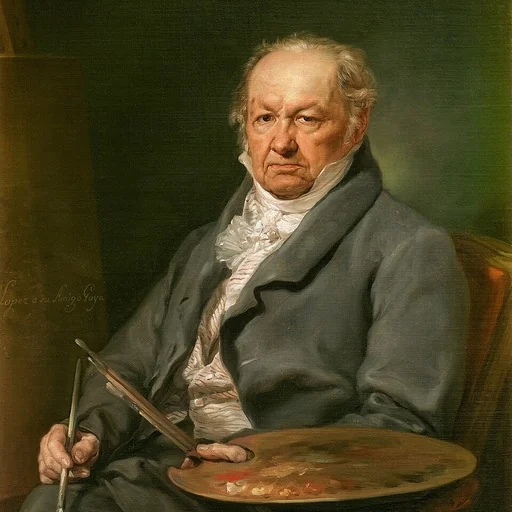
Francisco José de Goya y Lucientes (; Spanish: ; 30 March 1746 – 16 April 1828) was a Spanish romantic painter and printmaker.