Artwork
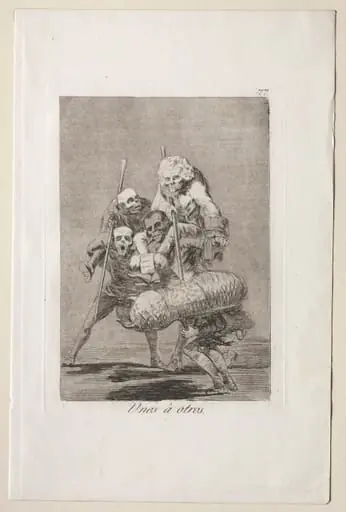
You understand?...Well, as I say...eh! Look out! Otherwise..., Plate 76
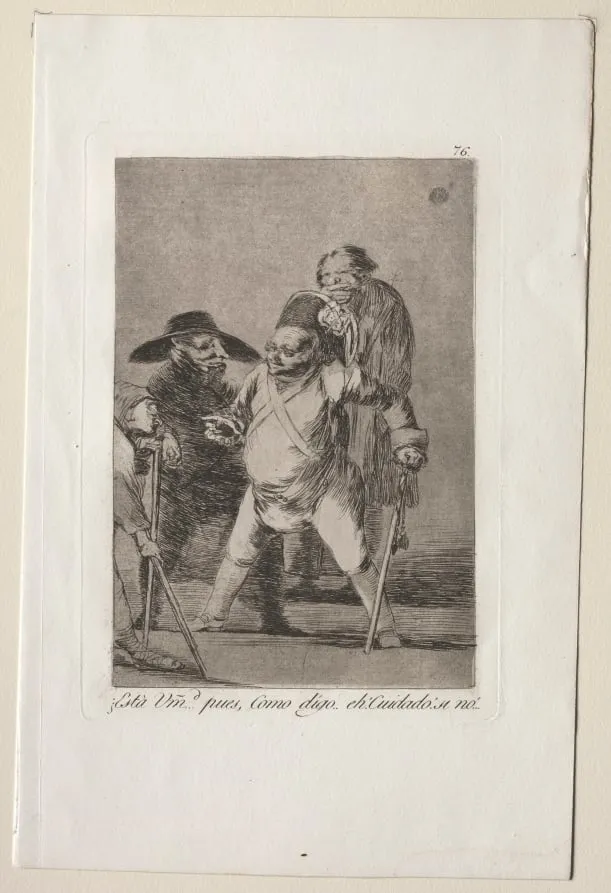
You understand?...Well, as I say...eh! Look out! Otherwise..., Plate 76 is a print by the Romanticist artist Francisco Goya. It dates from 1799 and is held in the collection of the Cleveland Museum of Art. Plate 76 is one of eighty prints from Francisco de Goya’s series 'Los Caprichos,' produced around 1799.
About this work
Overview
Plate 76 is one of eighty prints from Francisco de Goya’s series 'Los Caprichos,' produced around 1799. It is a drypoint and aquatint on paper, currently held by The Cleveland Museum of Art. Unlike finished illustrations, this plate captures a fleeting, unpolished moment, reflecting Goya’s interest in raw human behavior rather than idealized scenes.
Subject & Meaning
The scene depicts three men in a moment of confrontation. A central figure, leaning on a cane, appears agitated, his face contorted in exasperation. Behind him, a hand grips his shoulders, while another man, wearing a broad hat, points accusingly. The lack of context suggests a private dispute, possibly symbolizing social tension, irrational authority, or the absurdity of human conflict.
Technique & Style
Goya employed rapid, uneven drypoint lines and soft aquatint washes to convey emotional intensity over precision. The sketchlike quality emphasizes movement and psychological strain, with minimal background detail forcing focus onto gestures and facial expressions. The rough texture and lack of refinement reflect his rejection of academic polish in favor of expressive immediacy.
History & Provenance
Created during Goya’s critical period of social observation, this print was part of a privately published series that critiqued Spanish society. It entered The Cleveland Museum of Art’s collection through established acquisition channels in the 20th century, preserved as part of a complete set of 'Los Caprichos' that remain vital to understanding Goya’s satirical vision.
Context
Made during Spain’s Enlightenment era, 'Los Caprichos' responded to superstition, corruption, and class rigidity. Plate 76 aligns with Goya’s broader aim to expose human folly through everyday scenes. The work avoids overt political messaging, instead using ambiguous interpersonal dynamics to invite reflection on power, frustration, and social friction.
Legacy
This print exemplifies Goya’s influence on modern graphic art, particularly in its use of expressive line and psychological depth. Its unvarnished style prefigured later movements like Expressionism and influenced artists seeking to convey inner turmoil without idealization. The work remains a touchstone for studies of printmaking as a vehicle for social critique.
Artist & collection
Artist
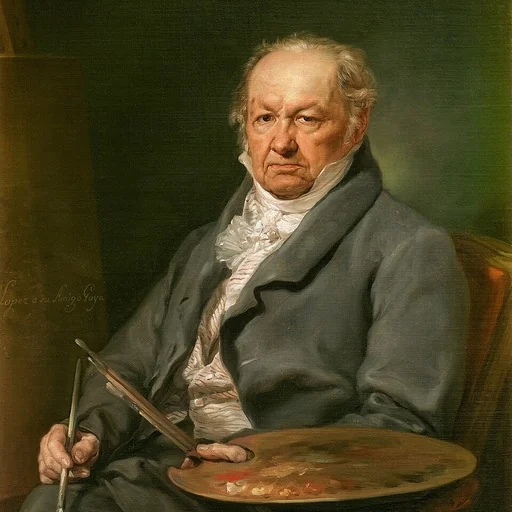
Francisco José de Goya y Lucientes (; Spanish: ; 30 March 1746 – 16 April 1828) was a Spanish romantic painter and printmaker.