Artwork
Horse
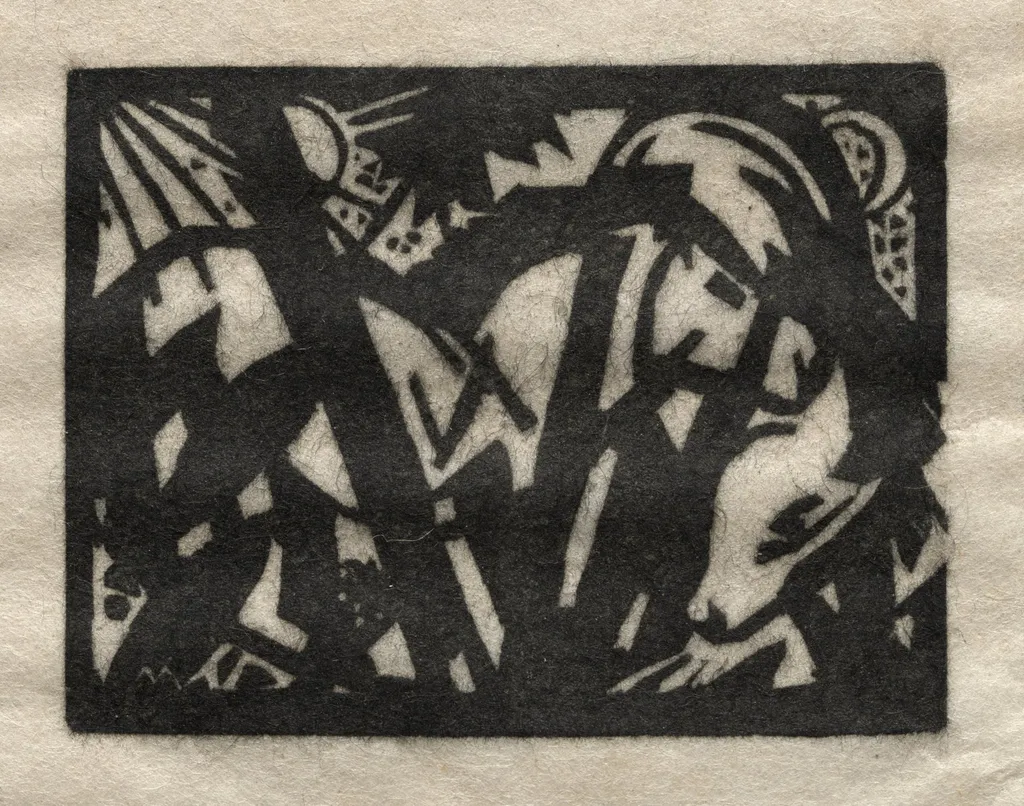
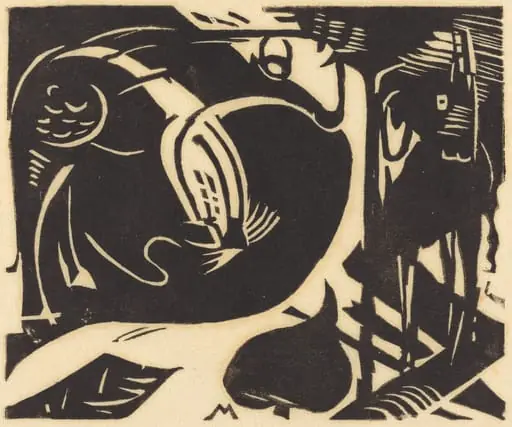
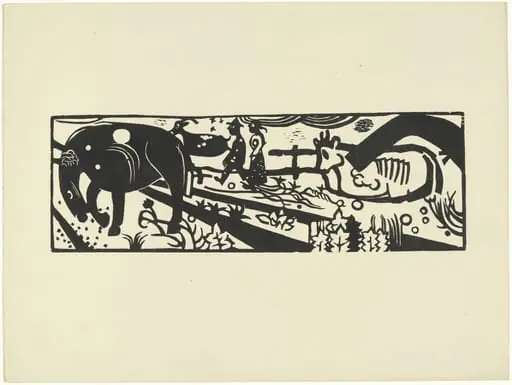
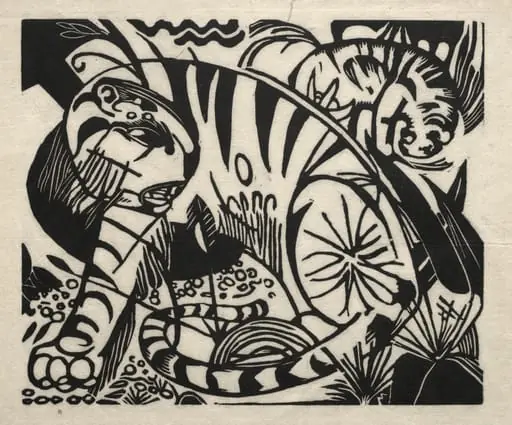
Horse is a print by Franz Marc. It dates from 1908 and is held in the collection of the Cleveland Museum of Art.
About this work
Overview
Unlike his later colorful paintings, this work employs a stark black-and-white palette, emphasizing structure over chromatic expression.
Created around 1908, *Horse* is a print by German artist Franz Marc, belonging to his early exploration of animal forms. Unlike his later colorful paintings, this work employs a stark black-and-white palette, emphasizing structure over chromatic expression. It reflects Marc’s transition toward abstraction, reducing the horse to essential geometric volumes while retaining a sense of vitality. The piece predates his involvement with Der Blaue Reiter but foreshadows its formal innovations.
Subject & Meaning
The horse, a recurring motif in Marc’s oeuvre, symbolizes purity and spiritual harmony for the artist. Here, its form is stripped of naturalistic detail, becoming an emblem rather than a literal representation. The absence of color shifts focus to the animal’s essential structure, suggesting an inner essence beyond physical appearance. Marc sought to convey the soul of animals, positioning them as more authentic than human subjects in a modernizing world.
Technique & Style
Marc used sharp, angular lines and simplified contours to construct the horse’s body, avoiding shading or texture in favor of bold, flat shapes. The print’s monochrome palette enhances the graphic quality, drawing attention to rhythm and composition. This approach aligns with early modernist tendencies toward abstraction, where form is distilled to its structural core. The result is a dynamic interplay of positive and negative space, suggesting motion through stillness.
History & Provenance
The print was produced during Marc’s formative years, before his association with Der Blaue Reiter became public. It remained in private collections until the mid-20th century. After his death in 1916 at Verdun, his work was later condemned by the Nazi regime as 'degenerate,' leading to removals from museums and public displays. This print survived due to its limited circulation and private ownership, avoiding the widespread destruction faced by his paintings.
Context
In early 20th-century Germany, artists were redefining representation amid industrialization and cultural upheaval. Marc’s focus on animals responded to a broader search for spiritual meaning outside urban modernity. His geometric simplifications paralleled developments in Cubism and early abstraction, yet retained a lyrical intensity distinct from purely formal experiments. This print reflects a moment when Expressionism was moving from emotional intensity toward structural clarity.
Legacy
Though less known than Marc’s color-saturated canvases, this print illustrates his foundational approach to abstraction. Its emphasis on form over ornament influenced later generations of German modernists and printmakers. The work’s restraint and clarity offer a counterpoint to his more famous chromatic expressions, revealing the discipline underlying his expressive vision. It remains a key example of how early modernists used minimal means to evoke profound presence.
Own this work as a print
Artist & collection
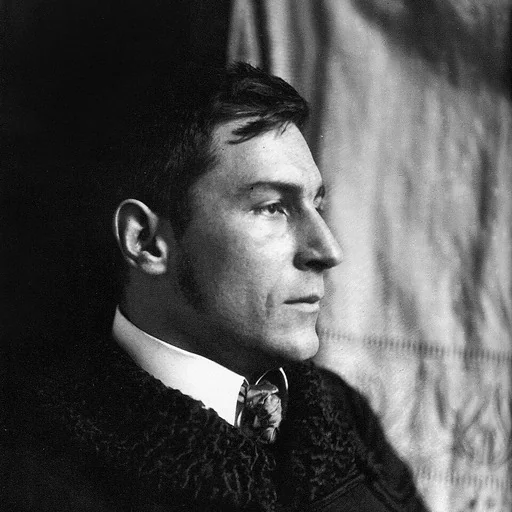
Artist
Franz Moritz Wilhelm Marc (8 February 1880 – 4 March 1916) was a German painter and printmaker, one of the key figures of German Expressionism.