Artwork
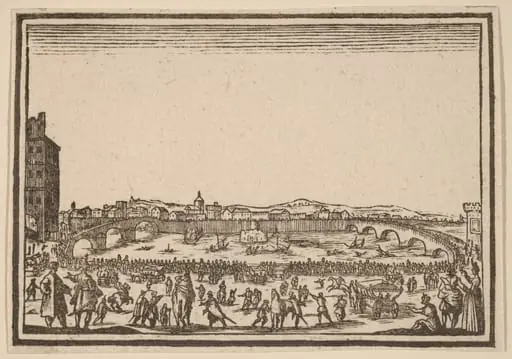
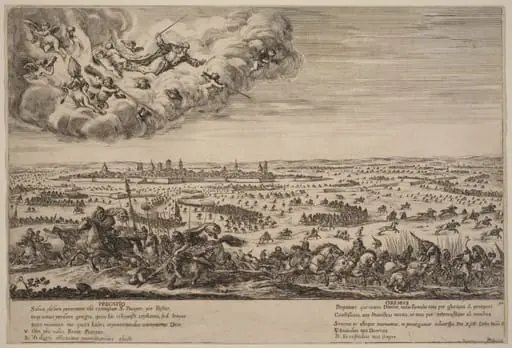
View of Nancy
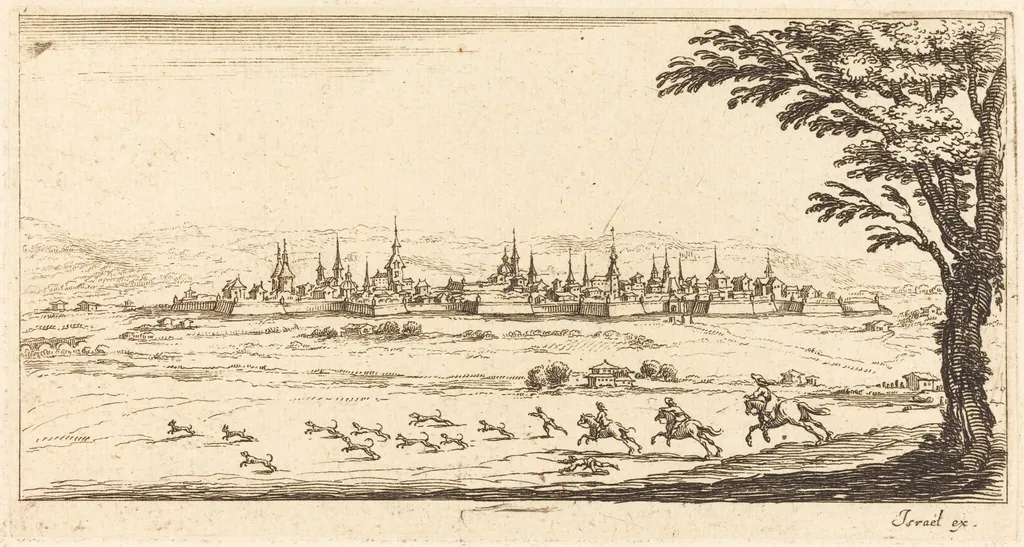
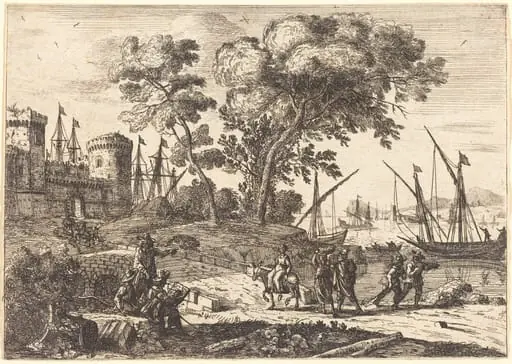
View of Nancy is an ink print by the Baroque artist French 17th Century. It dates from 1635 and is held in the collection of the National Gallery of Art. This etching depicts a rural landscape near Nancy, rendered in fine linear detail on laid paper.
About this work
Overview
The composition balances dynamic motion with quiet architectural stillness, characteristic of 17th-century printmaking traditions.
This etching depicts a rural landscape near Nancy, rendered in fine linear detail on laid paper. A distant walled city rises above rolling hills, its spires and towers clearly defined. In the foreground, riders on horseback pursue animals through open terrain, suggesting a hunting scene. The composition balances dynamic motion with quiet architectural stillness, characteristic of 17th-century printmaking traditions.
Subject & Meaning
The scene captures a moment of rural activity—hunting on horseback—set against the backdrop of an established urban center. The contrast between the energetic pursuit in the foreground and the static, fortified city suggests a tension between nature and civilization. Such imagery may reflect contemporary interests in aristocratic leisure or the ordered hierarchy of land use in early modern Europe.
Technique & Style
The artist employed etching to achieve fine, controlled lines, with varying density to suggest depth and texture. Laid paper’s subtle ribbing enhances the tactile quality of the print. The composition uses atmospheric perspective to recede the city into the distance, while the foreground figures are rendered with brisk, fluid strokes that convey motion and urgency.
History & Provenance
Created in the 17th century, this print likely originated in the Lorraine region, where Nancy was a cultural center. It may have been produced by a local artist or printmaker working in the tradition of Northern European topographical views. Its survival in collections today indicates it was valued for its detailed depiction of regional scenery and daily life.
Context
During the Baroque period, etchings like this served both documentary and decorative purposes. They circulated among educated elites interested in landscape, travel, and local governance. The inclusion of a walled city reflects the political and military importance of fortified towns in early modern Europe, while hunting scenes underscored noble pastimes tied to land ownership.
Legacy
This work contributes to a broader corpus of early modern prints that recorded regional geography and social customs. Though not attributed to a major name, its precision and composition align it with the observational rigor of Northern European printmakers. It remains a valuable record of how rural and urban spaces were visually articulated in the 17th century.
Artist & collection

Artist
Seventeenth-century French printmakers turned ink into story. Their tools were burin and acid, paper their stage. Look at the Beggar Woman with Rosary (1622), etched on laid paper, her hands folded around faith, or The…