Artwork
Lemminkäisen äiti
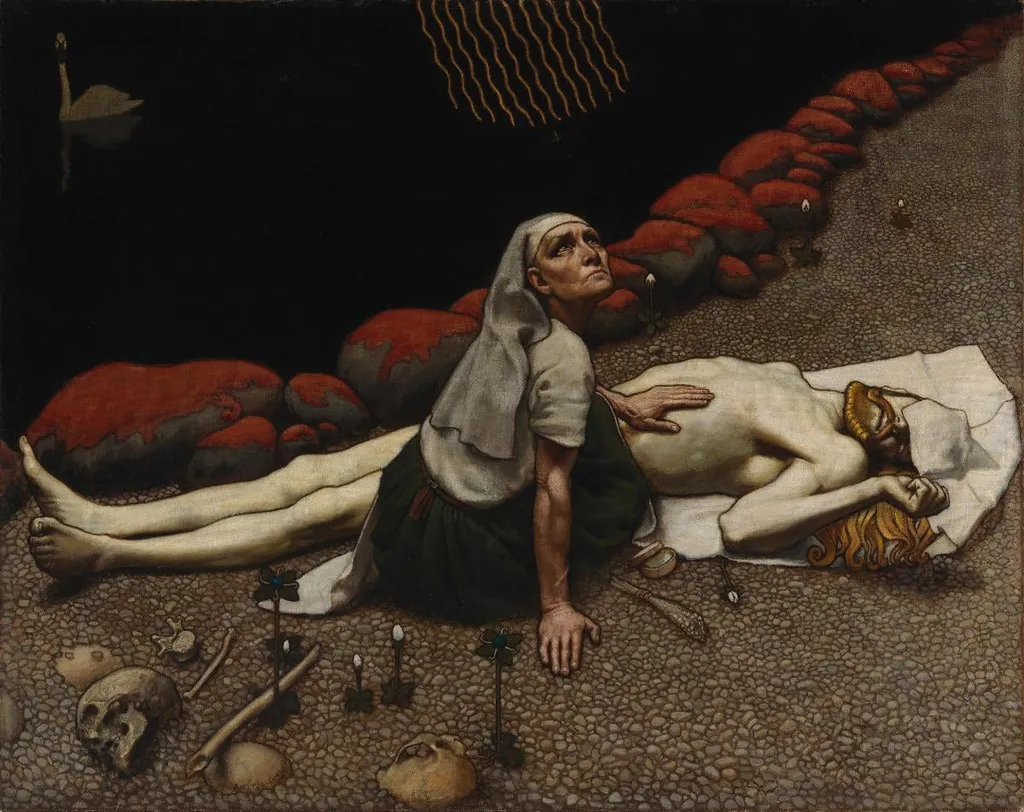
Lemminkäisen äiti is an unspecified painting by the Art Nouveau artist Akseli Gallen-Kallela. It dates from 1895 and is held in the collection of the Finnish National Gallery.
About this work
Overview
It is one of several paintings in which he sought to anchor national identity in indigenous legend, using visual narrative to assert cultural autonomy.
Akseli Gallen-Kallela painted *Lemminkäisen äiti* around 1895, aligning with the symbolic and decorative tendencies of late 19th-century art. The work emerges from his deepening focus on Finnish mythological subjects, moving beyond realism toward a more expressive, stylized form. It is one of several paintings in which he sought to anchor national identity in indigenous legend, using visual narrative to assert cultural autonomy.
Subject & Meaning
The painting depicts Lemminkäinen’s mother retrieving her son’s corpse from a river teeming with serpents, as told in the Kalevala. Her determined gesture, hair streaming downward, conveys grief transformed into resolve. The blood swirling in the water mirrors the myth’s supernatural violence, while the white shroud contrasts with the dark, chaotic currents. The scene embodies maternal power and the boundary between life and death in Finnish cosmology.
Technique & Style
Gallen-Kallela employs fluid, sinuous lines and a muted palette dominated by deep blues, blacks, and the vivid red of hair and blood. The figures are elongated and simplified, their forms echoing Art Nouveau’s organic rhythms. The water is rendered not as realistic liquid but as a patterned, almost textile-like field of swirling energy, enhancing the mythic tone and emotional intensity of the moment.
History & Provenance
Created during a period of rising Finnish cultural nationalism, the painting was part of a series Gallen-Kallela produced between 1890 and 1900 based on the Kalevala. It was exhibited in Finland and later acquired by the Ateneum Art Museum in Helsinki, where it remains. Its acquisition reflected institutional support for art that defined a national aesthetic distinct from Swedish and Russian influences.
Context
In the 1890s, Finland was an autonomous Grand Duchy under Russian rule, and artists like Gallen-Kallela turned to folklore as a means of cultural resistance. The Kalevala, compiled in the 1830s, became a touchstone for identity. By visualizing its tales, Gallen-Kallela contributed to a broader movement that elevated native myth over imported European traditions in both literature and visual art.
Legacy
The painting helped establish a visual vocabulary for Finnish national art, influencing later generations of artists and illustrators. Its integration of myth, symbolism, and stylized form became a reference point in discussions of Nordic identity. Though not widely known outside Finland, it remains a cornerstone in the country’s art historical canon, representing the fusion of folklore and modernist expression.
Artist & collection
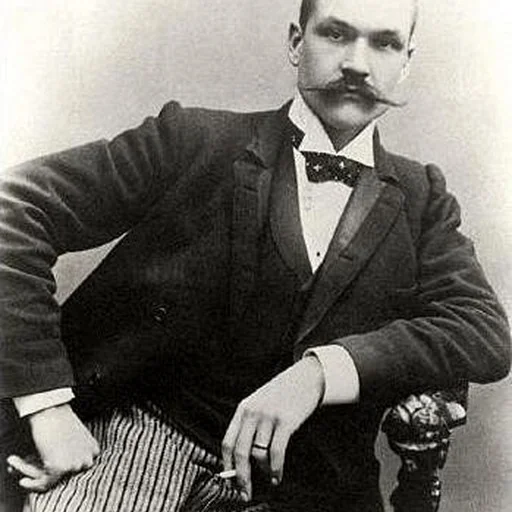
Artist
Akseli Gallen-Kallela (born Axel Waldemar Gallén; 26 April 1865 – 7 March 1931) was a Finnish painter and a leading figure of Finnish romantic nationalism around the turn of the 20th century.