Artwork
Manuscript Pages [verso]
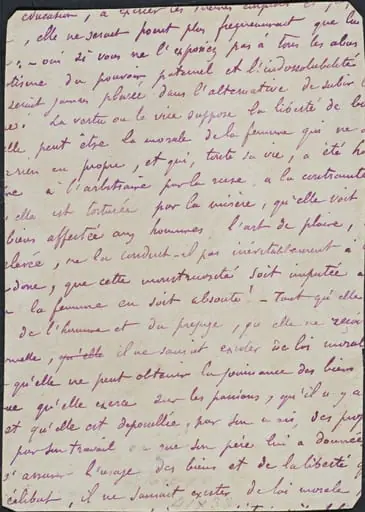
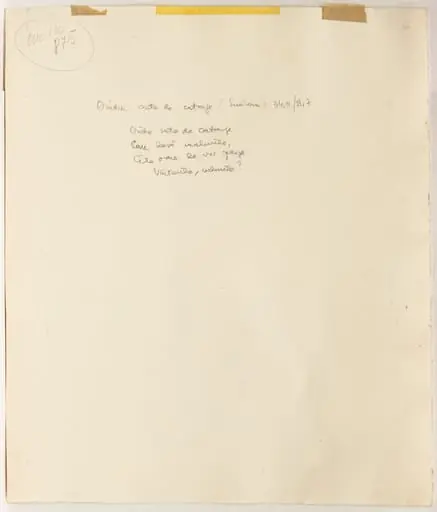
![Manuscript Pages [verso], by Paul Gauguin, ink, 1886](https://artifactworldgallery.com/img/paul-gauguin--manuscript-pages-verso--7220ad7c547e1bb1-w1024.webp)
Manuscript Pages [verso] is an ink drawing by the Impressionist artist Paul Gauguin. It dates from 1886 and is held in the collection of the National Gallery of Art.
About this work
Overview
The handwriting is hurried and irregular, with crossed-out passages and uneven margins, suggesting spontaneous composition rather than polished draft.
This verso page, dated 1886, contains handwritten notes by Paul Gauguin in brown ink on wove paper. Part of a larger manuscript, it reflects his habit of recording thoughts outside formal artistic output. The handwriting is hurried and irregular, with crossed-out passages and uneven margins, suggesting spontaneous composition rather than polished draft. The physical condition of the paper—slight yellowing and creasing—indicates age and handling over time.
Subject & Meaning
The notes revolve around sensory and emotional responses to the natural world, with recurring phrases such as 'la nature' and 'la lumière.' These fragments reveal Gauguin’s preoccupation with how environment influences inner experience. Rather than systematic theory, the text reads like private reflections—jottings that bridge his visual practice and philosophical inquiries into perception and feeling.
Technique & Style
Gauguin employed a fine-nibbed pen with fluid, unsteady strokes, creating dense clusters of script that spill across the page. The lack of uniformity—slanting lines, erasures, and irregular spacing—conveys immediacy. Unlike formal sketches, this is not meant for display; its rawness mirrors his rejection of academic polish, aligning with his broader artistic pursuit of authenticity over refinement.
History & Provenance
Created during Gauguin’s time in Brittany, this page belongs to a series of personal manuscripts from 1886, a transitional period before his move to Tahiti. It was likely retained by the artist or close associates and later entered institutional collections. Its survival as a fragment of his intellectual process offers rare insight into his working mind, separate from finished artworks.
Context
In 1886, Gauguin was distancing himself from Impressionism, seeking a more symbolic and emotionally charged language. These notes coincide with his early experiments in Synthetism, where form and color were simplified to express inner states. The textual fragments echo the same concerns he would later render visually: the spiritual weight of nature, the inadequacy of realism, and the search for primal truth.
Legacy
Though not a finished artwork, this manuscript page contributes to understanding Gauguin’s creative process. It reveals how his written thoughts informed his visual innovations, particularly in the use of symbolic motifs and emotional intensity. Scholars value it as evidence of his intellectual rigor and the intimate link between his writing and painting, extending his influence beyond the canvas.
Artist & collection
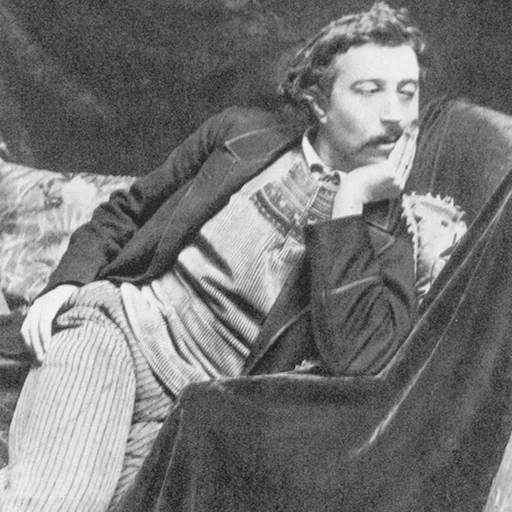
Artist
Eugène Henri Paul Gauguin (; French: ; 7 June 1848 – 8 May 1903) was a French painter, sculptor, printmaker, ceramist, and writer, whose work has been primarily associated with the Post-Impressionist and Symbolist movements.

![Head of a Monkey; Inventory of Bottles and Beverages [verso], by Paul Gauguin](https://artifactworldgallery.com/img/paul-gauguin--head-of-a-monkey-inventory-of-bottles-and-beverages-verso--0d4bb62a8bd056d4-w320.webp)
!["Neige" (Snow); Itinerary [recto], by Paul Gauguin](https://artifactworldgallery.com/img/paul-gauguin--neige-snow-itinerary-recto--3a093bdd330ec696-w320.webp)