Artwork
Pleasures of Brittany (Joies de Bretagne)
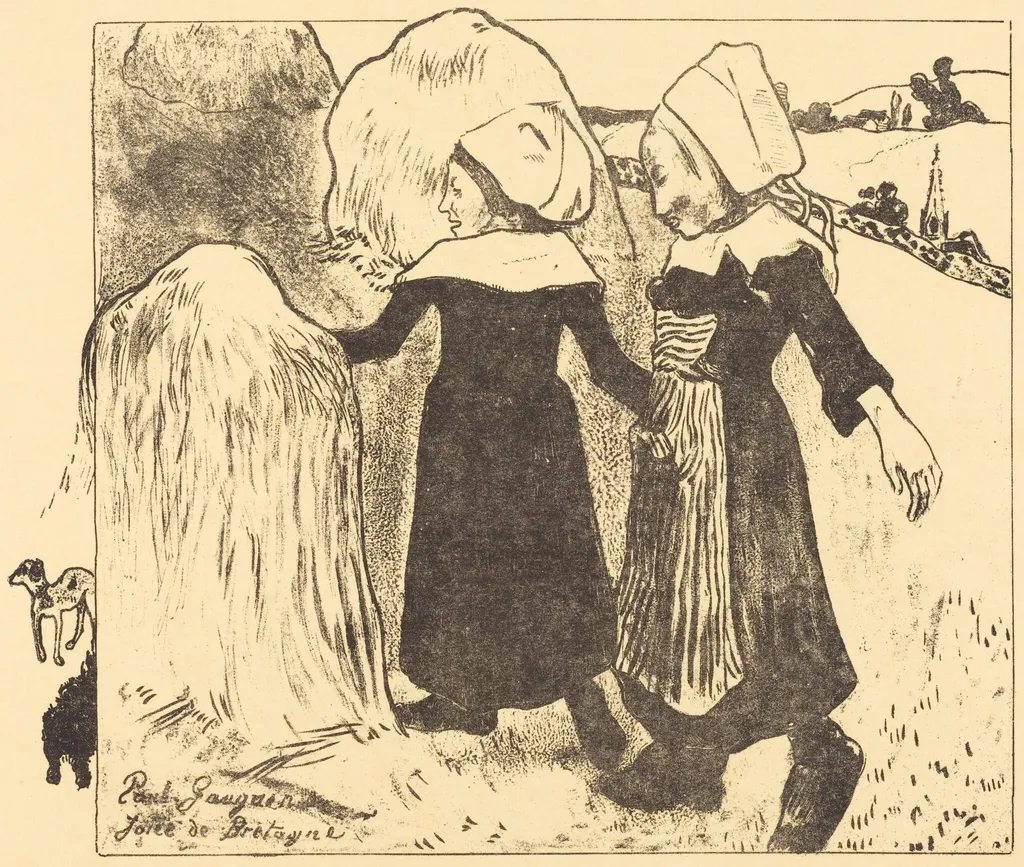
Pleasures of Brittany (Joies de Bretagne) is an ink print by the Impressionist artist Paul Gauguin. It dates from 1889 and is held in the collection of the National Gallery of Art.
About this work
Overview
Lithography allowed him to combine drawing immediacy with reproducibility, aligning with his interest in accessible art forms beyond the canvas.
Paul Gauguin produced *Pleasures of Brittany* in 1889 as a lithograph on imitation Japan paper, part of his broader exploration of printmaking during his time in rural Brittany. The work reflects his shift away from Impressionist naturalism toward a more stylized, symbolic approach. Lithography allowed him to combine drawing immediacy with reproducibility, aligning with his interest in accessible art forms beyond the canvas.
Subject & Meaning
Two women, dressed in dark, flowing garments and large hats, walk arm in arm across a sparse Breton landscape. Their quiet, synchronized movement suggests communal ritual or daily routine, evoking local life without narrative detail. The absence of facial features and the simplified forms invite interpretation as symbols of rural endurance or spiritual stillness, consistent with Gauguin’s Symbolist leanings.
Technique & Style
Gauguin drew directly onto a zinc plate, using lithography’s fluid line to capture loose, sketch-like contours. The ink’s softness and the paper’s texture enhance the work’s intimate, spontaneous feel. Bold outlines and minimal shading flatten the space, rejecting perspective in favor of decorative harmony. The background—hinted with a sheep and sparse foliage—remains suggestive, not descriptive, reinforcing the Synthetist principle of emotional synthesis over realism.
History & Provenance
Created during Gauguin’s second stay in Pont-Aven, the print emerged from a period of intense experimentation with local motifs and non-Western aesthetics. It was likely produced in small editions for distribution among artists and collectors, reflecting his desire to break from commercial art markets. Its survival in private and institutional collections attests to its early recognition within avant-garde circles.
Context
In 1889, Gauguin was distancing himself from Parisian art institutions and embracing rural Brittany as a site of cultural authenticity. Alongside fellow artists in the Pont-Aven School, he developed Synthetism—reducing forms to essential shapes and using color symbolically. This print aligns with his broader rejection of academic tradition and his search for spiritual depth in everyday peasant life.
Legacy
Though less known than his paintings, *Pleasures of Brittany* exemplifies Gauguin’s innovative use of printmaking to extend his symbolic vision. Its influence can be traced in early 20th-century modernist prints that prioritized expressive line over realism. The work remains a quiet but significant document of his artistic evolution and his commitment to art as a vehicle for inner experience.
Artist & collection
Artist
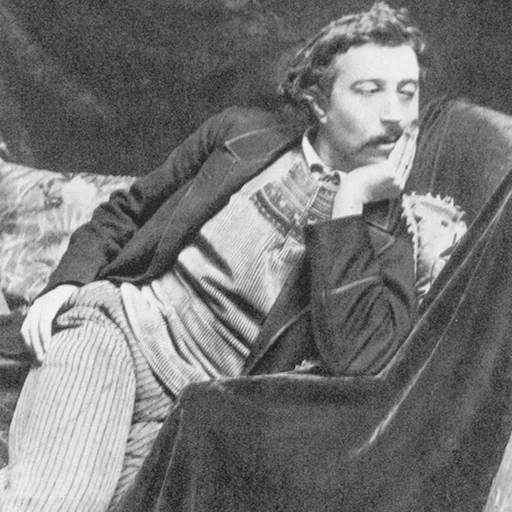
Eugène Henri Paul Gauguin (; French: ; 7 June 1848 – 8 May 1903) was a French painter, sculptor, printmaker, ceramist, and writer, whose work has been primarily associated with the Post-Impressionist and Symbolist movements.

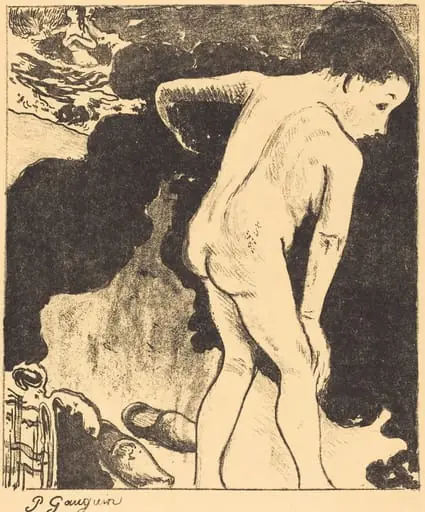 Breton Bathers (Baigneuses Bretonnes)
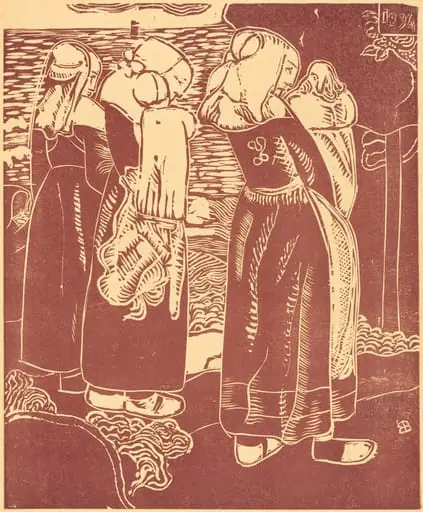 Three Breton Women with Infants
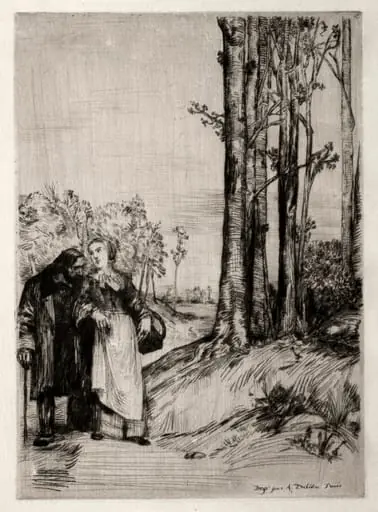 Le Promenade du convalescent
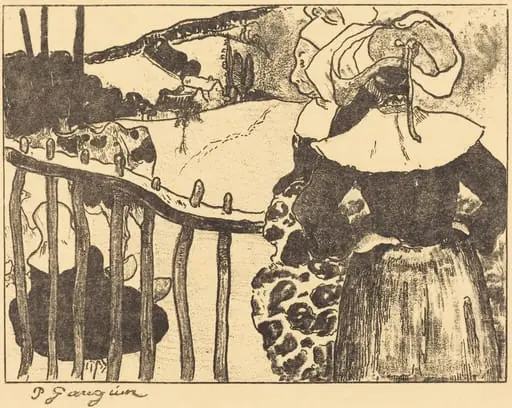 Breton Women beside a Fence (Bretonnes à la barrière)
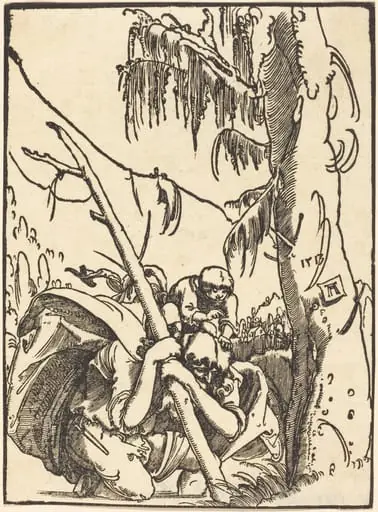 Saint Christopher
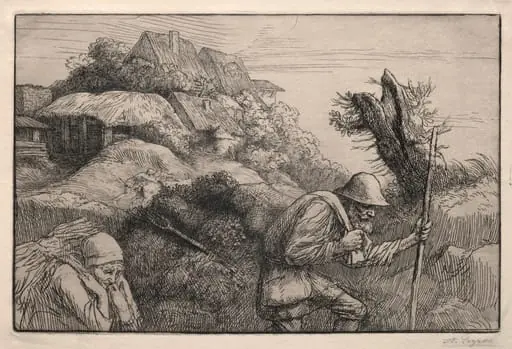 Return from the Woods
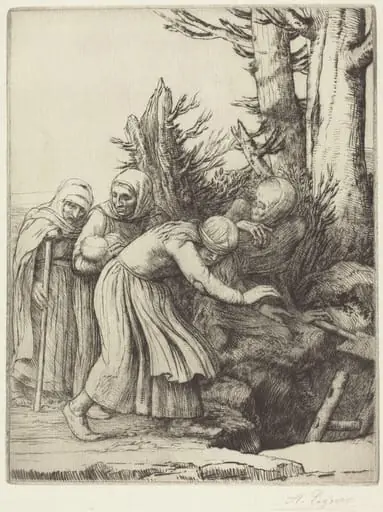 The Triumph of Death: Death Prepares a Dwelling for the Homeless (Le triomphe de la Mort: Lamort a prepare une demeure a des abandonnees)
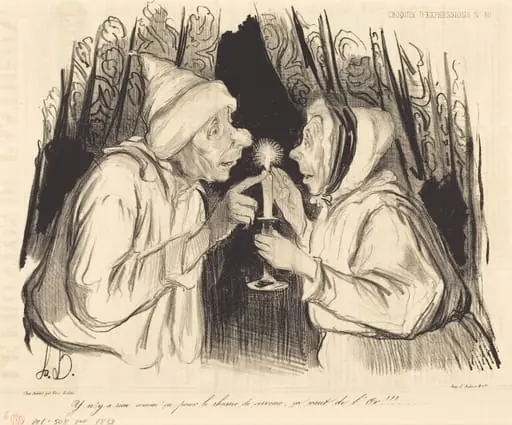 Y n'y a rien comm' ça pour le rhume...
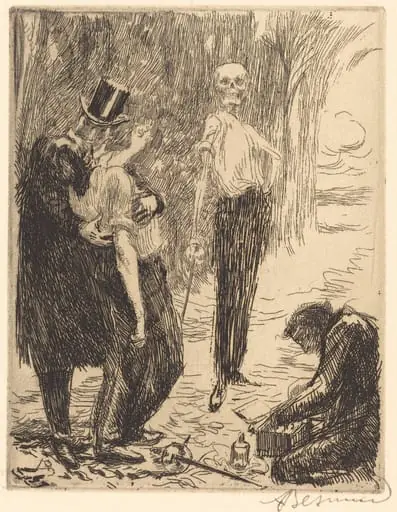 The Duel (Le duel)