Artwork
The Story of Joseph: Joseph Recounting his Dreams to his Father
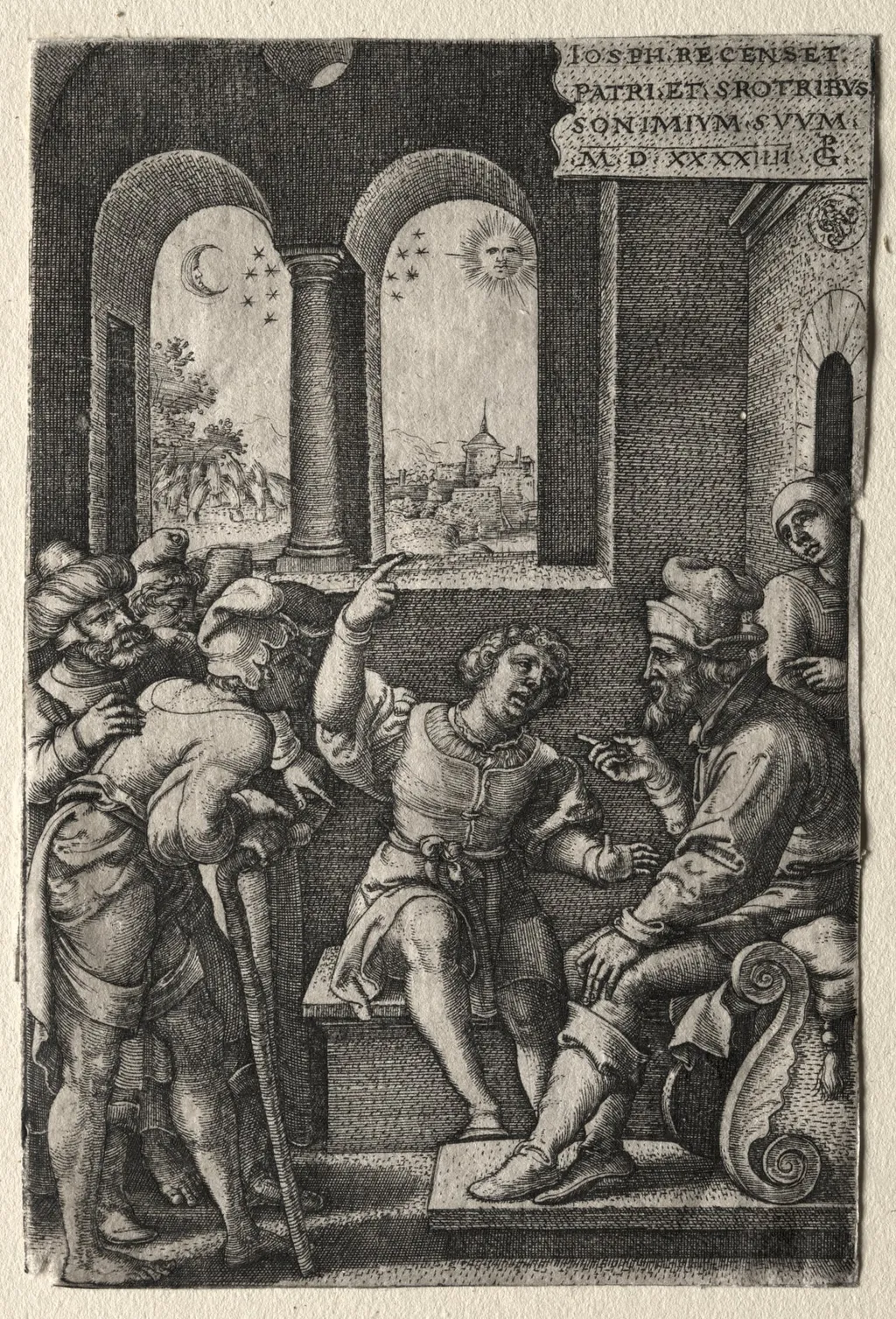
The Story of Joseph: Joseph Recounting his Dreams to his Father is a print by the Renaissance artist Georg Pencz. It dates from 1544 and is held in the collection of the Cleveland Museum of Art.
About this work
Overview
Created in 1544 by Georg Pencz, this print illustrates a moment from the biblical narrative of Joseph, son of Jacob.
Created in 1544 by Georg Pencz, this print illustrates a moment from the biblical narrative of Joseph, son of Jacob. Pencz, trained in Nuremberg under Albrecht Dürer and influenced by Italian Renaissance aesthetics, employed engraving techniques to render the scene with precision. The work belongs to a series depicting Joseph’s life, reflecting the artist’s engagement with both religious storytelling and the graphic traditions of Northern Europe.
Subject & Meaning
The scene captures Joseph narrating his dreams to his father, Jacob, as described in Genesis. Joseph’s gestures convey the vividness of his visions—sun, moon, and stars bowing to him—while Jacob’s attentive posture suggests unease and foreboding. The moment is charged with familial tension and divine implication, foreshadowing Joseph’s future rise and his brothers’ jealousy. The narrative is rendered with psychological nuance, emphasizing the weight of prophecy within domestic space.
Technique & Style
Pencz used fine-line engraving to achieve intricate detail and tonal contrast. Chiaroscuro is subtly applied through controlled hatching, modeling the figures and casting soft shadows that define the room’s depth. The window in the background, framed by architectural elements, opens to a celestial sky rendered with minimal yet evocative lines. The composition balances intimacy and symbolism, characteristic of Northern Renaissance printmaking’s emphasis on clarity and narrative precision.
History & Provenance
The print was produced during Pencz’s mature period, after his travels to Italy, where he encountered Venetian color and composition. It was likely part of a series commissioned or circulated among educated patrons interested in biblical themes. Though specific early ownership records are sparse, the work aligns with the broader dissemination of illustrated biblical stories in 16th-century German-speaking regions, often used for private devotion or teaching.
Context
In mid-16th-century Germany, religious imagery remained central to artistic production despite Reformation shifts. Pencz’s depiction of Joseph reflects a continued interest in Old Testament narratives, even among Protestant audiences. His synthesis of Dürer’s linear discipline with Italianate spatial awareness situates the work within a transregional artistic dialogue, bridging Northern detail with Renaissance harmony.
Legacy
Pencz’s engraving contributed to the visual vocabulary of biblical storytelling in print form, influencing later illustrators of religious texts. While less widely known than Dürer’s works, his prints were circulated across Europe and preserved in major collections. The clarity of his composition and emotional restraint helped sustain the tradition of narrative engraving into the late Renaissance, offering a quiet but enduring alternative to more dramatic interpretations.
Artist & collection
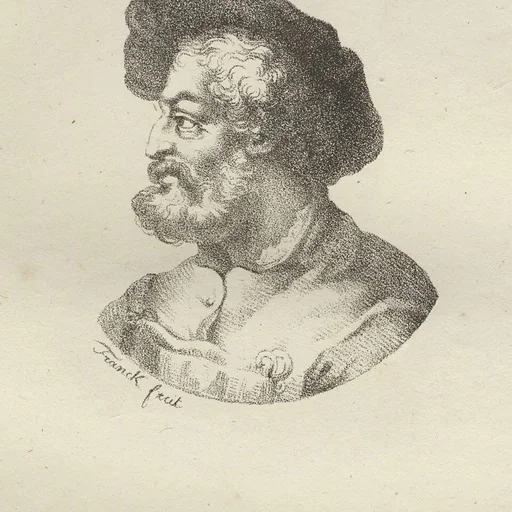
Artist
Georg Pencz (c. 1500 – 11 October 1550) was a German engraver, painter and printmaker. Pencz was probably born in Westheim near Bad Windsheim/Franconia. He travelled to Nuremberg in 1523 and joined Albrecht Dürer’s…

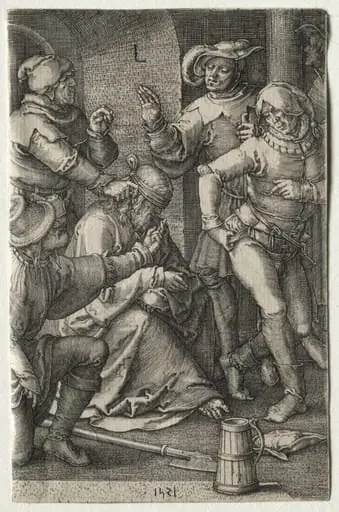 The Passion: The Mocking of Christ
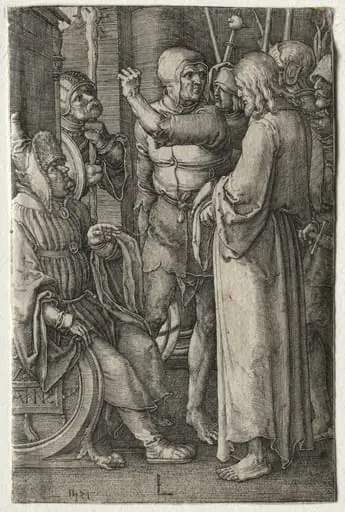 The Passion: Christ Before the High Priest
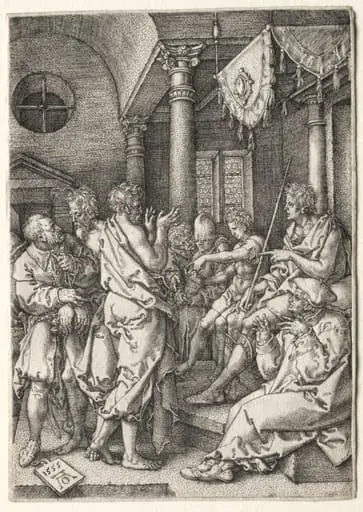 The Story of Susanna: Daniel Cross-Examining the Elders
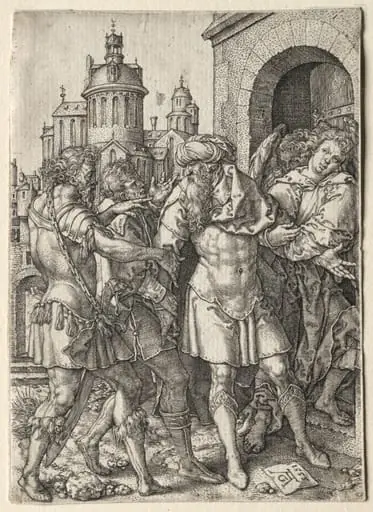 The Story of Lot: Lot Prevents the Sodomites from Violence
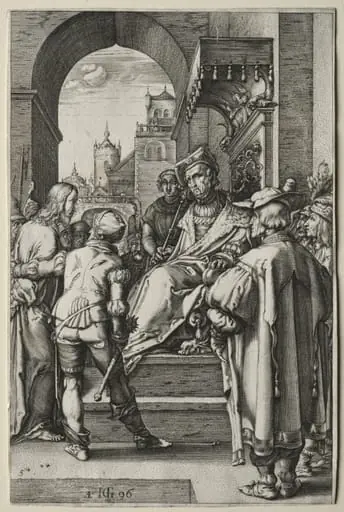 The Passion: Christ before Pilate
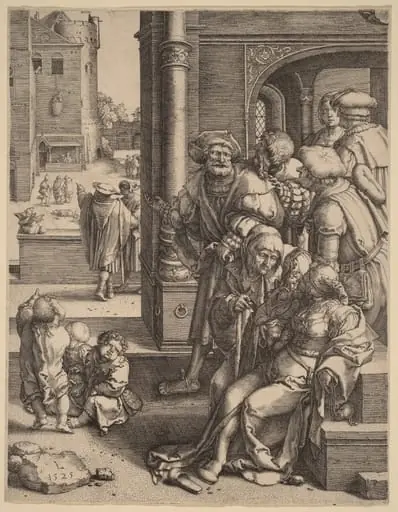 The Poet Virgil Suspended in a Basket
 Christ before Caiaphas
 The Old King on His Throne
 The Story of Susanna: Susanna Accused of Adultery