Artwork
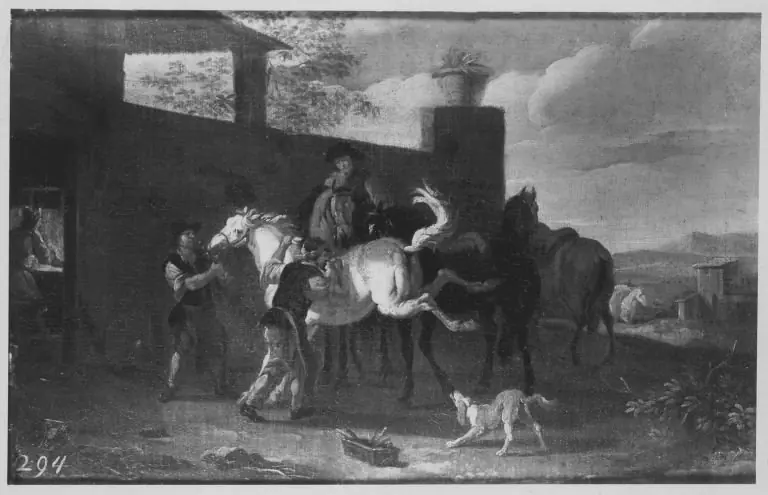
Der Hufschmied
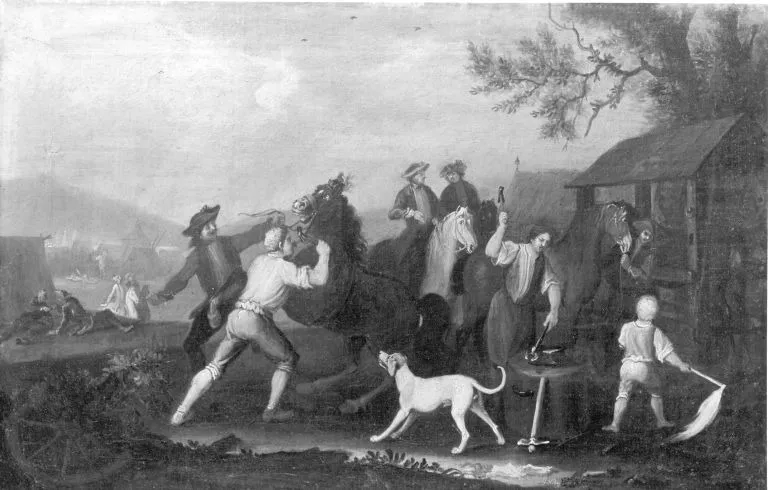
Der Hufschmied is an unspecified painting by Georg Philipp Rugendas the Younger. It dates from 1747 and is held in the collection of the Bavarian State Painting Collections.
About this work
Overview
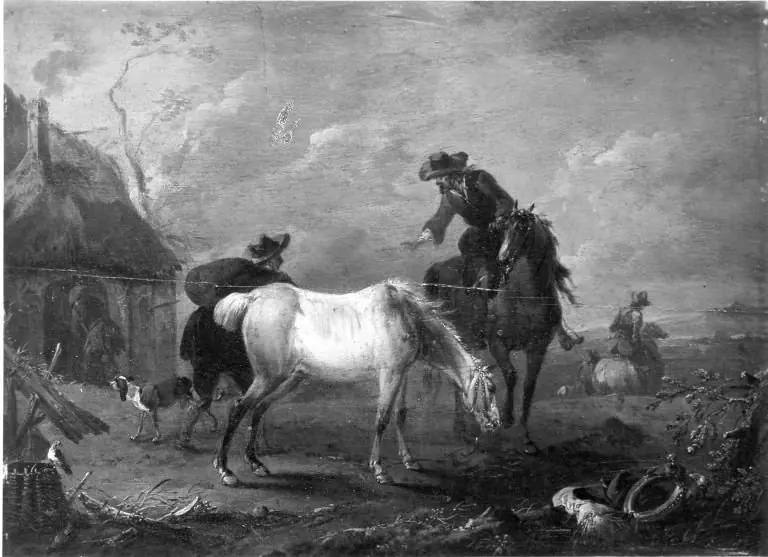
The scene captures a moment of organized chaos: horses, people, and a dog interact in a confined space, suggesting the daily rhythms of rural labor.
Painted around 1747 by Georg Philipp Rugendas the Younger, this work depicts a bustling farrier’s yard. It is part of the Alte Pinakothek’s collection in Munich. The scene captures a moment of organized chaos: horses, people, and a dog interact in a confined space, suggesting the daily rhythms of rural labor. The composition emphasizes motion and urgency, with figures arranged to guide the viewer’s gaze toward the central action.
Subject & Meaning
The painting illustrates the work of a farrier, a blacksmith who shoes horses, a vital trade in the 18th century. Figures are engaged in coordinated effort—holding reins, lifting hooves, and managing animals—revealing the physical demands of the craft. A child holds a cloth, possibly a banner or cloth for wiping, adding a human detail. The scene reflects the importance of equine care in an era reliant on horses for transport and agriculture.
Technique & Style
Rugendas employs dynamic brushwork and layered pigments to convey movement and texture. Figures are rendered with loose, energetic strokes, while the animals’ musculature and the dirt underfoot are suggested rather than meticulously detailed. The use of warm earth tones contrasts with muted sky tones, focusing attention on the foreground activity. Diagonal lines and overlapping forms heighten the sense of spatial depth and kinetic energy.
History & Provenance
The painting entered the Alte Pinakothek’s holdings in the 19th century, likely through the Bavarian royal collection. It was cataloged as part of a broader interest in genre scenes from the 18th century. While little is documented about its early ownership, its presence in the museum since the 1800s confirms its recognized status within German artistic heritage of the period.
Context
Rugendas belonged to a family of artists known for documenting military and rural life across Europe. This work aligns with a trend in German-speaking regions to depict everyday labor with narrative clarity. Unlike idealized pastoral scenes, this painting embraces the grit and urgency of working-class environments, reflecting Enlightenment-era interest in observable reality over mythological or aristocratic subjects.
Legacy
Though not widely reproduced, the painting remains a representative example of 18th-century German genre painting. It contributes to scholarly understanding of how artisans and rural labor were visually recorded before industrialization. Its preservation in a major public collection ensures continued access for study, offering insight into pre-modern equine care and social organization in Central Europe.
Artist & collection
Artist
Georg Philipp Rugendas the Younger
Georg Philipp Rugendas the Younger (1701–1774) was an artist, born in Augsburg.