Artwork
Voyages pittoresques et romantiques dans l'ancienne France (Languedoc II, part I): Castelnaudary
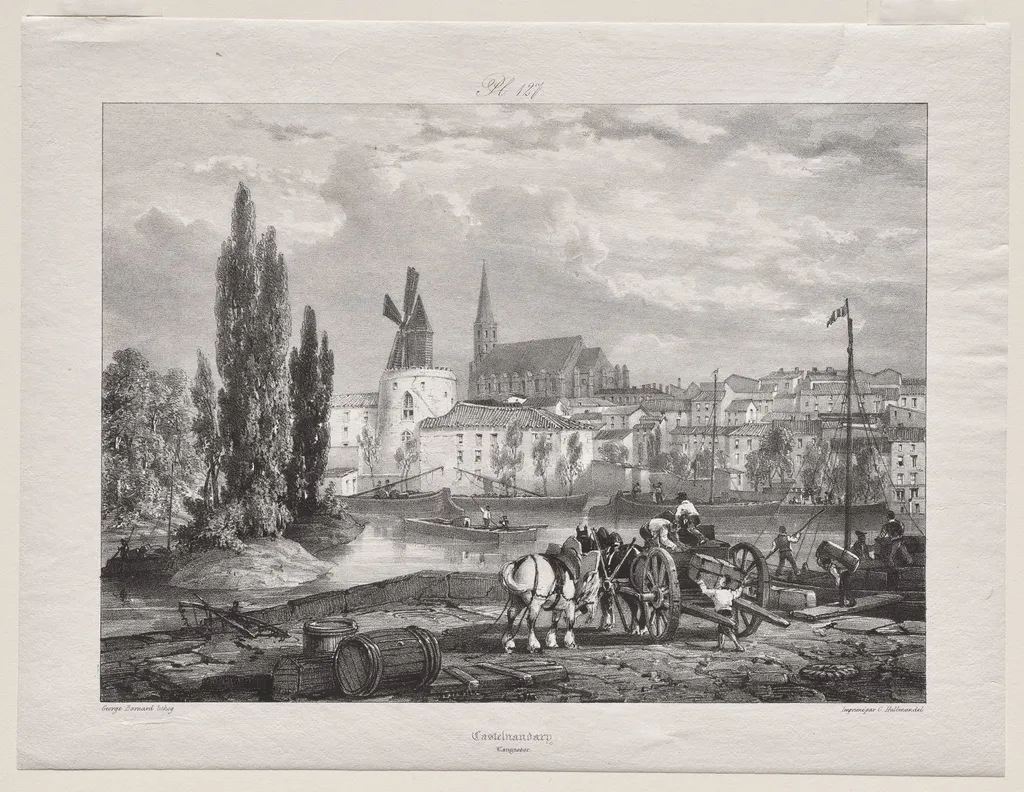
Voyages pittoresques et romantiques dans l'ancienne France (Languedoc II, part I): Castelnaudary is a print by the Romanticist artist George Barnard. It dates from 1835 and is held in the collection of the Cleveland Museum of Art.
About this work
Overview
It depicts Castelnaudary, a town in southern France, rendered from on-site sketches.
Created in 1835 by George Barnard, this print is one of many in the series Voyages pittoresques et romantiques dans l'ancienne France, focusing on the Languedoc region. It depicts Castelnaudary, a town in southern France, rendered from on-site sketches. The work was produced as part of a broader project to document historical French landscapes through detailed visual records, emphasizing quiet observation over theatricality.
Subject & Meaning
The scene captures ordinary rural life along the Aude River: a horse-drawn cart with barrels, laborers near the water, and modest architecture. A church tower and windmill anchor the background, suggesting the town’s religious and agricultural rhythms. Barnard avoids dramatic tension, instead presenting a serene, unidealized moment that reflects the daily rhythms of provincial France in the early 19th century.
Technique & Style
Barnard employed fine linear detail and subtle tonal gradations to convey atmosphere. Soft lighting blurs architectural edges and unifies the landscape, enhancing the calm mood. The composition balances horizontal elements—river, shore, rooftops—with vertical accents like the windmill and spire. This restrained approach aligns with Romantic-era interest in nature and authenticity, prioritizing mood over narrative intensity.
History & Provenance
The print was produced as part of a multi-volume publication commissioned to record France’s architectural heritage. Barnard traveled extensively to sketch locations before engraving them for publication. The work entered The Cleveland Museum of Art’s collection through documented acquisition, preserving its role as a visual archive of pre-industrial French towns.
Context
This print emerged during a period of growing interest in regional identity and historical preservation in France. As industrialization reshaped the countryside, artists and publishers sought to document vanishing rural scenes. Barnard’s series responded to this cultural impulse, offering a visual record grounded in direct observation rather than idealized nostalgia.
Legacy
Barnard’s prints contributed to a broader movement of topographical documentation in 19th-century Europe. Though not widely celebrated in his time, his work remains valuable for its unembellished depiction of provincial life. Today, such images serve as historical references for scholars studying landscape, architecture, and social conditions in pre-modern France.
Artist & collection