Artwork
The grave of little Nell
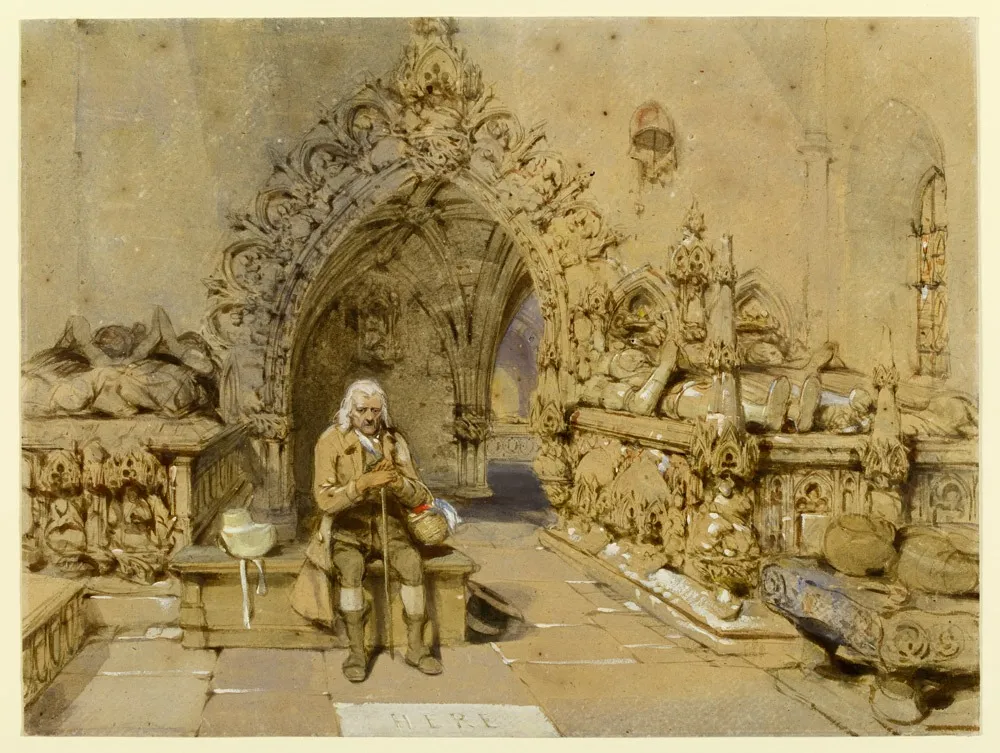
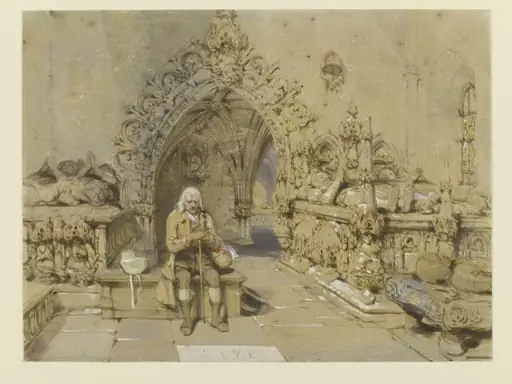
The grave of little Nell is a watercolor painting by George Cattermole. It dates from 1867 and is held in the collection of the Victoria and Albert Museum.
About this work
Overview
Its subdued palette and intimate scale reflect the artist’s preference for literary subjects rendered with restrained emotion rather than dramatic flair.
Created in 1867, this watercolor painting by George Cattermole illustrates a moment of quiet sorrow tied to Charles Dickens’s character Nell Trent. Executed in delicate transparent washes, the work belongs to the Victoria and Albert Museum’s collection. Its subdued palette and intimate scale reflect the artist’s preference for literary subjects rendered with restrained emotion rather than dramatic flair.
Subject & Meaning
The figure is an elderly man, likely Nell’s grandfather, seated in contemplation beside her grave. His worn clothing and still posture convey grief and endurance. The setting, a dimly lit stone chapel with carved arches and statues, evokes a sacred, timeless space. The basket at his feet suggests offerings or personal mementos, reinforcing themes of memory and loss rooted in Dickens’s narrative.
Technique & Style
Cattermole employed fine watercolor washes to build subtle tonal gradations, capturing the softness of light filtering through stone arches. Fine linework defines the carvings and fabric folds without heavy detail, favoring atmospheric suggestion over precision. The composition directs attention to the solitary figure, framed by architectural elements that amplify the sense of solitude and reverence.
History & Provenance
The painting was completed near the end of Cattermole’s career, following his long engagement with literary illustration. It entered the Victoria and Albert Museum’s collection in the late 19th century, likely through acquisition or donation. Its preservation reflects institutional interest in 19th-century British narrative art, particularly works connected to popular literature of the era.
Context
Cattermole was known for illustrating Dickens’s novels, and this piece responds to the emotional weight of 'The Old Curiosity Shop.' In the 1860s, public fascination with literary scenes translated into demand for visual interpretations. The painting aligns with a broader trend of artists translating prose into intimate, emotionally resonant images for middle-class audiences.
Legacy
Though not widely exhibited today, the work remains a quiet example of Victorian illustration’s capacity for emotional nuance. It preserves a moment from a culturally significant novel and demonstrates how artists translated literary grief into visual form. Its presence in the V&A underscores its role in documenting the intersection of literature and fine art in 19th-century Britain.
Artist & collection
Artist
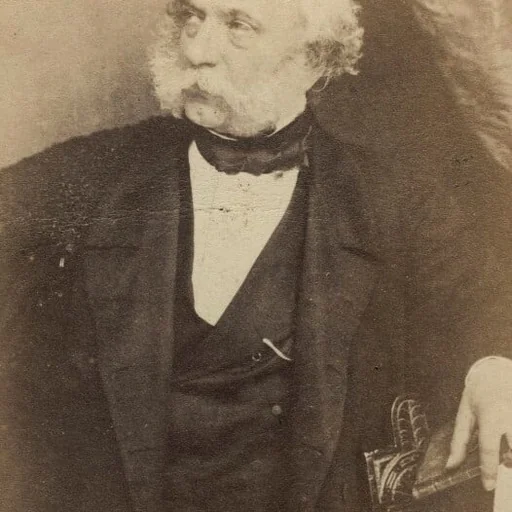
George Cattermole was a British painter and illustrator, chiefly in watercolours.

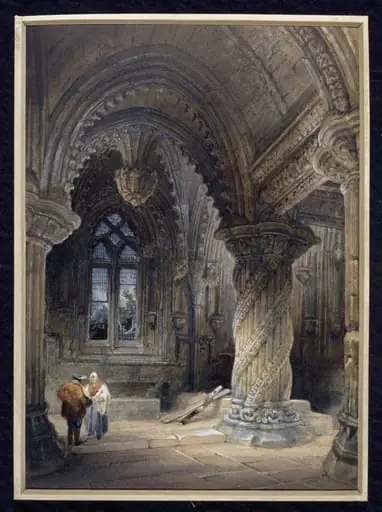 The Prentice Pillar, Roslin Chapel
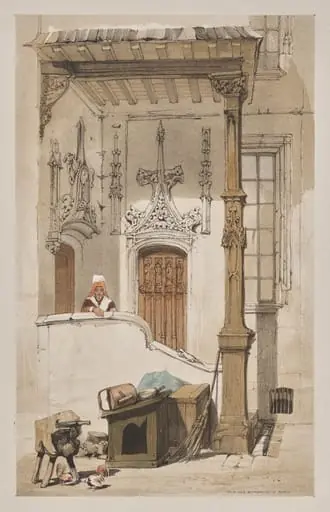 Picturesque Architecture in Paris, Ghent, Antwerp, Rouen: Rue des Marmousets, Paris
![The Bishop's Tomb [center], by Canaletto](https://artifactworldgallery.com/img/canaletto--the-bishop-s-tomb-center--d27fef1dd2f2d61a-w320.webp) The Bishop's Tomb [center]
The Bishop's Tomb [center]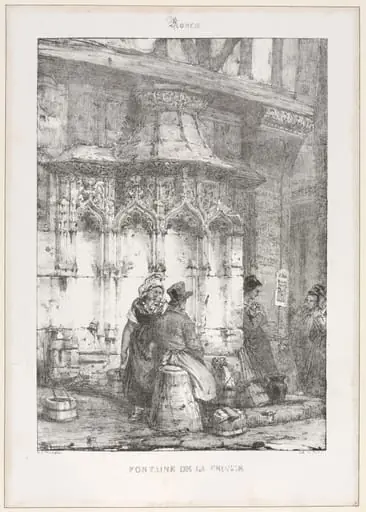 Architectural Remains and Fragments: Rouen - Fontaine de la Crosse
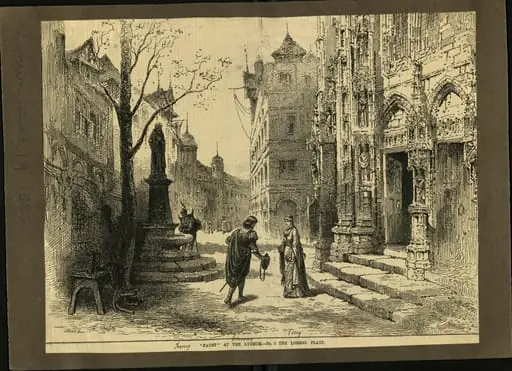 Faust
Faust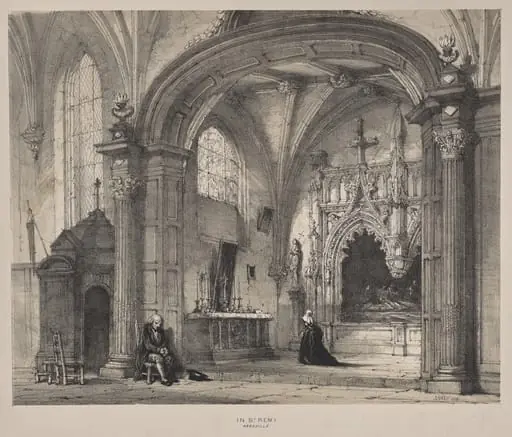 Architecture of the Middle Ages: In St. Remi, Abbeville
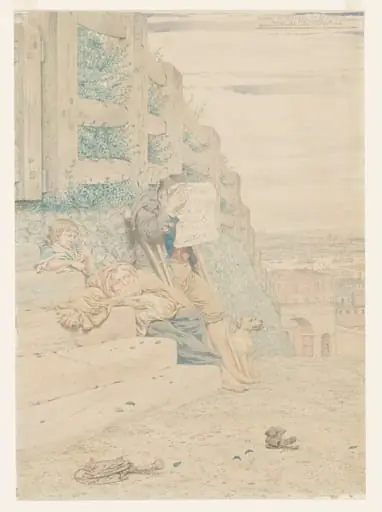 Sketch to illustrate the Passions: Want
 The Blind Beggar
 The Porch at Roslin, near Edinburgh
 Interior of a Cathedral
 Architecture of the Middle Ages: Chapel in St. Jacques, Dieppe
 The Grave of little Nell