Artwork
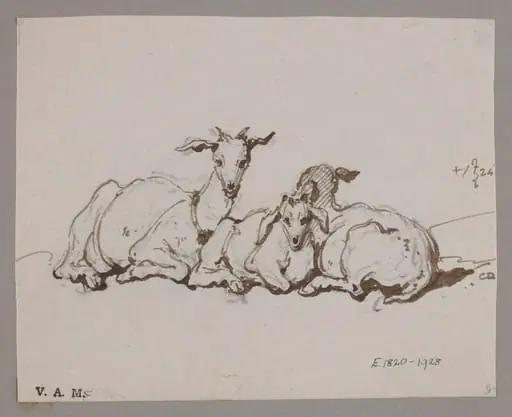
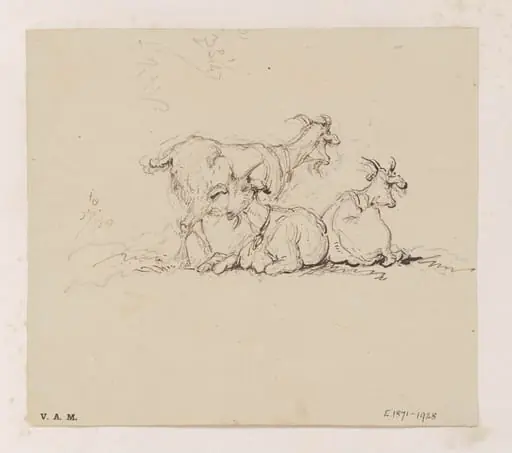
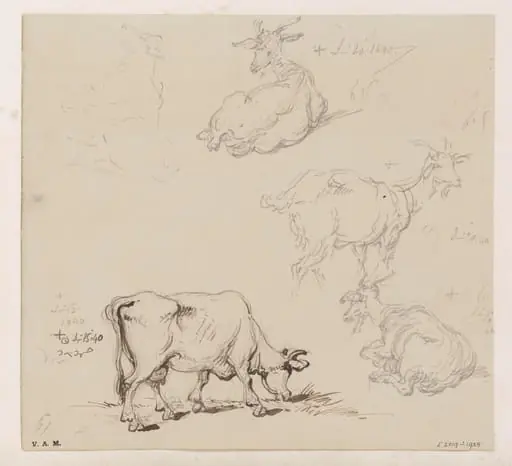
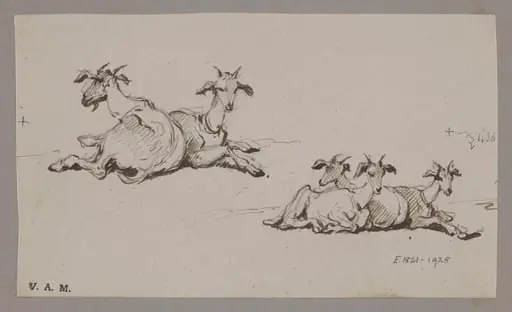
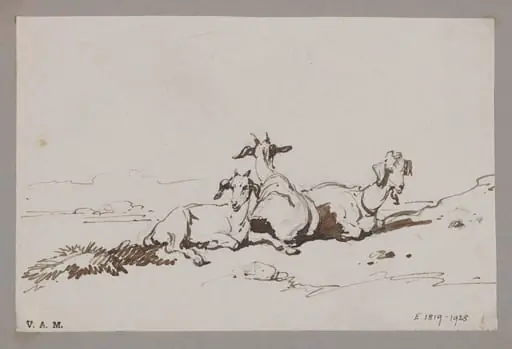
Studies of goats
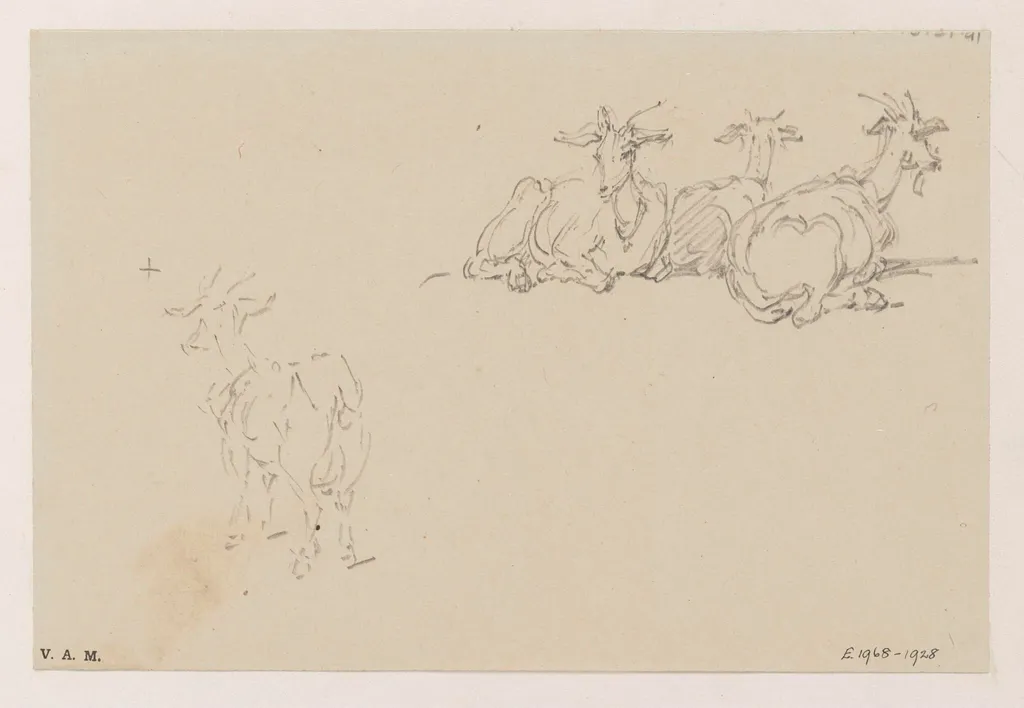
Studies of goats is a drawing by the Romanticist artist George Chinnery. It dates from 1 and is held in the collection of the Victoria and Albert Museum.
About this work
It shows three goats standing together, with one goat sketched lightly nearby.
George Chinnery made a careful drawing called *Studies of Goats* in 1841.
It shows three goats standing together, with one goat sketched lightly nearby.
A small detail is that the animals look calm and natural.
The artist used Romanticism’s love of detail and nature in this work.
This style often highlights everyday animals with gentle lines.
It’s a quiet, close-up look at farm life.
Check out George Chinnery next.
Overview
George Chinnery created this 1841 drawing as a study of domesticated goats, capturing three animals in a composed group with a fourth rendered in faint, tentative lines. Executed in pencil or charcoal, the work reflects the artist’s interest in observational accuracy and the quiet presence of rural life. Its modest scale and focused subject suggest it was intended as a preparatory exercise rather than a finished piece.
Subject & Meaning
The three main goats stand calmly, their postures relaxed and natural, suggesting an unposed moment in a pastoral setting. The lightly sketched fourth goat introduces a sense of movement or hesitation, as if the animal is entering the scene. The composition avoids drama, instead emphasizing stillness and the quiet dignity of ordinary animals, aligning with Romantic-era reverence for the natural world.
Technique & Style
Chinnery employed subtle tonal variations and delicate linework to define the goats’ forms, avoiding heavy shading in favor of soft contours. The contrast between the fully rendered trio and the faintly suggested fourth figure demonstrates his control over draftsmanship. The style reflects Romanticism’s emphasis on direct observation and emotional resonance through simplicity, rather than idealization.
History & Provenance
Created during Chinnery’s time in Asia, where he lived from the 1820s until his death, this drawing likely stems from his continued practice of sketching local fauna and rural scenes. Though its exact provenance is undocumented, it aligns with his broader body of work that records everyday life in colonial-era South China and India, preserving moments often overlooked by contemporaries.
Context
In the early 19th century, European artists increasingly turned to nature and domestic animals as subjects worthy of serious study. Chinnery’s work fits within this trend, though his perspective was shaped by his life outside Europe. His drawings of goats, like those of other animals, reflect a personal engagement with the landscapes and creatures around him, distinct from academic traditions.
Legacy
Though not widely exhibited, Chinnery’s studies of animals, including this one, contribute to a quieter legacy of observational drawing in the Romantic period. They offer insight into his method and sensitivity to natural behavior, influencing later artists interested in unidealized depictions of rural life. These works remain valuable for their authenticity and understated precision.
Artist & collection
Artist
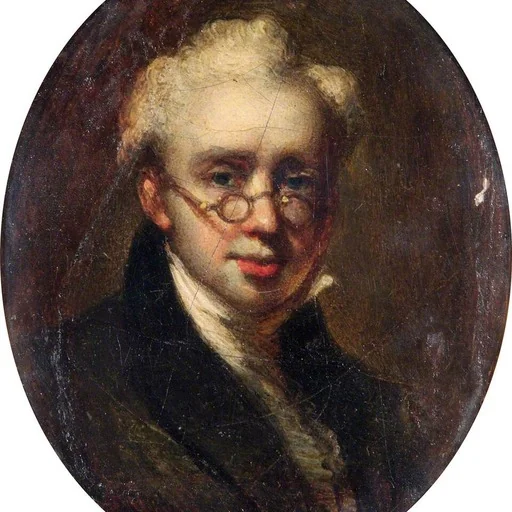
George Chinnery (Chinese: 錢納利; 5 January 1774 – 30 May 1852) was an English painter who spent most of his life in Asia, especially India and southern China.