Artwork
Albano, Italy
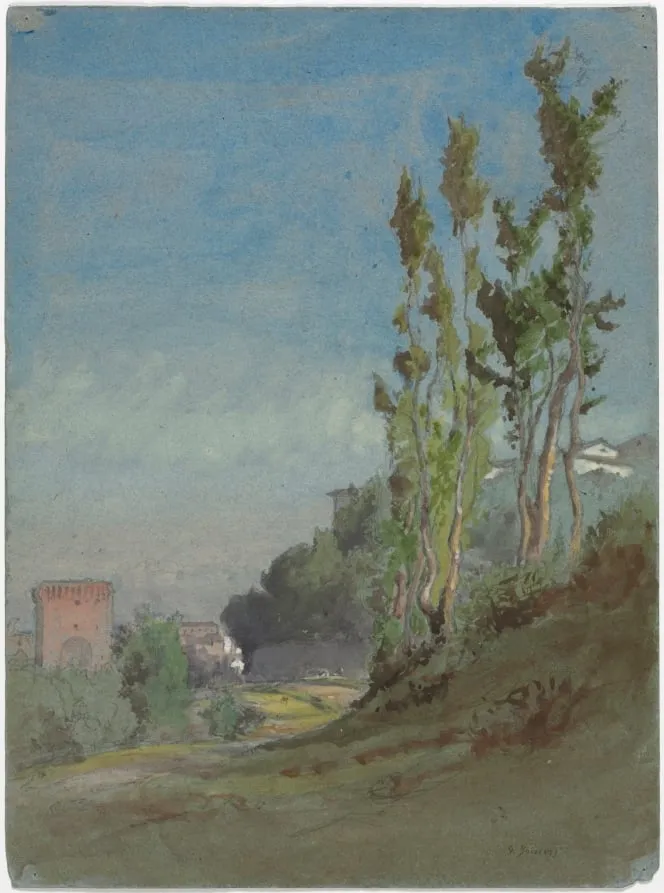
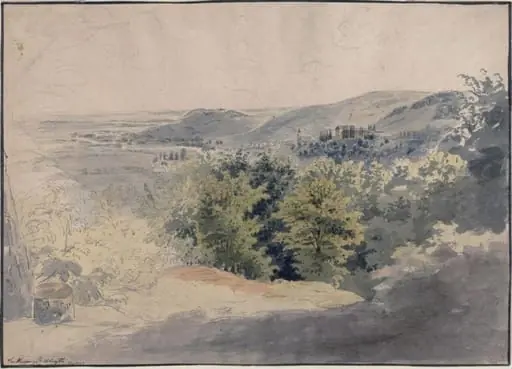
Albano, Italy is a drawing by the Impressionist artist George Inness. It dates from 1872 and is held in the collection of the Cleveland Museum of Art.
About this work
Overview
Executed in the early 1870s, it reflects a shift from his earlier, detailed Hudson River School style toward a more atmospheric, expressive approach.
Created during George Inness’s travels in Italy, this watercolor drawing on blue paper captures a quiet moment in the countryside near Albano. Executed in the early 1870s, it reflects a shift from his earlier, detailed Hudson River School style toward a more atmospheric, expressive approach. The luminous blue substrate enhances the softness of the washes, contributing to an ethereal tone that distinguishes it from conventional topographical sketches.
Subject & Meaning
The scene depicts a winding path leading through a modest Italian village, framed by trees and anchored by distant ruins. Rather than documenting architecture or topography, Inness evokes a sense of quiet contemplation. The blurred forms and muted tones suggest recollection rather than observation, inviting the viewer to experience the landscape as a lingering impression rather than a precise record.
Technique & Style
Inness applied layered watercolor washes while the paper was still damp, allowing colors to bleed and merge organically. This method produced a hazy, indistinct quality, particularly in the hills and structures, echoing the optical effects of sfumato. The blue paper, left partially visible, acts as both ground and ambient light source, unifying the composition and deepening its atmospheric mood.
History & Provenance
This work originated from a series of sketches Inness made during his 1870–71 journey through Italy, a period marked by personal and artistic transformation. Unlike his earlier, meticulously composed American landscapes, these Italian studies embraced spontaneity. The drawing remained in private hands until entering a major museum collection, where it is now recognized as a key example of his mature style.
Context
Inness’s Italian sketches coincided with his growing interest in European Romanticism and Eastern philosophy, both of which emphasized emotional resonance over literal representation. His move away from topographical accuracy aligned with broader 19th-century shifts in landscape art, where mood and memory began to supersede documentary precision as artistic goals.
Legacy
This drawing exemplifies Inness’s transition toward a more introspective, tonal mode that influenced later American Tonalists. Its emphasis on atmosphere over detail, and the use of colored paper to unify light and form, prefigured techniques adopted by artists seeking emotional depth in landscape. It stands as a quiet but significant pivot in the evolution of American watercolor.
Artist & collection

Artist
George Inness (May 1, 1825 – August 3, 1894) was an American landscape painter. Now recognized as one of the most influential American artists of the nineteenth century, Inness was influenced by the Hudson River School…

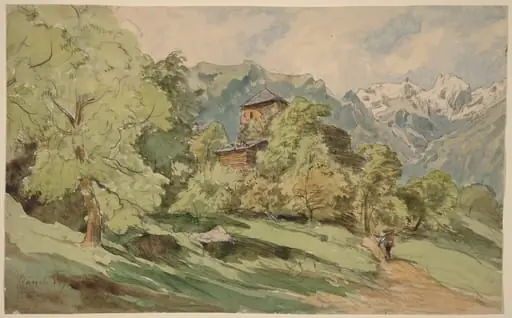 The Castle of Bürglen with the Alps Beyond
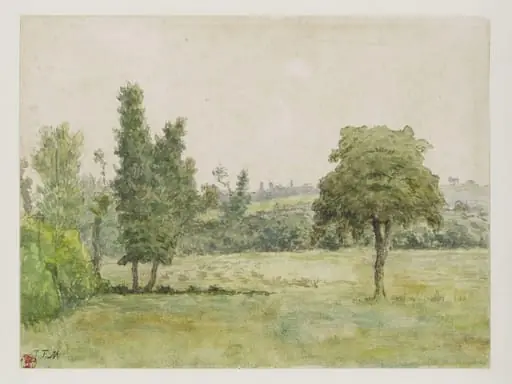 Meadow with trees
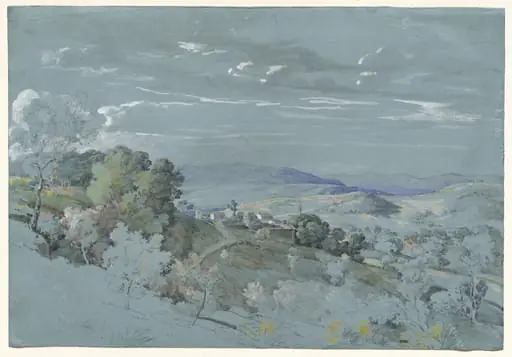 The Hills of Umbria near Perugia
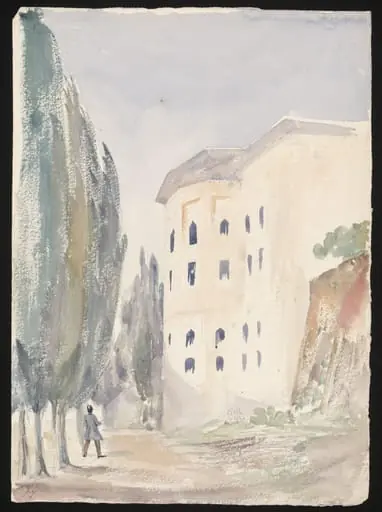 Untitled
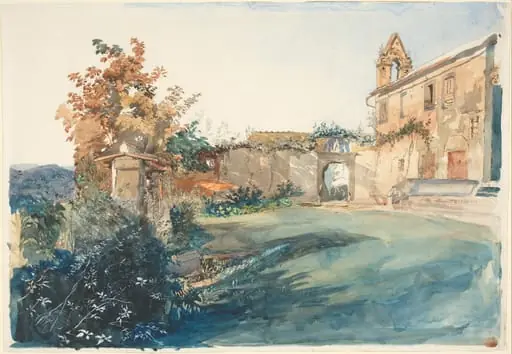 The Garden of San Miniato near Florence
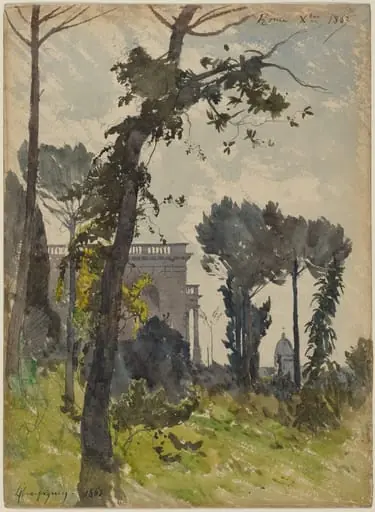 View of the Dome of Saint Peter's, Rome
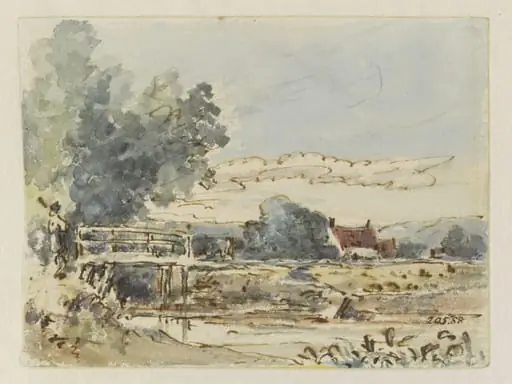 A bridge over a stream, with a cottage behind
 `Temple of Denderah. Distant view from bank of River. Upper Egypt'
 Landscape with trees and water
 Choropiskopos, June 16th & 17th 1856
 Drum înspre pădure
 Landscape with hills in the background