Artwork
Dealuri I
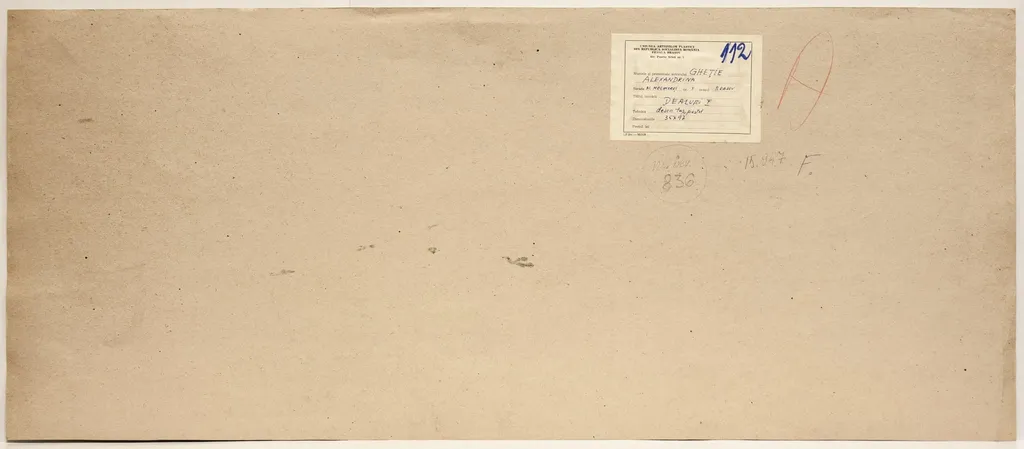
Dealuri I is a drawing by Alexandrina Gheție-Hilohi. It dates from 1950 and is held in the collection of the Gavrila Simion Eco-Museum Research Institute Tulcea.
About this work
Overview
Faint annotations, stamps, and a red 'F' in a circle suggest administrative handling, possibly from a cataloged study or sketch archive.
Dealuri I is a modest sheet of light brown paper, dated around 1950, created by Romanian artist Alexandrina Gheție-Hilohi. It is part of the Museum of Ethnography’s collection. The surface bears minimal pencil markings near the upper edge and a small, typed label centered on the sheet. Faint annotations, stamps, and a red 'F' in a circle suggest administrative handling, possibly from a cataloged study or sketch archive.
Subject & Meaning
The title 'Dealuri I' translates to 'Hills I,' hinting at a landscape theme, though no clear forms emerge. The sparse pencil traces may represent early attempts to capture terrain or light, possibly preparatory studies for larger works. The lack of defined imagery suggests an exploratory, private phase of work rather than a finished composition, reflecting the artist’s process rather than a public statement.
Technique & Style
The drawing employs subtle, light pencil strokes, with no heavy shading or defined contours. Faint, intersecting lines near the top may indicate early experimentation with cross-hatching, a method used to suggest texture and depth through layered strokes. The restraint in mark-making points to a focus on observation over elaboration, characteristic of informal studies rather than polished compositions.
History & Provenance
The paper carries a typed label identifying the artist and title, alongside handwritten numbers and institutional stamps, including a red 'F' in a circle. These markings suggest the sheet was once cataloged within a systematic collection, likely part of a larger body of studies gathered for educational or archival purposes. Its preservation in the Museum of Ethnography implies recognition of its documentary value.
Context
Created in postwar Romania, the work reflects a period when artists often produced private sketches amid limited resources and shifting cultural priorities. While public art emphasized socialist realism, personal studies like this one reveal quieter, introspective practices. The absence of overt political or folk motifs aligns it with individual experimentation rather than state-sanctioned themes.
Legacy
Dealuri I endures not as a celebrated work but as a quiet artifact of artistic process. Its preservation underscores the value placed on preliminary studies in understanding an artist’s development. It offers insight into Gheție-Hilohi’s method, serving as a tangible trace of thought and gesture, preserved for its historical rather than aesthetic significance.
Artist & collection
Artist
Alexandrina Gheție-Hilohi kept a tiny sketchbook in her coat pocket and drew whenever the light hit the hills just right.
Museum
Gavrila Simion Eco-Museum Research Institute Tulcea
Continue through works from the same source collection.
 Peisaj (Ercea) sat
 Blocuri noi în Constanța
 Pe marginea lacului
 Ghivece
 Fără cuvinte
 În cherhana
 Peisaj din Balcic
 Lacul Babadag
 Imortele
 La terasă
 Holde nesfârșite
 Studiu de peisaj cu un lac. În prim-plan, malul lacului acoperit de iarbă. În plan secund, lacul cu o barcă roșie în marginea din dreapta a lucrării și cu o cabană parțial acoperită de un dâmb în extremitatea opusă. În fundal, cerul cu linia orizontului joasă, cu soarele aproape dispărând și luminând roșu-indigo, albastru. Semnat cu negru, dreapta jos: Craiu.