Artwork
Un cavaler - Porthos
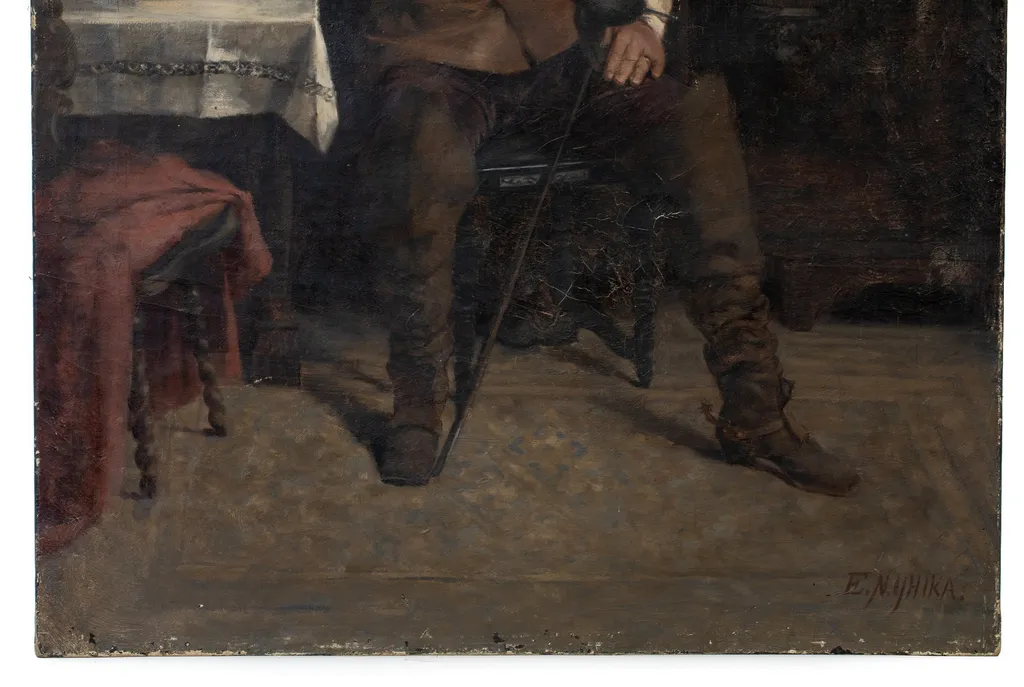
Un cavaler - Porthos is a print by Ghica-Budești Eugeniu Neculai. It is held in the collection of the Moldova National Museum Complex.
About this work
Overview
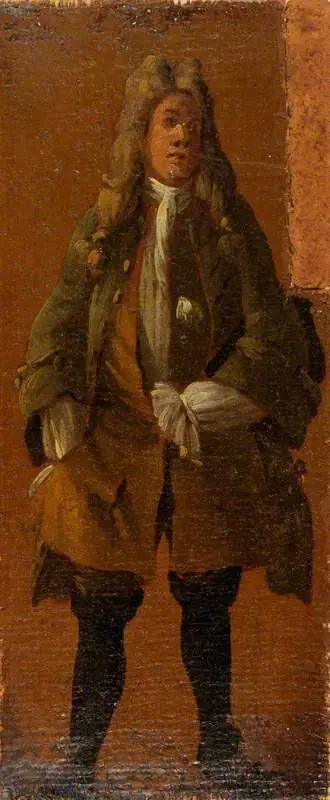
The painting 'Un cavaler - Porthos' portrays a solitary male figure seated in a modest interior.
The painting 'Un cavaler - Porthos' portrays a solitary male figure seated in a modest interior. Dressed in a brown jacket, white shirt, and knee-high boots, with a scarf loosely wound around his neck, he holds a glass in one hand while his other rests on his thigh. A sword rests near his feet, and a red-draped table sits to his left. The dark, patterned background focuses attention on the figure and his possessions.
Subject & Meaning
The figure is identified as Porthos, one of the Three Musketeers, suggesting a literary reference. His relaxed posture and the presence of a sword and drinking vessel imply a moment of repose after action. The scene evokes a quiet, introspective pause rather than martial grandeur, blending aristocratic attire with domestic stillness to suggest the human side of a fictional hero.
Technique & Style
The painting employs a restrained palette dominated by earth tones and deep shadows. Light falls subtly on the figure’s face and clothing, defining form without dramatic contrast. The background is rendered with minimal detail, enhancing the figure’s presence. Brushwork is controlled, with attention to fabric texture and the sheen of the glass, conveying realism without embellishment.
History & Provenance
The work is held in the collection of the Museum of Ethnography, an institution more commonly associated with cultural artifacts than fine art. Its presence there suggests the painting may have been acquired as part of a broader interest in literary or folk representations of historical identity, though its exact origin and date of acquisition remain undocumented in public records.
Context
Created during a period when literary figures were frequently visualized in domestic settings, the painting reflects a 19th-century trend of humanizing heroic archetypes. Unlike grand historical paintings, this work emphasizes intimacy and quietude, aligning with evolving tastes that valued psychological nuance over spectacle in depictions of fictional characters.
Legacy
Though not widely reproduced or studied, the painting contributes to a lesser-known strand of literary portraiture that prioritizes everyday realism over idealization. Its placement in an ethnographic museum underscores its role as a cultural artifact reflecting how literature shaped perceptions of identity, rather than as a work of high artistic ambition.
Artist & collection
Artist
Eugeniu Neculai Ghica-Budești made a print called *Un cavaler - Porthos*. It shows a single rider in detail, typical of early 20th-century printmaking that focused on strong lines and clear shapes. The work carries the…