Artwork
Self-Portrait (Allegory of painting)
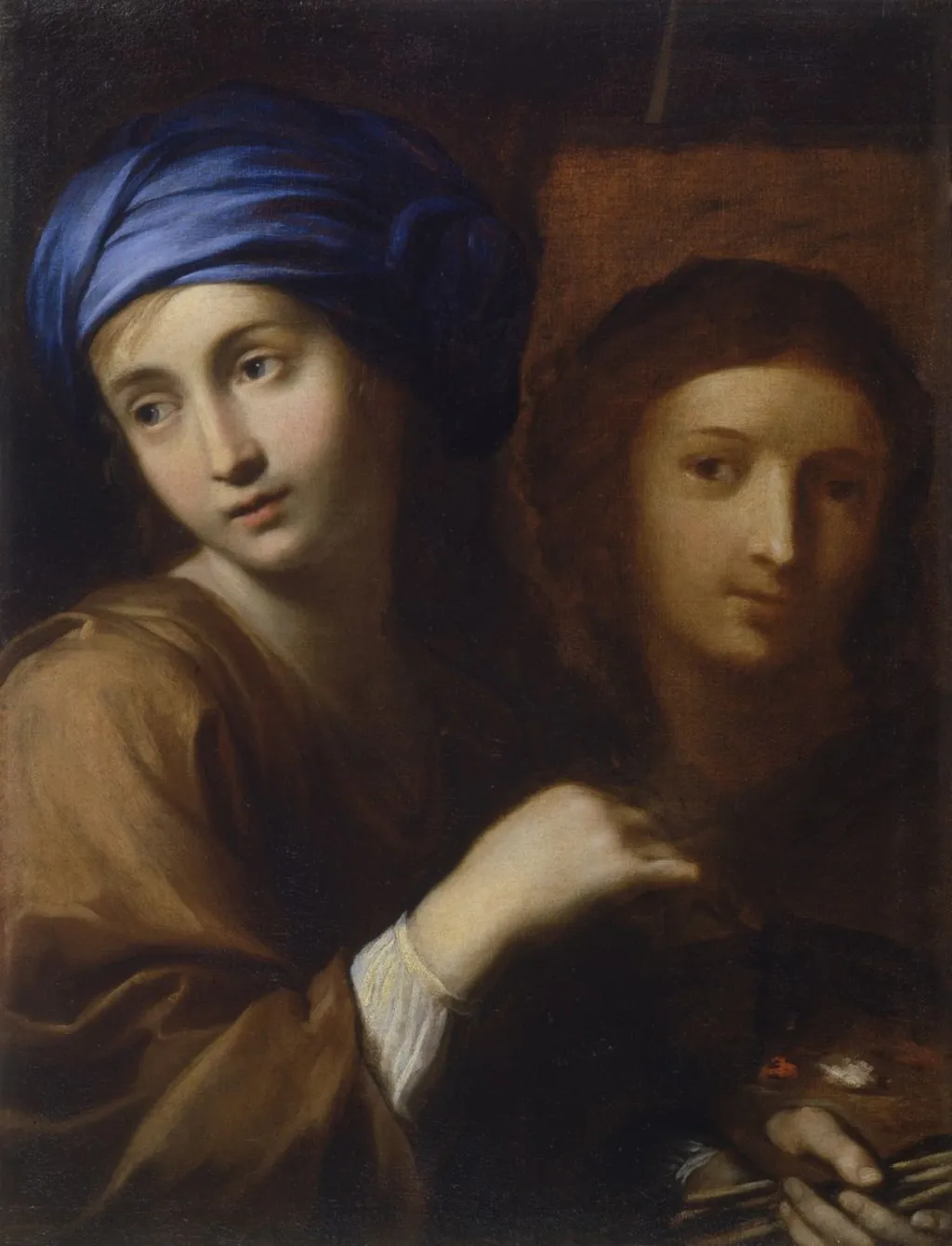
Self-Portrait (Allegory of painting) is an oil painting by the Early Baroque Italian artist Ginevra Cantofoli. It dates from 1660 and is held in the collection of the Pinacoteca di Brera.
About this work
The style and use of color in this painting are reminiscent of the techniques employed by Ginevra Cantofoli, an artist known for her work in the 17th century.
This painting features a woman with a blue headscarf, gazing to her right. She wears a brown dress with a white striped cuff, and her left hand holds a palette of paints. To her right is a bust of a woman, and the background is dark.
The woman's attire and the presence of the palette suggest that she is an artist. The bust beside her may represent a subject she is painting or a symbol of her artistic inspiration.
The style and use of color in this painting are reminiscent of the techniques employed by Ginevra Cantofoli, an artist known for her work in the 17th century.
Overview
Ginevra Cantofoli painted this oil-on-canvas self-portrait in 1660 while active in Bologna. It is one of the few surviving works by a female artist of the period who worked within the Baroque tradition. The painting is now held in the Pinacoteca di Brera in Milan, where it serves as a rare visual record of a woman asserting her identity as a professional painter in 17th-century Italy.
Subject & Meaning
The portrait depicts Cantofoli herself, dressed in modest attire, holding a painter’s palette. A bust of a woman rests beside her, likely symbolizing artistic inspiration or the classical ideal she engages with. The composition frames her not merely as a sitter but as a creator, merging personal identity with the allegorical role of the artist. The dark background focuses attention on her gesture and the tools of her trade.
Technique & Style
Cantofoli employs a restrained palette of earth tones and muted blues, with careful attention to texture in fabric and the smooth surface of the bust. The lighting is subtle, modeling form without dramatic contrast, aligning with Bolognese naturalism rather than the theatricality of Roman Baroque. Brushwork is precise yet unobtrusive, emphasizing clarity over ornamentation, reflecting her training in a region known for its emphasis on draftsmanship.
History & Provenance
The painting entered the Pinacoteca di Brera’s collection in the 19th century, though its earlier ownership is undocumented. It was likely preserved within private or ecclesiastical circles in northern Italy after Cantofoli’s death in 1672. Its survival is notable, as many works by female artists of the era were lost or misattributed. The attribution to Cantofoli is based on stylistic analysis and historical records of her known output.
Context
In mid-17th-century Bologna, women could train as artists through family workshops or academies, though few achieved public recognition. Cantofoli was among the rare female painters to sign and date her works. This portrait reflects a broader, quiet trend of women asserting professional legitimacy through self-representation, countering societal norms that often confined them to domestic or decorative roles.
Legacy
Cantofoli’s self-portrait remains a significant document of female artistic agency in early modern Europe. It contributes to the reevaluation of women’s roles in the Baroque art world, offering tangible evidence of their participation beyond patronage or muses. While not widely exhibited, it is referenced in scholarly studies on gender and artistic identity in 17th-century Italy.
Own this work as a print
Artist & collection
Artist
Ginevra Cantofoli (Italian pronunciation: ; 1608 or 1618 – 1672) was an Italian painter. She was active in Bologna during the Baroque period.