Artwork
Saint Cosma
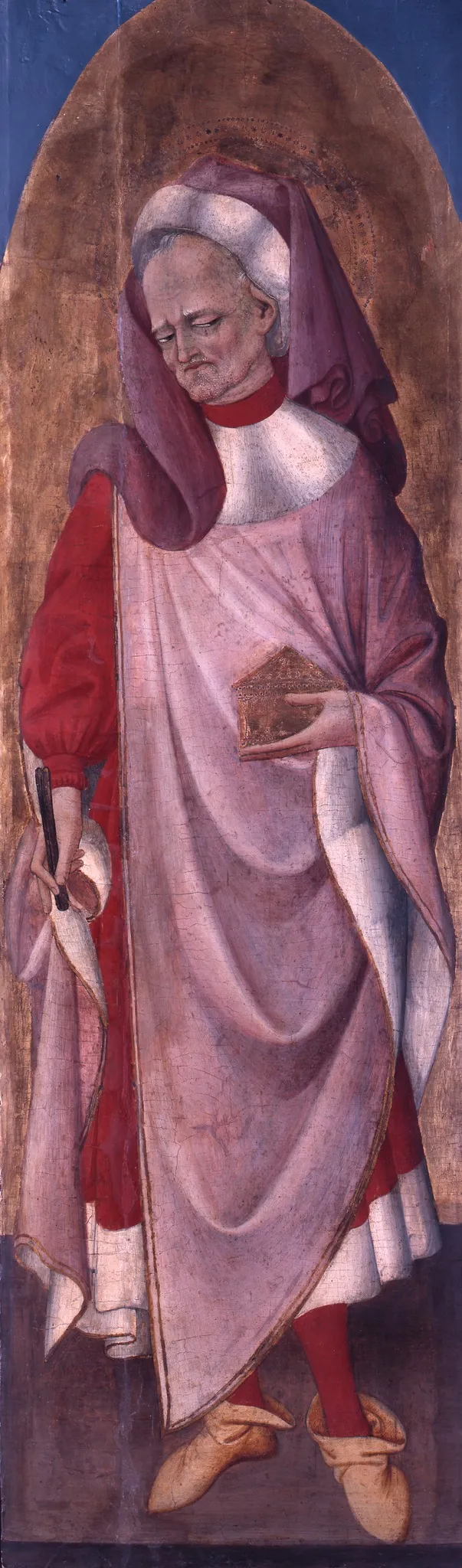
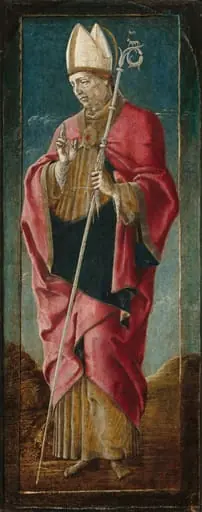
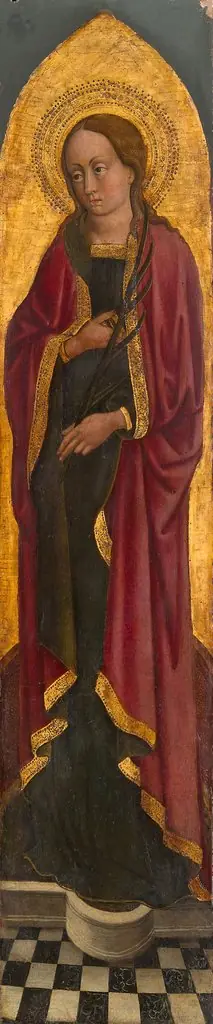
Saint Cosma is a paint painting by the Early Renaissance artist Giovanni di Pietro Falloppi. It is held in the collection of the Gemäldegalerie Berlin.
About this work
Overview
Painted around 1500 by Giovanni di Pietro Falloppi, this work portrays Saint Cosma, one of the twin physician saints venerated in Christian tradition.
Painted around 1500 by Giovanni di Pietro Falloppi, this work portrays Saint Cosma, one of the twin physician saints venerated in Christian tradition. Executed in tempera or oil on panel, it resides in the Gemäldegalerie, Berlin. The composition is restrained, emphasizing stillness and spiritual focus rather than narrative action. The saint’s posture and setting reflect devotional conventions of early Renaissance Italy.
Subject & Meaning
Saint Cosma, a patron of physicians, is depicted with the tools of his trade: a book symbolizing medical knowledge and a scalpel representing his healing practice. His white robe and red cloak signify purity and martyrdom, common in hagiographic imagery. The downward gaze and calm expression convey introspection and divine wisdom, aligning the saint with ideals of quiet virtue and scholarly devotion.
Technique & Style
The painting employs a limited palette of white, red, and deep blue, with a gold-leaf arch framing the figure to suggest sacred space. Modeling is subtle, with soft transitions between light and shadow to define form without dramatic contrast. The flat background enhances the figure’s presence, while precise brushwork in the folds of fabric and facial features reflects a refined, late medieval sensibility transitioning toward Renaissance naturalism.
History & Provenance
The painting entered the Gemäldegalerie Berlin’s collection in the 19th century, likely acquired from a German ecclesiastical or noble collection. Its attribution to Giovanni di Pietro Falloppi, a lesser-known artist active in central Italy, suggests regional production rather than a major urban center. No earlier documentation of its commission or original location has been firmly established.
Context
Created during a period when devotional images of healing saints were widely commissioned for hospitals and monasteries, this work reflects the enduring cult of Cosmas and Damian. Its stylistic traits—gold background, frontal pose, and symbolic attributes—link it to late Gothic traditions still prevalent in smaller Italian workshops, even as Florence and Rome embraced more naturalistic approaches.
Legacy
Though not widely reproduced or studied, the painting contributes to understanding the persistence of traditional iconography in early 16th-century Italy. It illustrates how regional artists maintained devotional formats while incorporating emerging techniques in modeling and color. Its preservation in a major museum underscores its value as a quiet example of transitional religious art.
Artist & collection
Artist
Giovanni di Pietro Falloppi (1379–1455) was an artist, born in Modena.

![The Archangel Gabriel [middle left panel], by Cosmè Tura](https://artifactworldgallery.com/img/cosme-tura--the-archangel-gabriel-middle-left-panel--c900f72d54477be2-w320.webp)