Artwork
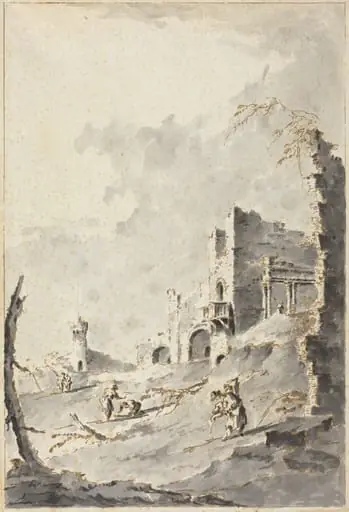
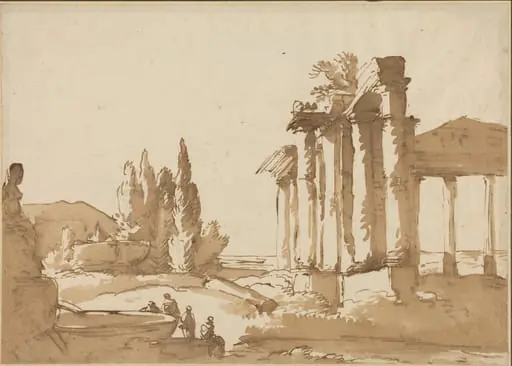
Capriccio of Classical Ruins on a Shore
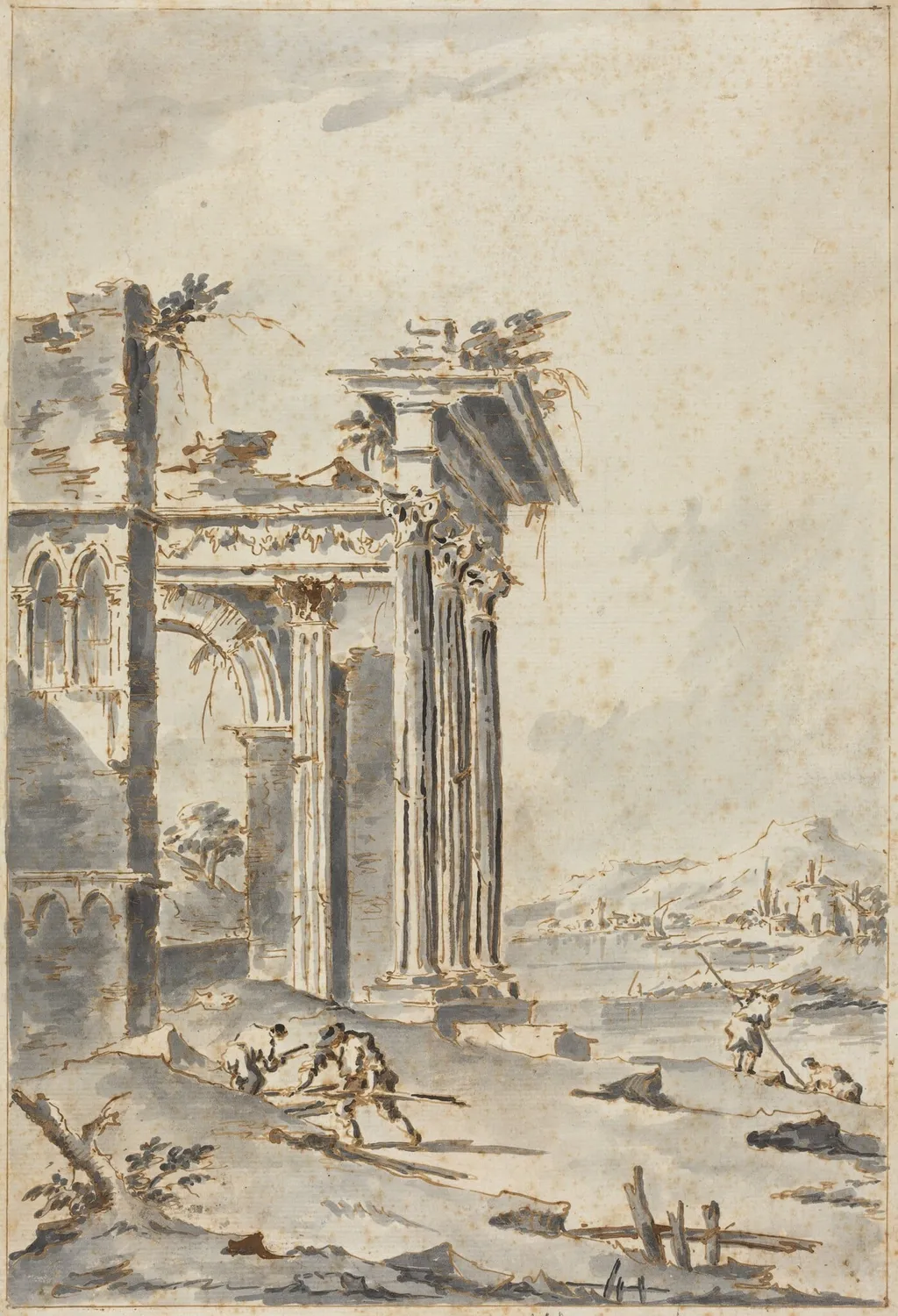
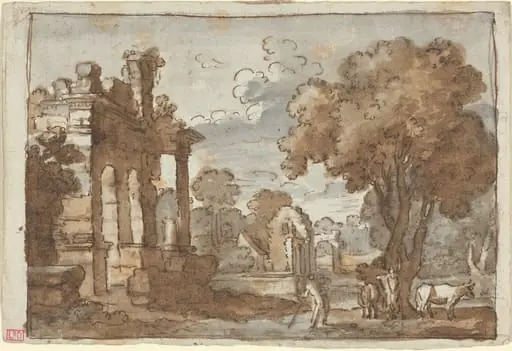
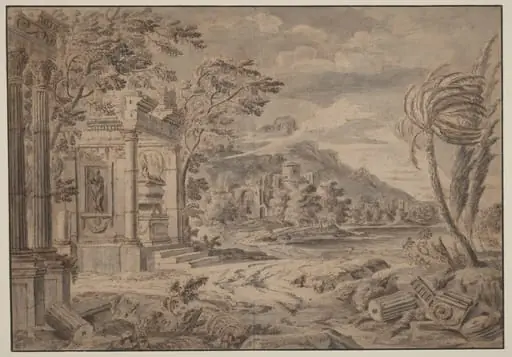
Capriccio of Classical Ruins on a Shore is an ink drawing by the Romanticist artist Giacomo Guardi. It dates from 1800 and is held in the collection of the National Gallery of Art.
About this work
Overview
Executed in pen and ink with washes of gray and brown on laid paper, it reflects the Venetian draftsmanship of the late 18th and early 19th centuries.
Created in 1800, this drawing by Giacomo Guardi belongs to the capriccio tradition, blending real and imagined architectural elements into a fictional landscape. Executed in pen and ink with washes of gray and brown on laid paper, it reflects the Venetian draftsmanship of the late 18th and early 19th centuries. Unlike grand vedute, Guardi’s approach favors intimate, contemplative compositions, emphasizing atmosphere over monumental scale.
Subject & Meaning
The scene depicts fragmented classical ruins—columns, arches, and stonework—nestled along a quiet shoreline, suggesting the passage of time and the decay of ancient civilizations. No human figures are present, enhancing the sense of solitude and quiet reverence. The arrangement is not topographically accurate but constructed to evoke a mood of nostalgic contemplation, typical of capricci that blend memory, imagination, and antiquarian interest.
Technique & Style
Guardi employed fine pen lines to define architectural forms, layered with soft washes of gray and brown ink to suggest depth, shadow, and atmospheric haze. The use of laid paper, with its subtle texture, enhances the tonal richness of the washes. His technique is precise yet fluid, balancing structural clarity with a delicate, almost ethereal handling of light and mass, characteristic of late Venetian drawing practices.
History & Provenance
Giacomo Guardi, son of the more famous Francesco Guardi, continued his father’s legacy but with a quieter, more personal aesthetic. His works, including this drawing, were often confused with those of his father or other Venetian draftsmen, leading to frequent misattributions in earlier collections. This piece survives as a clear example of his mature style, though its early ownership history remains largely undocumented.
Context
Produced during the early 19th century, the drawing aligns with a broader European fascination with classical antiquity, fueled by archaeological discoveries and Romantic ideals of ruins as symbols of transience. While not part of the overtly emotional Romantic painting movement, Guardi’s work shares its introspective tone, offering a subdued meditation on time and memory rather than dramatic spectacle.
Legacy
Giacomo Guardi’s drawings, though less celebrated than his father’s, contributed to the evolution of Venetian topographical art into more introspective forms. His capricci influenced later 19th-century artists interested in atmospheric landscape and architectural fantasy. Today, his works are valued for their technical restraint and poetic sensitivity, offering a nuanced counterpoint to the grander visions of his contemporaries.
Artist & collection
Artist
Giacomo Guardi (13 April 1764 – 3 November 1835) was an Italian painter from Venice.