Artwork
Martirio de Santa Apolonia
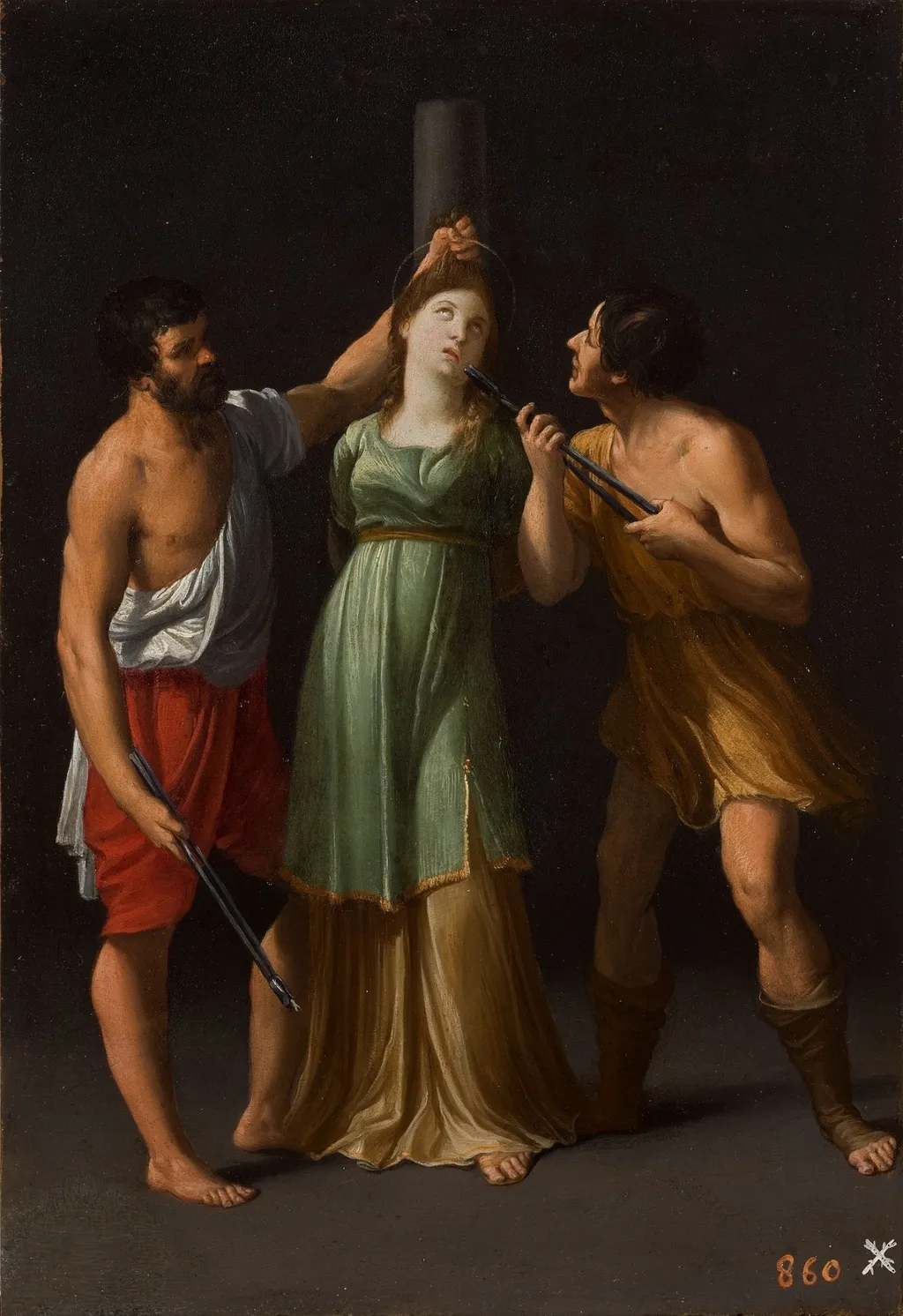
Martirio de Santa Apolonia is an oil painting by the Early Baroque Italian artist Guido Reni. It dates from 1600 and is held in the collection of the Museo del Prado.
About this work
Overview
Guido Reni’s early‑17th‑century oil, titled *Martirio di Santa Apolonia*, presents a compact interior scene illuminated by a stark chiaroscuro.
Guido Reni’s early‑17th‑century oil, titled *Martirio di Santa Apolonia*, presents a compact interior scene illuminated by a stark chiaroscuro. The composition centers on a woman in a green gown, her head inclined backward, flanked by two men—one gripping a staff, the other brandishing a pair of tongs near her face. The limited light highlights their expressions and hands, creating a tense, suspended moment.
Subject & Meaning
The work portrays the martyrdom of Saint Apollonia, a Christian figure traditionally associated with dental torture. The tongs held by one assailant reference the legend of her teeth being extracted as punishment for her faith. Reni captures the psychological intensity of the impending violence, emphasizing the saint’s composed demeanor amid the threat.
Technique & Style
Reni employs a dramatic contrast of light and shadow characteristic of Baroque chiaroscuro, allowing the illuminated faces and hands to emerge from a darkened setting. The oil medium renders subtle flesh tones and the sheen of the green dress, while the precise modeling of the figures conveys both physical tension and emotional restraint.
History & Provenance
Executed around 1600, the painting entered the collection of the Museo del Prado, where it remains on display. Its attribution to Reni aligns with his early religious commissions, reflecting the artist’s development of a refined, yet forceful, visual language during the transition from Mannerism to Baroque.
Own this work as a print
Artist & collection

Artist
Guido Reni was an Italian Baroque painter, although his works showed a classical manner, similar to Simon Vouet, Nicolas Poussin, and Philippe de Champaigne.