Artwork
Paris Street; Rainy Day
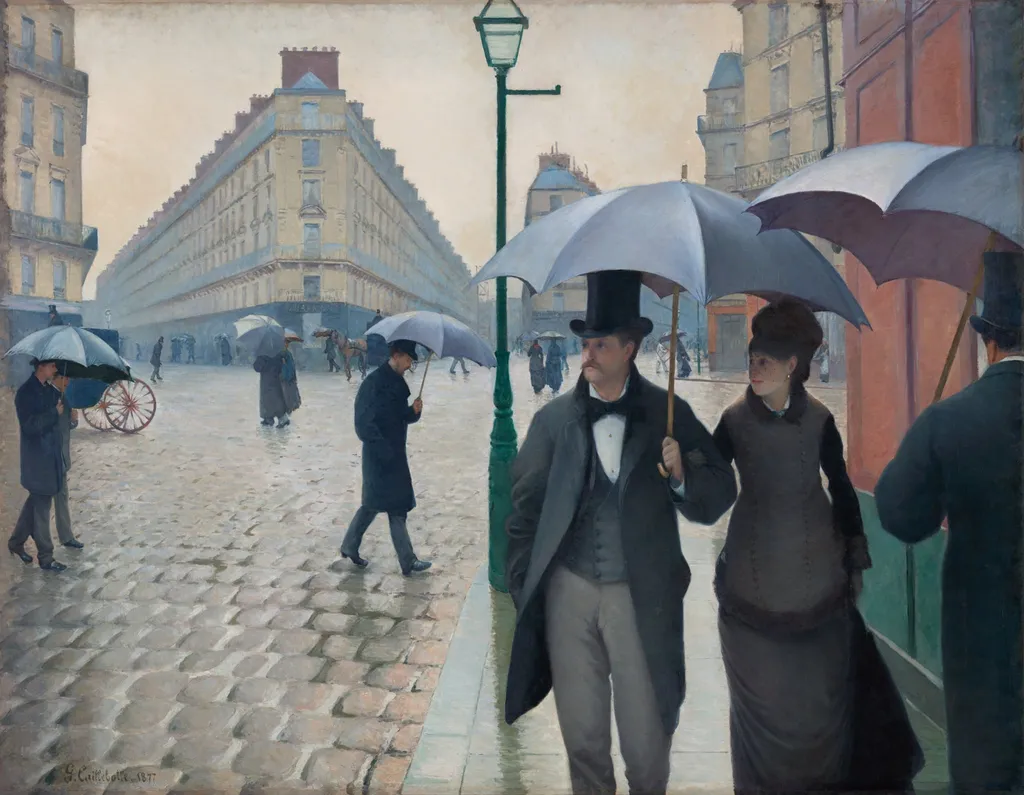
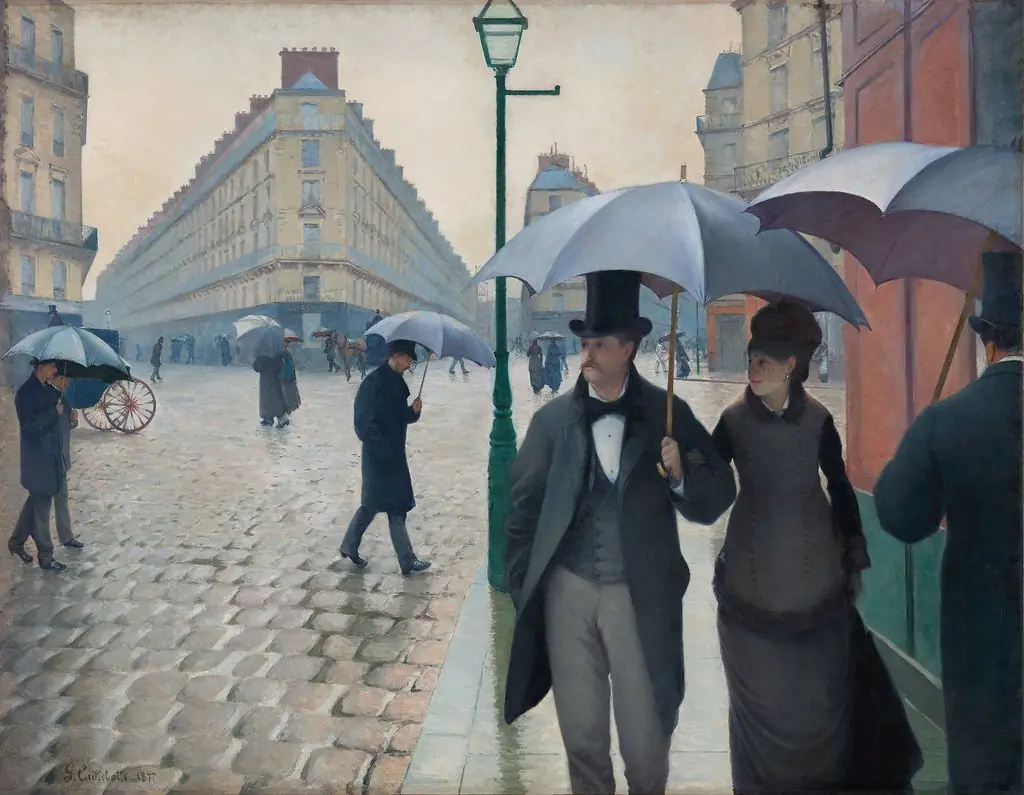
Paris Street; Rainy Day is an oil painting by the Impressionist artist Gustave Caillebotte. It dates from 1877 and is held in the collection of the Art Institute of Chicago.
About this work
Here’s your rewrite:
A rainy day in Paris, 1877. A man holds an umbrella near a lamppost. Couples and lone figures cross a wet street. Their reflections shimmer on the pavement.
Caillebotte painted this spot near his home. He used sharp angles to show depth. The umbrellas and hats feel real, like you could touch them.
See it in person at the Art Institute of Chicago.
Overview
Though associated with the Impressionists, Caillebotte’s approach leans toward realism, emphasizing structure and spatial clarity over atmospheric brushwork.
Painted in 1877, Paris Street; Rainy Day is Gustave Caillebotte’s largest canvas and one of his most meticulously composed urban scenes. It depicts a bustling intersection near his residence in the eighth arrondissement, rendered with precise perspective and a restrained palette. Though associated with the Impressionists, Caillebotte’s approach leans toward realism, emphasizing structure and spatial clarity over atmospheric brushwork.
Subject & Meaning
The painting captures ordinary Parisians navigating a rainy afternoon—figures pause, walk, or stand under umbrellas, their movements frozen mid-stride. No single narrative dominates; instead, the scene conveys the rhythm of modern city life. The cropped composition and figures advancing toward the viewer suggest an unmediated glimpse into daily routine, as if the viewer has stepped onto the street themselves.
Technique & Style
Caillebotte employed sharp linear perspective and carefully aligned architectural elements to create depth, with the street receding toward a vanishing point behind a lamppost. Figures are rendered with anatomical precision, their clothing and posture studied rather than loosely suggested. Reflections on the wet cobblestones are subtly modeled, not painted with literal droplets, conveying moisture through tone and surface contrast.
History & Provenance
Completed in 1877, the painting was exhibited with the Impressionists in 1877 and 1879 but remained largely overlooked until the Art Institute of Chicago acquired it in 1964. Caillebotte’s estate had preserved it, and its acquisition helped shift scholarly attention toward his role in the movement. It has since become one of the museum’s most frequently viewed works.
Context
In the 1870s, Paris was undergoing radical transformation under Haussmann’s renovations, and Caillebotte’s neighborhood reflected this new urban order. His focus on middle-class pedestrians, umbrellas, and cobblestone streets aligned with contemporary interests in modernity. Photography’s influence is evident in the off-center framing and cropped figures, breaking from traditional compositional norms.
Legacy
Paris Street; Rainy Day redefined how urban life could be portrayed in painting—neither idealized nor sentimentalized, but observed with quiet precision. Its combination of photographic framing and realist detail influenced later generations of artists exploring movement and space. The work remains a touchstone for studies of 19th-century urban experience and the evolving boundaries of Impressionism.
Own this work as a print
Artist & collection
Artist
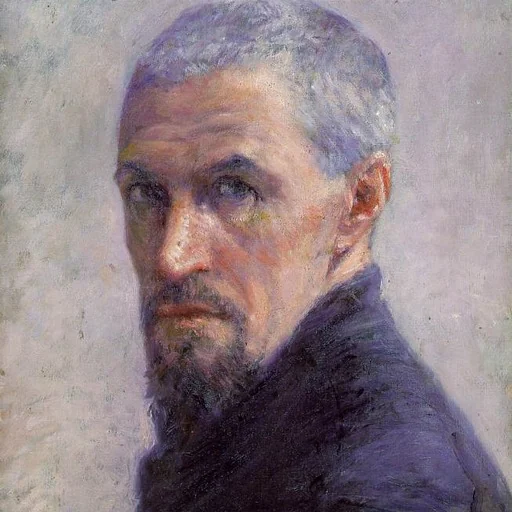
Gustave Caillebotte (French: ; 19 August 1848 – 21 February 1894) was a French painter who was a member and patron of the Impressionists, although he painted in a more realistic manner than many others in the group.