Artwork
Designs for Necklaces, Pendants and Earrings of the Highest Skill
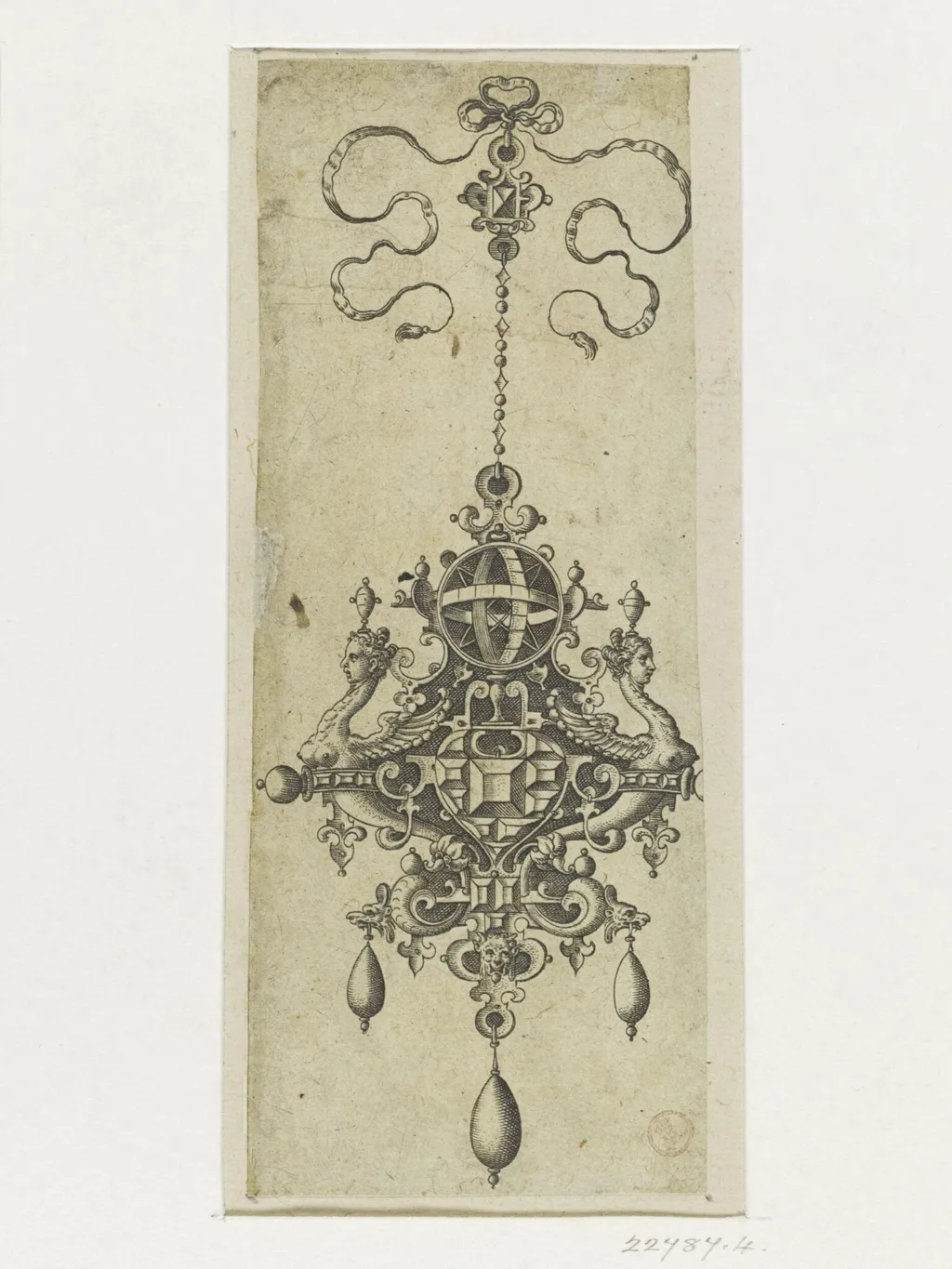
Designs for Necklaces, Pendants and Earrings of the Highest Skill is a print by the Renaissance artist Hans Collaert. It is held in the collection of the Victoria and Albert Museum.
About this work
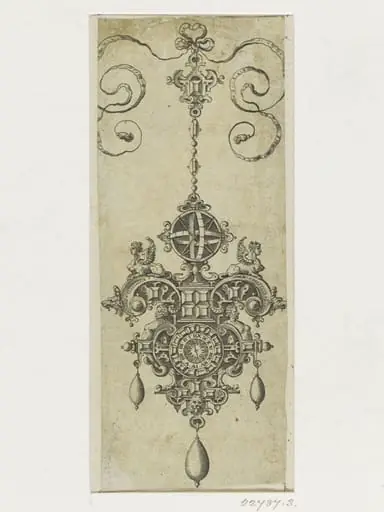
This is a set of ten engravings by Hans Collaert from 1581. Each page shows a different necklace design with delicate patterns and three pearls. Two pages even feature a sundial and a clock.
Collaert died in 1580. His sons and a publisher turned his jewelry sketches into these prints the next year.
Check out the Victoria and Albert Museum where this set is kept.
Overview
Ten engravings published in 1581 present jewelry designs originally conceived by Hans Collaert before his death in 1580.
Ten engravings published in 1581 present jewelry designs originally conceived by Hans Collaert before his death in 1580. Produced by his sons and publisher Philips Galle, the set includes a title page and nine additional plates, each illustrating ornate necklaces, pendants, and earrings. The prints preserve Collaert’s intricate draftsmanship, translating his sketches into detailed reproductive prints for wider circulation among artisans and patrons.
Subject & Meaning
Each pendant design features a mythological figure, often suspended beneath elaborate strapwork and a ribbon motif, with three pearls dangling below. These figures—drawn from classical mythology—evoke themes of beauty, power, and divine favor, aligning jewelry with humanist ideals of the late Renaissance. The final two plates diverge, depicting a sundial and a clock, suggesting a thematic shift toward time, mortality, or the precision of craftsmanship.
Technique & Style
The engravings employ fine, controlled lines to render delicate strapwork against dark, textured backgrounds, enhancing contrast and depth. The precision of the etching captures the fluidity of ribbons and the subtle sheen of pearls, reflecting the technical mastery of 16th-century printmaking. The compositions are symmetrical and densely detailed, emphasizing ornamentation without clutter, characteristic of Northern Mannerist aesthetics.
History & Provenance
Following Hans Collaert’s death in 1580, his sons and Philips Galle, a prominent Antwerp publisher, compiled and printed his unpublished jewelry designs in 1581. The set was likely intended as a pattern book for goldsmiths and jewelers. The only known complete set resides in the Victoria and Albert Museum, where it has been preserved as a key example of Renaissance design documentation and print culture.
Context
In late 16th-century Antwerp, engraved pattern books served as vital tools for artisans, disseminating fashionable designs across Europe. Collaert’s work emerged amid a flourishing market for luxury goods and a growing demand for illustrated manuals. His designs reflect the period’s fascination with classical mythology and the integration of scientific instruments—like clocks and sundials—into decorative arts, blending art, science, and symbolism.
Legacy
Collaert’s engravings influenced subsequent generations of goldsmiths and designers by standardizing visual motifs in jewelry. The set remains a rare surviving example of a specialized print genre that bridged fine art and craft. Its preservation in the Victoria and Albert Museum underscores its value as a historical record of Renaissance material culture and the transmission of design knowledge through print.
Artist & collection
Artist
Jan Collaert the Elder or (I), Hans Collaert the Elder or Johannes Collaert (Brussels, between 1525 and 1530 – Antwerp, October 1580) was a Flemish printmaker, publisher, draftsman, tapestry designer, glass painter and designer and…

 Strapwork Pendant with Two Square Tablestonesas Earrings at Left and Right
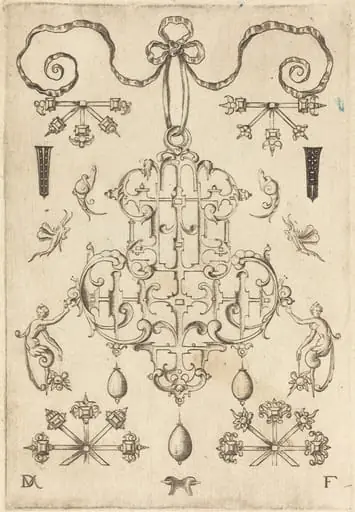 Large Pendant with Three Drops Below
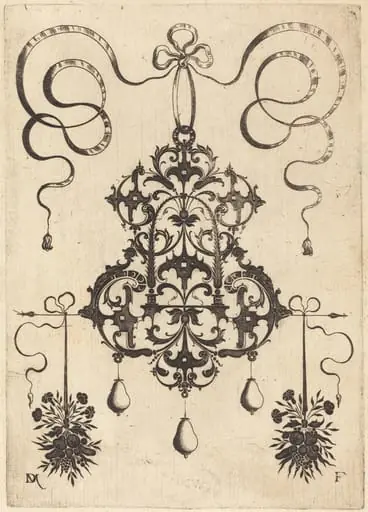 Large Pendant, Lower Left and Right Two Bunches of Grass, Flowers, and Fruit
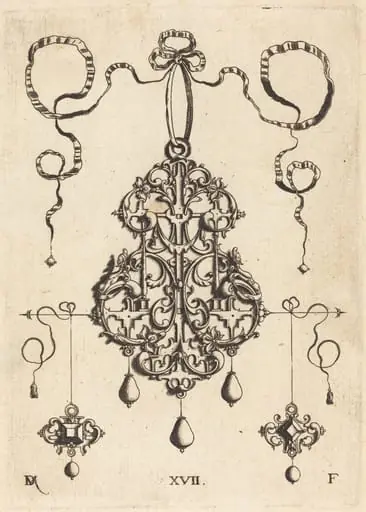
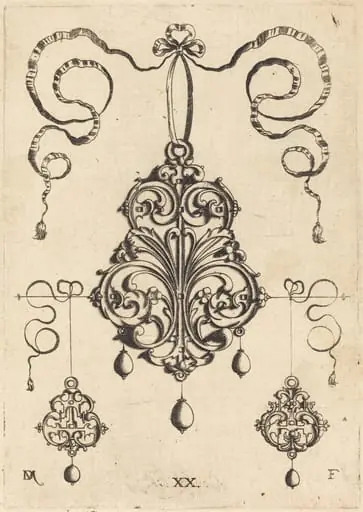 One Large and Two Smaller Strapwork Pendants
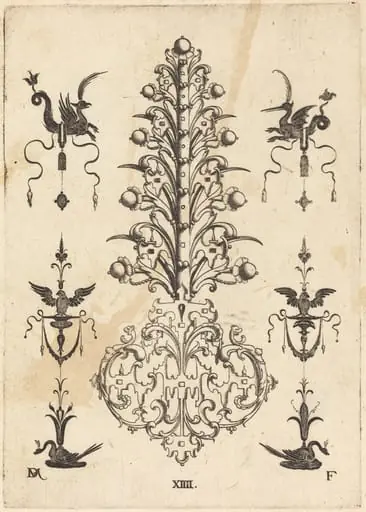 Hyacinth-Shaped Brooch with Winged Animals at Top and Crouching Swans at Bottom
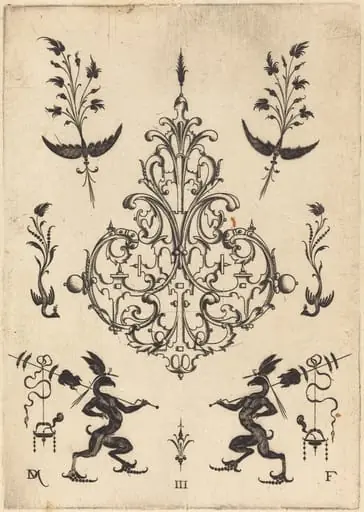 Brooch with Sprigs at Top and Griffins with Trophies at Bottom
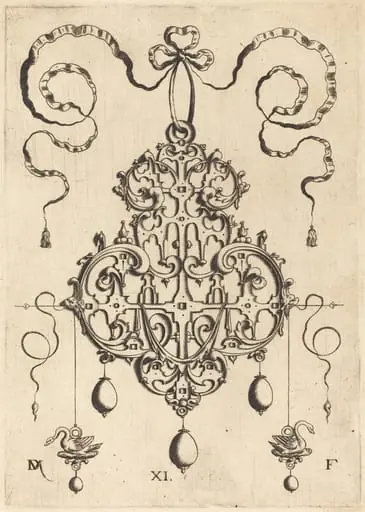 Strapwork Pendant with Two Swans as Earrings at Left and Right
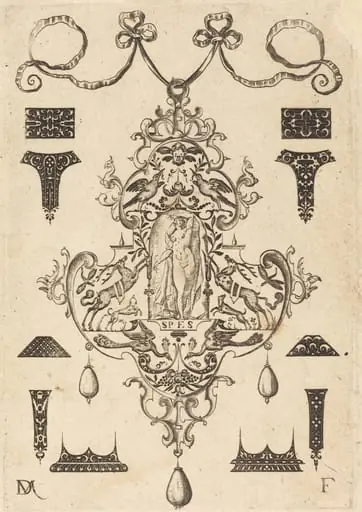 Large Pendant, Hope Standing at Centre
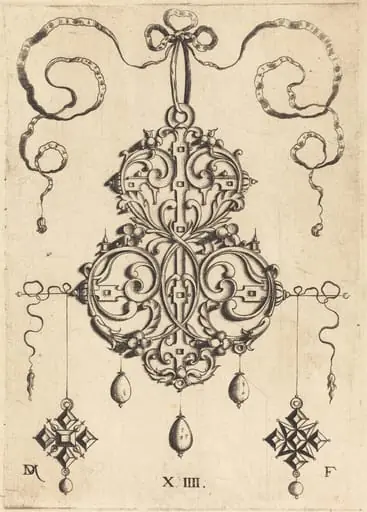 Strapwork Pendant with Three Drops and Two Cross-Shaped Pendants as Earrings at Left and Right
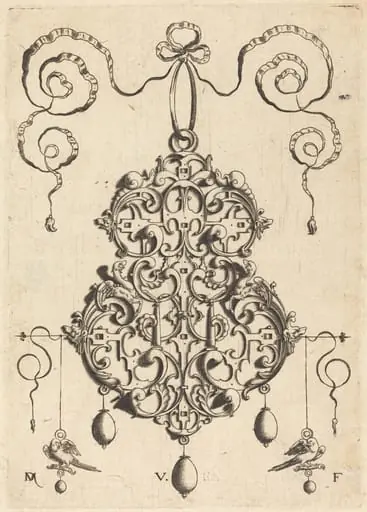 Strapwork Pendant with Two Birds as Earrings at Left and Right