Artwork
The Dance of Death: The Preacher; The Priest
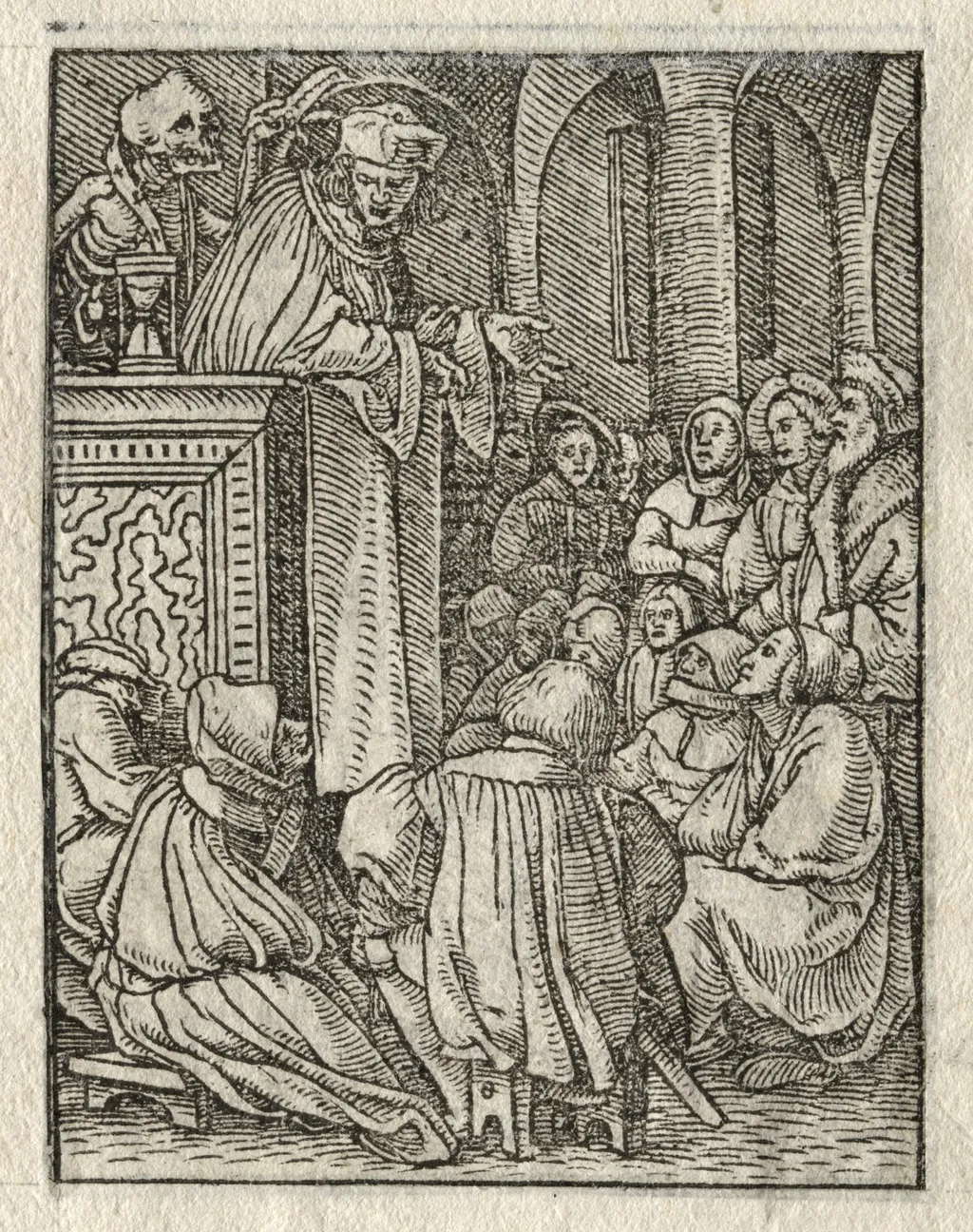
The Dance of Death: The Preacher; The Priest is a print by the Renaissance artist Hans Holbein the Younger. It dates from 1526 and is held in the collection of the Cleveland Museum of Art.
About this work
Check out another Death scene by the same artist, Hans Holbein the Younger (German, active England and Switzerland, 1497/98–1543).
A skeleton stands behind a preacher in black robes. The preacher reads from an open book while the skeleton grips his shoulder. Death’s grin shows no malice—just a quiet nudge.
This is one of Holbein’s Dance of Death woodcuts turned into paint. The skeleton isn’t scary. It’s just there, like an uninvited guest who won’t leave. The preacher keeps reading anyway.
Check out another Death scene by the same artist, Hans Holbein the Younger (German, active England and Switzerland, 1497/98–1543).
Overview
Created around 1526, this woodcut is part of Hans Holbein the Younger’s series on the Dance of Death, a medieval allegory reimagined in the early Reformation era. Holbein, active across Germany, Switzerland, and England, used the medium of print to reach a broad audience. The image pairs a religious figure with a skeletal figure, not as a horror, but as an inevitable companion—calm, unthreatening, and inescapable.
Subject & Meaning
The scene shows a preacher, absorbed in his text, unaware or indifferent to the skeleton gripping his shoulder. The skeleton’s expression is neutral, not menacing—its presence is not punishment but reminder. The image critiques the pretensions of clerical authority, suggesting that spiritual authority offers no immunity from mortality. Death does not discriminate; it interrupts even the most solemn rituals.
Technique & Style
Holbein employed precise woodcut engraving, characteristic of Northern Renaissance printmaking, to render fine lines and clear contrasts. Figures are rendered with restrained detail, emphasizing form over ornament. The composition is tightly framed, focusing attention on the interaction between the living and the dead. The skeleton’s posture is natural, its gesture unforced, reinforcing the quiet inevitability of the moment.
History & Provenance
The woodcut was produced during a time of religious transformation in Europe, when the authority of the Church was being questioned. Holbein’s series circulated widely through printed books, contributing to public discourse on mortality and institutional hypocrisy. The image was later reproduced in painted forms, extending its reach beyond the printed page and into private collections across Protestant and Catholic regions.
Context
The Dance of Death motif had roots in medieval plague-era art, but Holbein’s version reflected the anxieties of the Reformation. As religious institutions faced scrutiny, the image of death confronting clergy served as both moral lesson and social critique. The work aligns with broader humanist trends that emphasized human vulnerability, stripping away the illusion of earthly power against the certainty of death.
Legacy
Holbein’s series influenced later artistic treatments of mortality, particularly in Northern Europe. Its understated tone—death as an ordinary, persistent presence—set it apart from more dramatic depictions. The image endures as a quiet testament to the universality of death, its power lying not in terror but in its unyielding, unremarkable presence in the midst of daily life.
Artist & collection
Artist
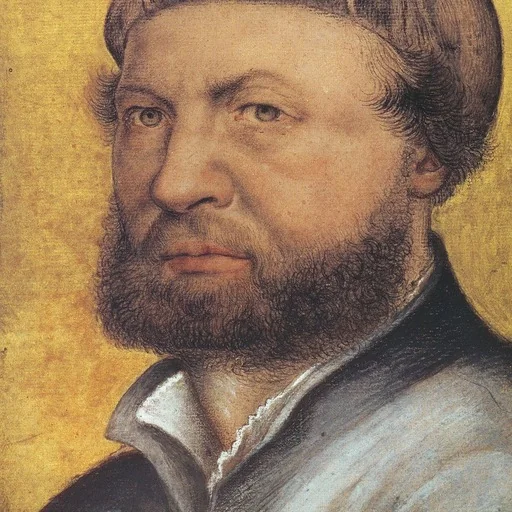
Hans Holbein the Younger (UK: HOL-byne, US: HOHL-byne, HAWL-; German: Hans Holbein der Jüngere; c.