Artwork
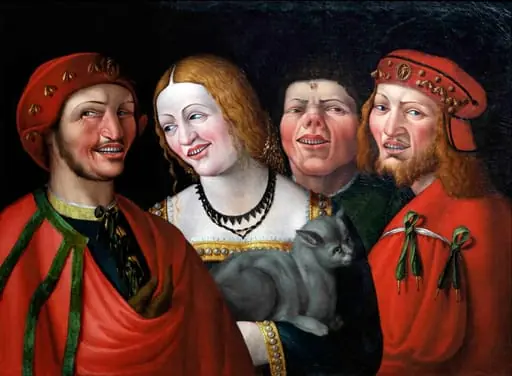
A Jeering Crowd: fragment of a Mocking of Christ
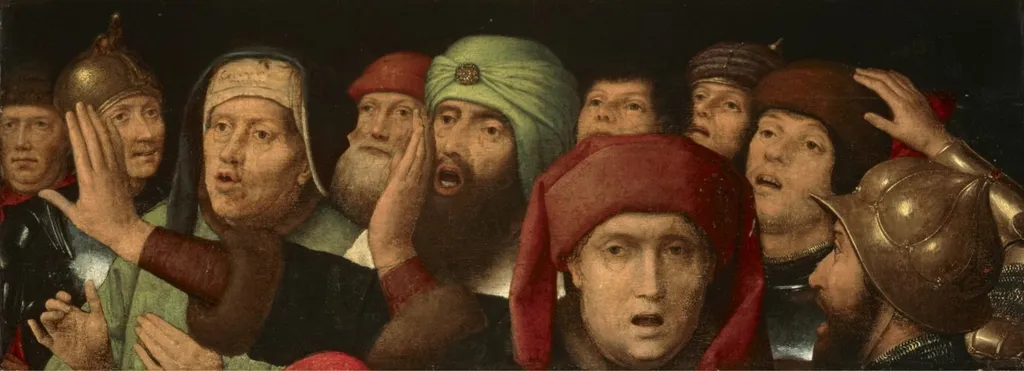
A Jeering Crowd: fragment of a Mocking of Christ is an oil painting by the Northern Renaissance artist Hans Memling. It dates from 1450 and is held in the collection of the National Galleries Scotland.
About this work
Overview
This fragment of a larger religious panel, dated around 1450, is attributed to Hans Memling, a leading painter of the Northern Renaissance.
This fragment of a larger religious panel, dated around 1450, is attributed to Hans Memling, a leading painter of the Northern Renaissance. Executed in oil on wood, it depicts a portion of the Mocking of Christ, a scene from the Passion narrative. The work is currently held in the collection of the Scottish National Gallery, where it survives as a detached section of what was once part of a multi-panel altarpiece.
Subject & Meaning
The scene captures a moment of humiliation as Christ is mocked by a diverse group of onlookers. Figures in varied attire—turbans, armor, simple tunics—suggest a mix of ethnicities and social ranks, emphasizing the universality of the act of derision. The central figure raising a hand to his face may indicate mockery or disbelief, reinforcing the emotional tension of the moment within a theological context of suffering and scorn.
Technique & Style
Memling employs oil paint with precise brushwork to render textures of fabric, metal, and skin. The dark, unmodeled background isolates the figures, heightening their psychological presence. Chiaroscuro is used subtly to model forms and create spatial depth, while the varied facial expressions convey individualized emotion. The attention to detail in costume and gesture reflects the Northern Renaissance emphasis on realism and observational fidelity.
History & Provenance
The panel was likely part of a larger devotional altarpiece, possibly commissioned for a private chapel or religious institution in Bruges. Over time, the original structure was dismantled, and this fragment was separated from its companions. It entered the Scottish National Gallery’s collection in the 19th century, having passed through private European collections before its acquisition.
Context
In mid-15th-century Flanders, religious imagery was central to both public worship and private devotion. Scenes from Christ’s Passion were commonly depicted in multi-panel works designed for contemplation. Memling’s treatment of the Mocking aligns with regional trends that favored intimate, emotionally charged compositions, often rendered with meticulous detail to invite personal reflection.
Legacy
Though only a fragment, this work exemplifies Memling’s skill in conveying human emotion through restrained gesture and nuanced expression. It contributes to the understanding of how Northern Renaissance artists adapted biblical narratives into psychologically rich, visually compelling scenes. Its survival offers insight into the fragmentation and dispersal of early altarpieces across centuries.
Artist & collection
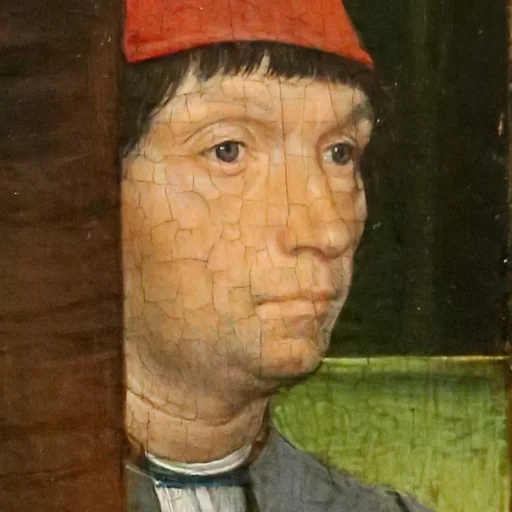
Artist
Hans Memling was a German-Flemish painter who worked in the tradition of Early Netherlandish painting.

![Saint Veronica [obverse], by Hans Memling](https://artifactworldgallery.com/img/hans-memling--saint-veronica-obverse--5a649fd8b09c96b9-w320.webp)