Artwork
Two Genii
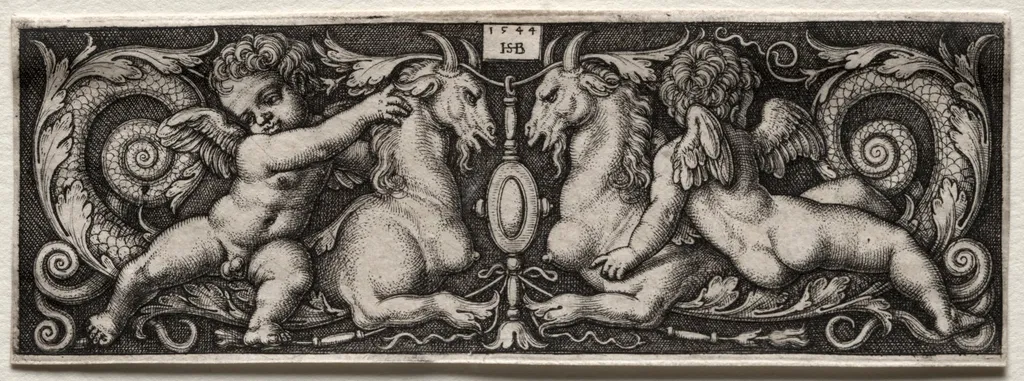
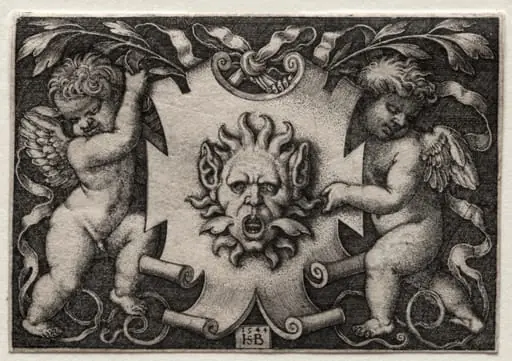
Two Genii is a print by the Renaissance artist Sebald Beham. It dates from 1544 and is held in the collection of the Cleveland Museum of Art.
About this work
Overview
A central figure among the Little Masters, he specialized in small-scale, highly detailed prints that extended the legacy of Albrecht Dürer.
Hans Sebald Beham, a German artist active in the mid-16th century, produced *Two Genii* in 1544 as a copper engraving. A central figure among the Little Masters, he specialized in small-scale, highly detailed prints that extended the legacy of Albrecht Dürer. After early work in Nuremberg, Beham settled in Frankfurt, where he continued refining his intricate technique. This print exemplifies his mastery of fine line and compressed composition within a compact format.
Subject & Meaning
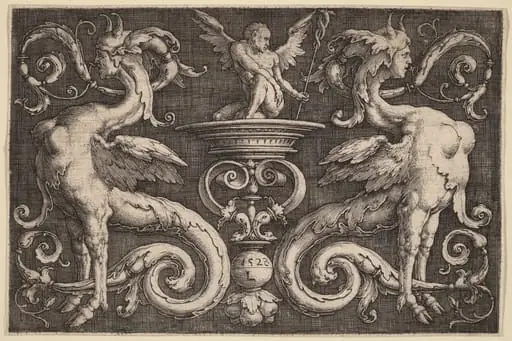
The print portrays two winged, muscular figures kneeling beside ram-headed beings, jointly supporting a circular object—possibly a mirror or shield. Their exaggerated musculature and dynamic posture reflect Renaissance ideals of the heroic form. The ram heads suggest a connection to ancient symbolism, perhaps linked to fertility or divinity, though no definitive interpretation exists. The figures may represent mythological spirits or allegorical entities, their purpose left intentionally ambiguous.
Technique & Style
Beham employed fine, precise engraving lines to render every texture and contour with exceptional clarity. The figures are defined by sharp, rhythmic contours, while the background swells with dense, lace-like patterns resembling vines or swirling filigree. This ornamental density contrasts with the sculptural clarity of the central forms, demonstrating his ability to balance detail with compositional focus. His technique prioritizes precision over atmospheric depth, characteristic of the Little Masters’ approach.
History & Provenance
Created during Beham’s time in Frankfurt, *Two Genii* belongs to a series of small engravings he produced after leaving Nuremberg. While the print’s early ownership is undocumented, it entered institutional collections in the 19th century, where it was recognized for its technical refinement. No major alterations or restrikes are recorded, and surviving impressions remain rare, reflecting its limited original print run and the fragility of early copper plates.
Context
In mid-16th-century Germany, printmaking flourished as a medium for disseminating artistic ideas beyond painting. Beham’s work responded to a market for small, collectible images that appealed to educated elites. His engravings drew from classical mythology, Mannerist aesthetics, and Northern European decorative traditions. *Two Genii* reflects this hybrid culture, merging Italianate figure studies with intricate Northern ornamentation in a format suited to private contemplation.
Legacy
Beham’s engravings, including *Two Genii*, influenced later generations of printmakers through their technical rigor and compact narrative density. Though overshadowed by larger Renaissance painters, his work preserved the tradition of fine-line engraving during a period of stylistic transition. Today, his prints are studied for their craftsmanship and as artifacts of how mythological themes were adapted in Protestant Germany, where religious imagery was shifting in form and function.
Artist & collection
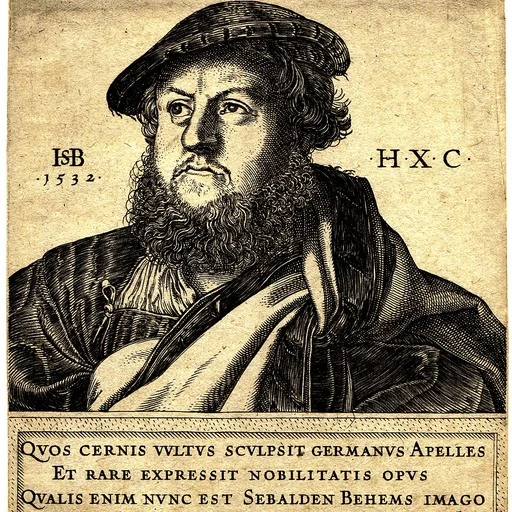
Artist
Sebald Beham (1500–1550) was a German painter and printmaker, mainly known for his very small engravings.