Artwork
De doop van Christus in de Jordaan, rechter paneel van een drieluik (open)
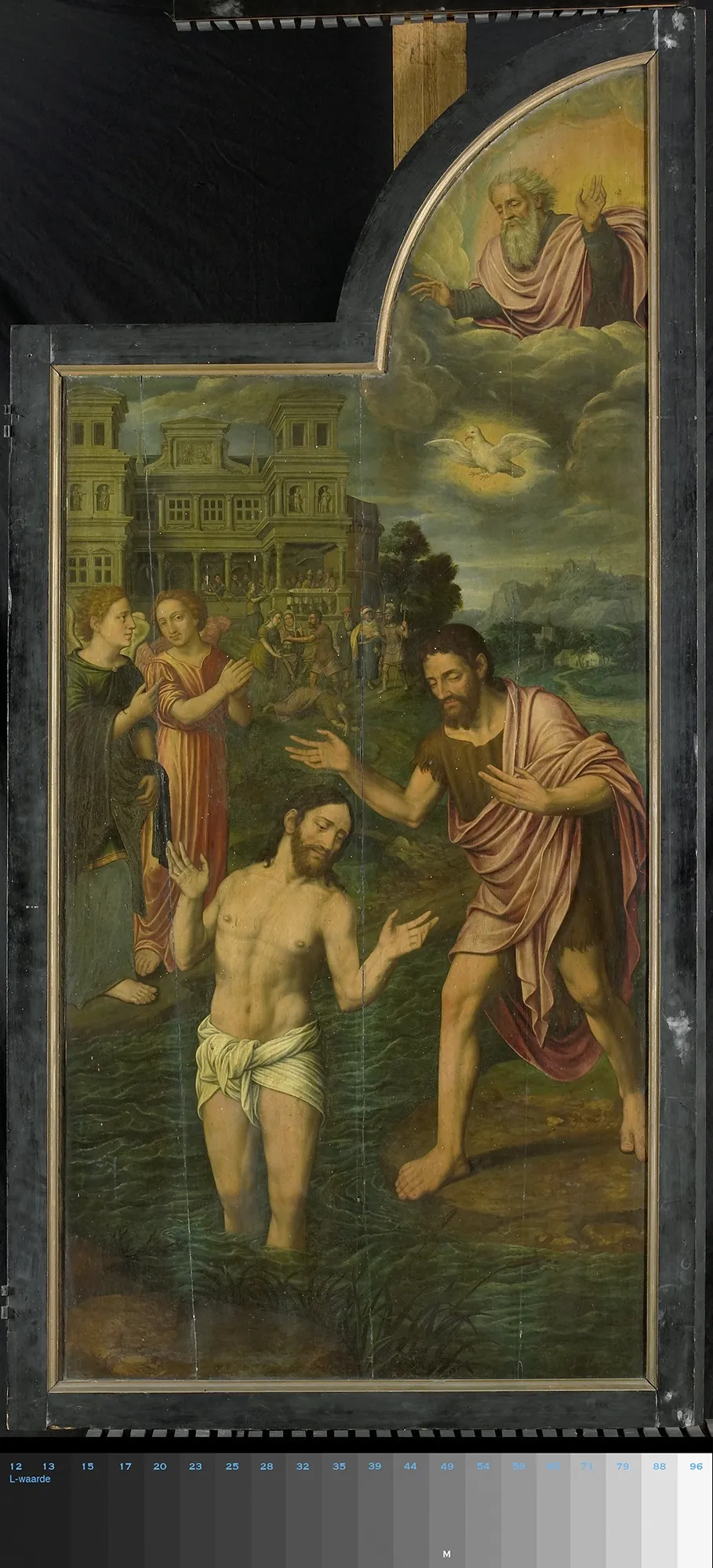
De doop van Christus in de Jordaan, rechter paneel van een drieluik (open) is an oil painting by the Northern Renaissance artist Hans van Coninxloo. It dates from 1557 and is held in the collection of the Rijksmuseum.
About this work
Overview
Hans van Coninxloo’s 1557 oil on panel forms the right wing of an open triptych now displayed in the Rijksmuseum. The work portrays the biblical moment of Christ’s baptism in the Jordan River, rendered with a careful attention to narrative detail and spatial arrangement.
Subject & Meaning
The composition centers on Jesus standing waist‑deep in the flowing water while John the Baptist extends his hand toward him, signalling the act of baptism. A dove descends from a clouded sky, symbolising the Holy Spirit, and a modest crowd of onlookers gathers on the riverbank, underscoring the public significance of the event.
Technique & Style
Van Coninxloo employs oil paint to achieve fine modeling of figures and architecture, using chiaroscuro to generate depth. Light appears to emanate from the upper left, illuminating the central figures and casting shadows that enhance the three‑dimensional illusion. The rendering of textures—from water ripples to stone façades—demonstrates a meticulous approach to naturalistic detail.
History & Provenance
Created in 1557, the panel was originally part of a larger three‑panel altarpiece. Over the centuries it entered various private collections before being acquired by the Rijksmuseum, where it remains on public view as part of the museum’s Flemish and Dutch painting holdings.
Context
The painting reflects the mid‑sixteenth‑century Northern Renaissance interest in biblical narrative combined with a realistic treatment of space and light. Van Coninxloo, known for his landscape and religious works, integrates architectural elements typical of contemporary Netherlandish art, situating the sacred scene within a recognizable, everyday setting.
Artist & collection