Artwork
Cassive
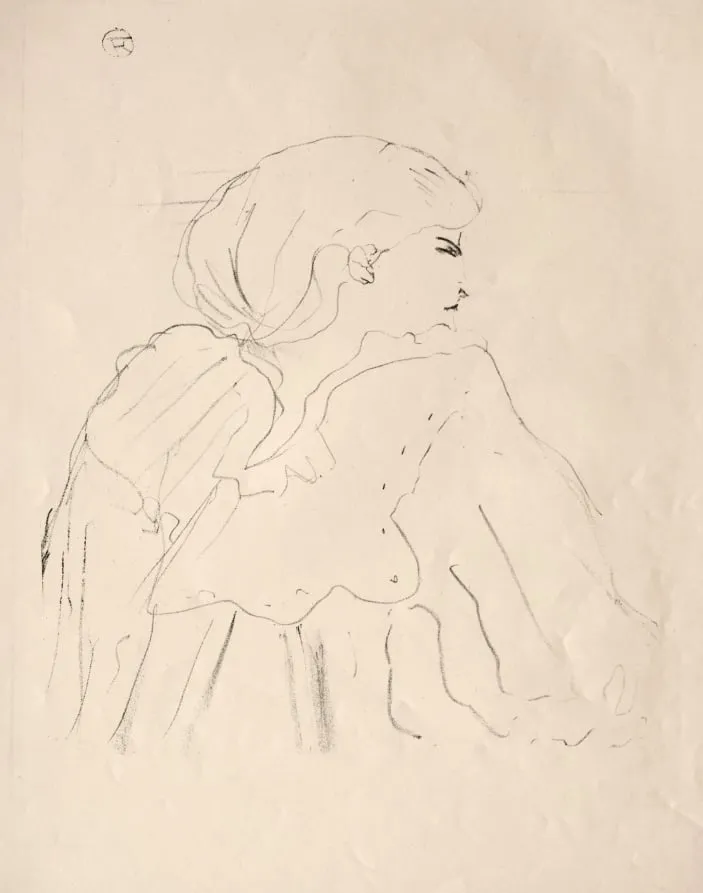
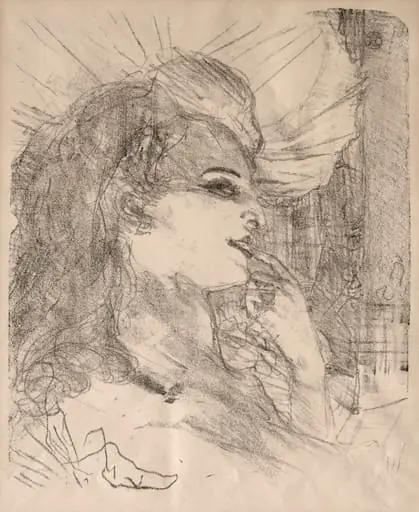
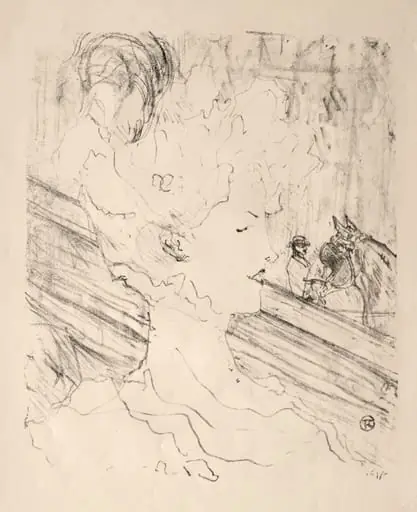
Cassive is a print by the Impressionist artist Henri de Toulouse-Lautrec. It dates from 1896 and is held in the collection of the Cleveland Museum of Art.
About this work
Overview
Though born into nobility, Lautrec gravitated toward spaces outside elite circles, using sketching as a means to observe and record everyday figures.
Created around 1896, this ink drawing by Henri de Toulouse-Lautrec captures a moment from Paris’s underground social world. Though born into nobility, Lautrec gravitated toward spaces outside elite circles, using sketching as a means to observe and record everyday figures. This work exemplifies his preference for immediacy over polish, reflecting his deep immersion in the lives of those often ignored by mainstream art.
Subject & Meaning
The figure is a woman seated sideways, her head turned toward the viewer with a quiet, unguarded presence. Her modest attire—a high-collared dress and headscarf—suggests working-class or marginalized status, possibly a sex worker or domestic laborer. The lack of ornamentation and the direct gaze convey dignity without sentimentality, aligning with Lautrec’s tendency to portray his subjects with unvarnished humanity rather than romanticized allure.
Technique & Style
Lautrec employed swift, uneven ink lines to define form, avoiding fine detail in favor of bold silhouettes and suggestive shadows. The loose, almost hesitant strokes convey a sense of spontaneity, as if drawn in real time. The minimal background isolates the figure, directing attention to her posture and expression. This approach echoes the immediacy of sketchbook studies, prioritizing observation over finished composition.
History & Provenance
This drawing belongs to a series of works Lautrec produced during his most active years in Montmartre, where he frequented cabarets and brothels. While the exact provenance of this piece is undocumented, it aligns with his habit of creating intimate studies of individuals he encountered. Many such drawings were later collected by patrons and institutions, preserving his unfiltered view of late-19th-century Parisian life.
Context
In the 1890s, Paris saw a flourishing of print culture and illustrated periodicals, which provided Lautrec with platforms to reach wider audiences. His work emerged alongside broader artistic shifts toward realism and the depiction of modern life. Unlike academic painters, he focused on transient moments and ordinary people, drawing from personal experience and a sense of alienation shaped by his physical condition and social detachment.
Legacy
Lautrec’s sketches like this one influenced later generations of artists who valued candid observation over idealized representation. His ability to capture psychological presence with minimal means helped bridge 19th-century realism and 20th-century modernism. Though less celebrated than his posters, these intimate drawings remain vital for understanding his empathetic gaze and his role in redefining the artistic portrayal of the urban underclass.
Artist & collection
Artist
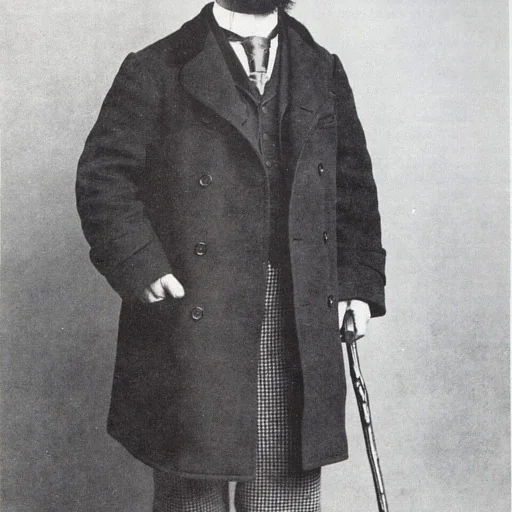
Comte Henri Marie Raymond de Toulouse-Lautrec-Montfa (24 November 1864 – 9 September 1901), known as Toulouse-Lautrec (French: ), was a French painter, printmaker, draughtsman, caricaturist, and illustrator.