Artwork
Jane Avril
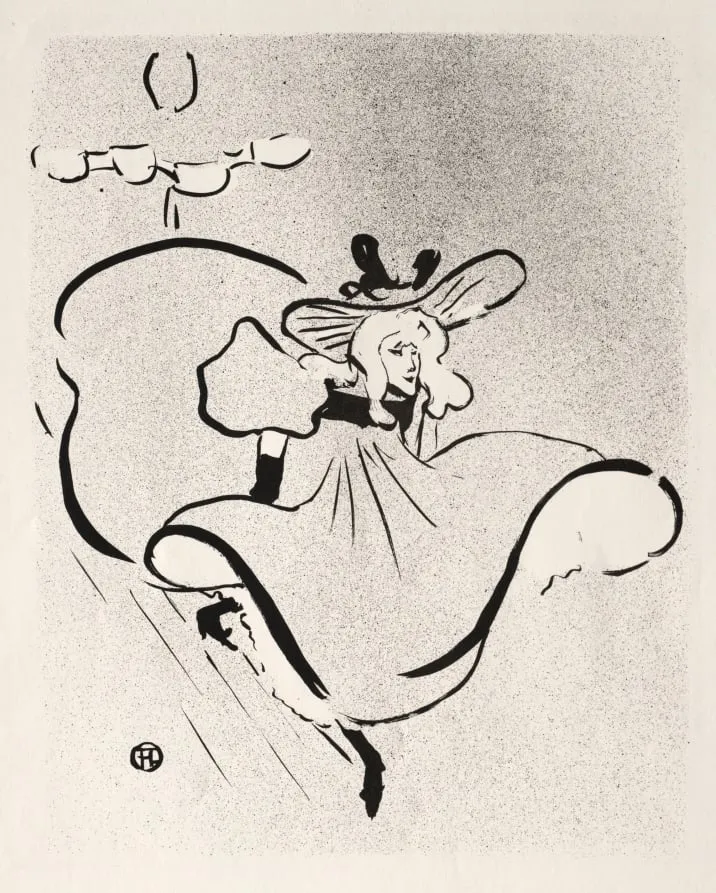
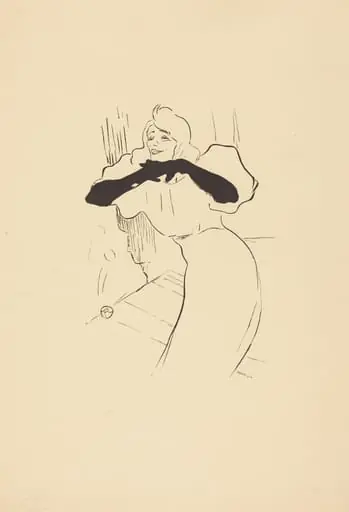
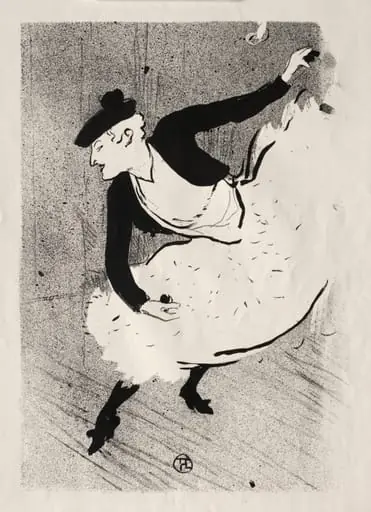
Jane Avril is a print by the Impressionist artist Henri de Toulouse-Lautrec. It dates from 1893 and is held in the collection of the Cleveland Museum of Art.
About this work
Next, check out Henri de Toulouse-Lautrec (French, 1864–1901) for more of his bold, expressive drawings.
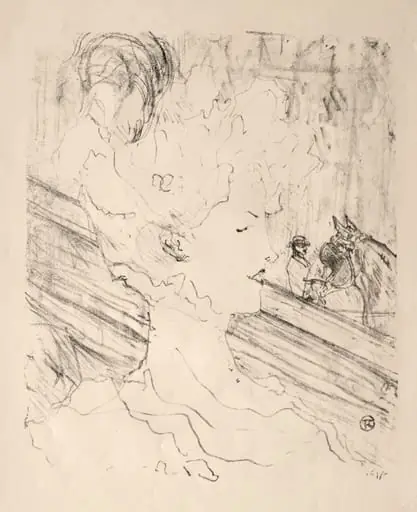
This drawing shows a woman with a big hat and flowing skirt, twirling in a circle. Her face is blurred, and her arms stretch out as she spins. The background is simple—just a few wavy lines and a cloud shape above.
The artist used loose, sketchy lines to show movement, almost like the figure is dancing. The hat is the most detailed part, with a feather sticking up.
Next, check out Henri de Toulouse-Lautrec (French, 1864–1901) for more of his bold, expressive drawings.
Overview
Created in 1893, this lithograph by Henri de Toulouse-Lautrec portrays Jane Avril, a celebrated dancer at Parisian cabarets. The work belongs to a series of prints capturing performers from Montmartre’s nightlife, a world Lautrec knew intimately. His distinctive style blends observational precision with expressive line work, transforming fleeting stage moments into enduring images of motion and personality.
Subject & Meaning
Jane Avril, known for her distinctive dancing style and eccentric stage presence, is depicted mid-motion, her body caught in a whirl of movement. The blurred face and elongated limbs suggest impermanence and energy rather than individual likeness. The emphasis on gesture over facial detail shifts focus from identity to the physicality of performance, reflecting Lautrec’s interest in the rhythm and solitude of entertainers.
Technique & Style
Lautrec employed lithography to achieve fluid, spontaneous lines that mimic the dancer’s motion. The background consists of minimal, wavy strokes and a single cloud-like form, isolating the figure and enhancing the sense of motion. The hat, rendered with sharp detail and a prominent feather, anchors the composition, contrasting with the loose, almost sketch-like rendering of the body and skirt.
History & Provenance
This print was produced during Lautrec’s most prolific period, when he collaborated with Parisian printers to create posters and lithographs for cabarets like the Moulin Rouge. It was likely distributed as a commercial print or promotional piece, circulating among patrons and collectors. Its survival in museum collections reflects its early recognition as a significant example of modern graphic art.
Context
In the 1890s, Parisian nightlife became a subject of serious artistic interest, as artists turned from traditional themes to contemporary urban life. Lautrec, marginalized by his physical condition, found kinship with performers on the fringes of society. His depictions of dancers, singers, and patrons offered unidealized glimpses into a world often dismissed by the cultural elite.
Legacy
Lautrec’s approach to lithography influenced the development of modern poster design and expressive printmaking. His ability to convey motion and psychological nuance through simplified forms paved the way for later artists in both graphic arts and modernist painting. Jane Avril remains a key example of how everyday performance could be elevated through careful observation and technical innovation.
Artist & collection
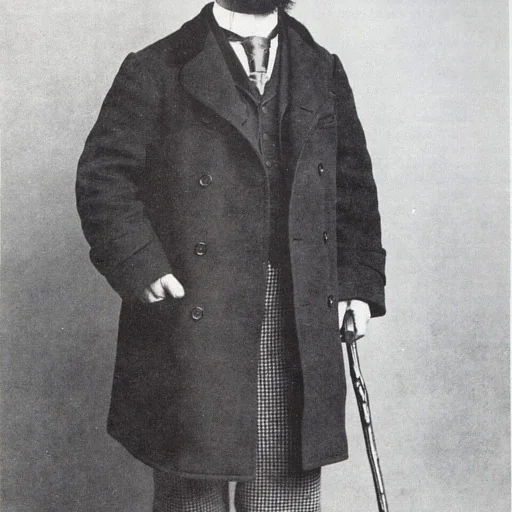
Artist
Comte Henri Marie Raymond de Toulouse-Lautrec-Montfa (24 November 1864 – 9 September 1901), known as Toulouse-Lautrec (French: ), was a French painter, printmaker, draughtsman, caricaturist, and illustrator.