Artwork
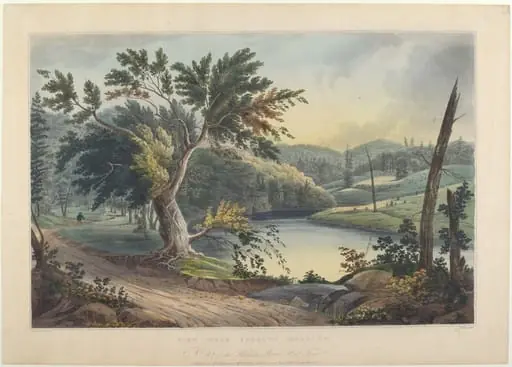
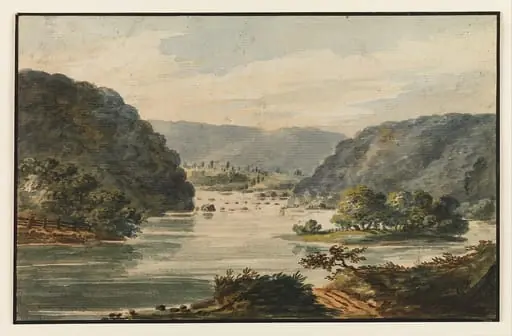
View from Fishkill Looking to West Point
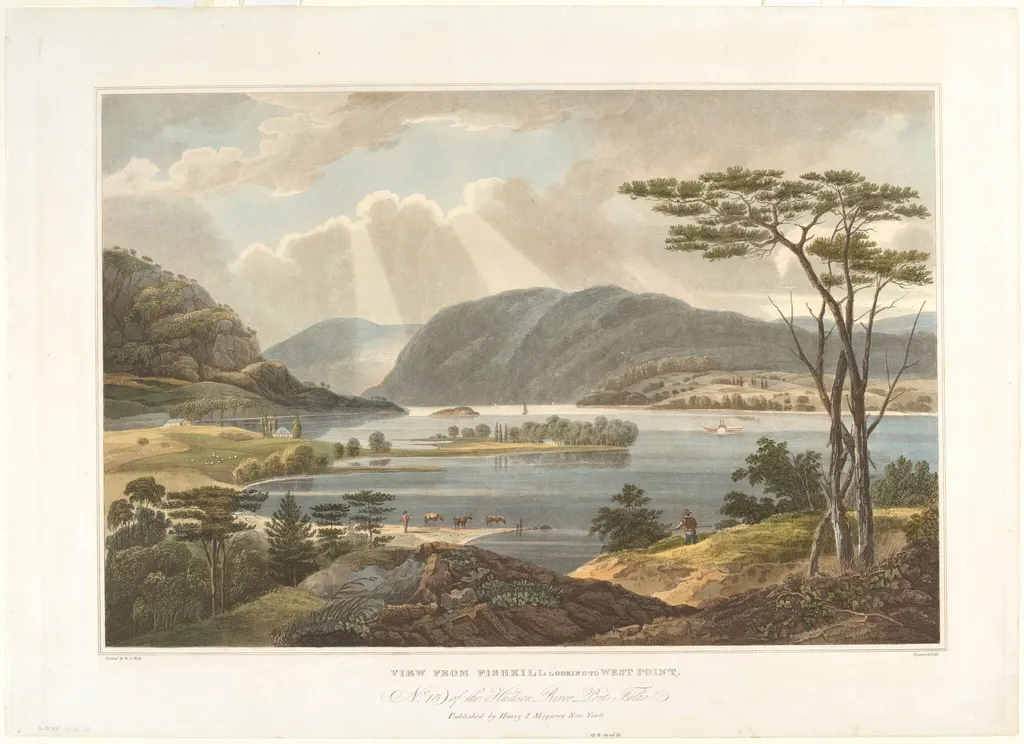
View from Fishkill Looking to West Point is an ink print by the Romanticist artist John Hill. It dates from 1825 and is held in the collection of the National Gallery of Art.
About this work
Overview
The image balances natural elements with human presence, offering a measured observation of the American landscape during the early 19th century.
Created in 1825 by John Hill, this hand-colored engraving and aquatint depicts a tranquil stretch of the Hudson River as seen from Fishkill, with West Point visible in the distance. Rendered on wove paper, the work combines precise line work with subtle tonal gradations to capture the quiet atmosphere of the riverscape. The image balances natural elements with human presence, offering a measured observation of the American landscape during the early 19th century.
Subject & Meaning
The scene portrays a serene riverside moment: two figures and a horse gather near a rocky shore, while small boats drift along the water. The distant buildings on the far bank suggest settled life, and the lone tree anchors the composition. The view from Fishkill toward West Point reflects a period of growing interest in the Hudson River Valley as both a strategic and scenic corridor, subtly acknowledging its dual role in commerce and national identity.
Technique & Style
Hill employed engraving and aquatint to achieve fine detail and atmospheric depth. The engraving defined sharp contours, while aquatint provided soft, graduated tones for the sky and water. Hand-coloring added naturalistic hues to the foliage, clouds, and river, enhancing realism without overwhelming the linear structure. The result is a restrained, observational style that prioritizes clarity and spatial harmony over dramatic effect.
History & Provenance
Produced in 1825, the print was likely part of a series documenting key locations along the Hudson River. It circulated among collectors and travelers interested in American topography during a time of expanding infrastructure and tourism. No definitive record of its early ownership exists, but its preservation in institutional collections suggests early recognition of its documentary value within American print culture.
Context
In the 1820s, the Hudson River Valley was becoming a focal point for artistic and scientific interest, as railroads and canals transformed regional connectivity. Topographical prints like this one served both as records of place and as tools for promoting travel and settlement. Hill’s work aligns with a broader movement to visually map and legitimize the American landscape through precise, accessible imagery.
Legacy
Though not widely known today, Hill’s print contributes to a significant body of early American landscape documentation. Its technical precision and calm composition reflect the era’s preference for orderly, factual representation over romanticized grandeur. As a surviving example of hand-colored printmaking, it offers insight into the methods and aesthetics of pre-photographic visual culture in the United States.
Own this work as a print
Artist & collection