Artwork
Abraham Rees
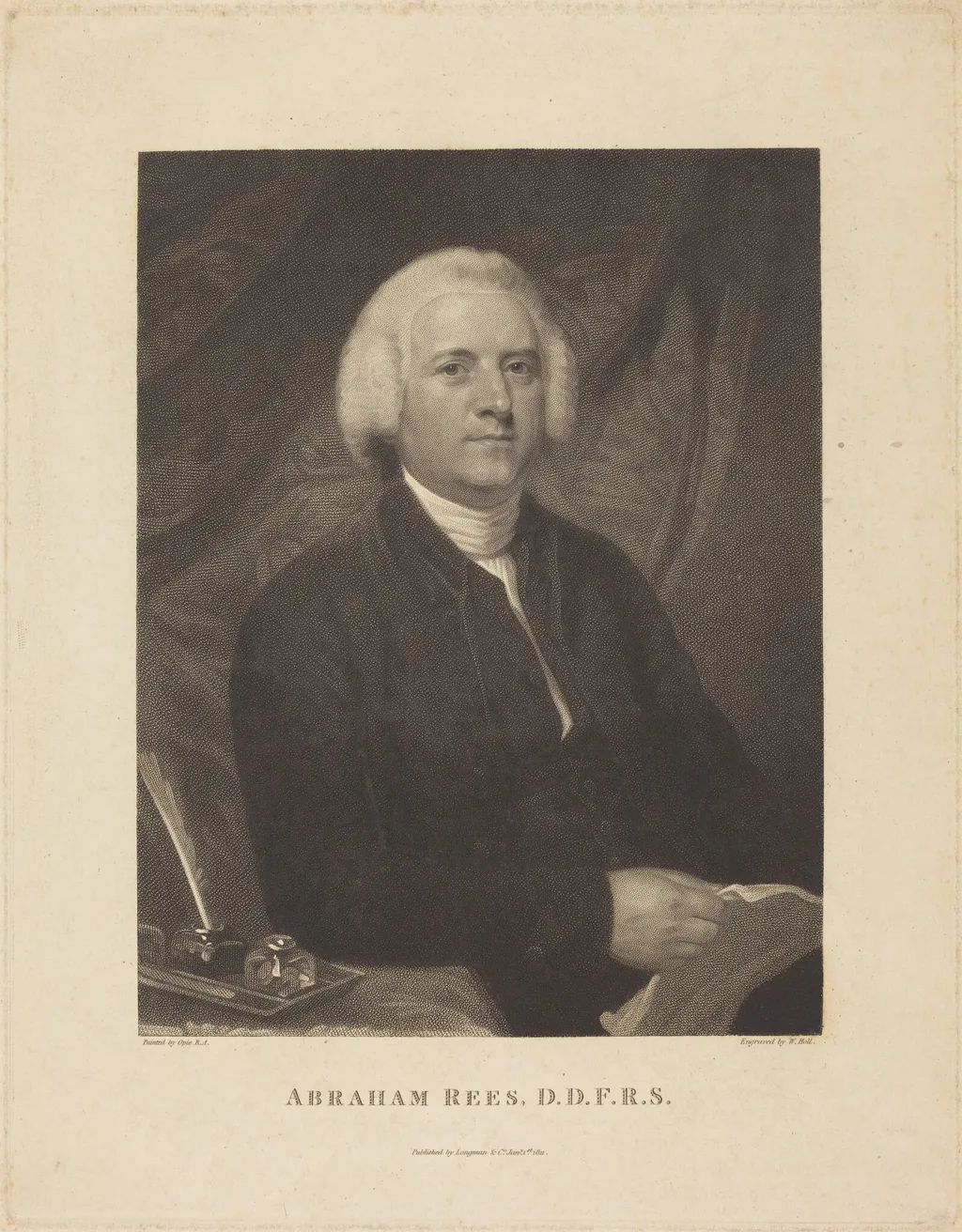
Abraham Rees is an ink print by the Romanticist artist William Holl I. It dates from 1811 and is held in the collection of the National Gallery of Art.
About this work
Overview
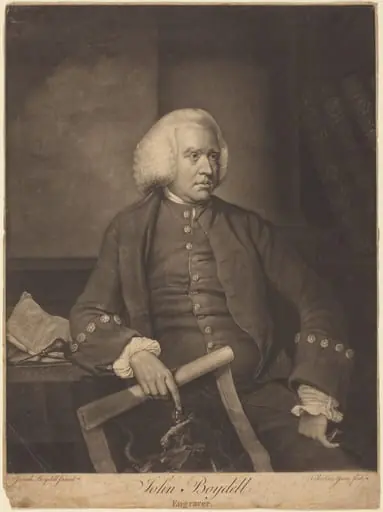
William Holl I produced a stipple engraving of Abraham Rees in 1811. The portrait presents the scholar in formal attire, with a dark coat, white cravat, and powdered hair pulled back. He is seated at a small table, his right hand holding a quill pen beside an inkwell, suggesting his intellectual pursuits.
Subject & Meaning
The figure depicted is Abraham Rees, identified by the inscription "Abraham Rees, D.D.F.R.S." indicating his status as a Doctor of Divinity and Fellow of the Royal Society. The inclusion of writing implements underscores his role as a learned author and compiler, emphasizing the connection between his scholarly output and his personal identity.
Technique & Style
The image is executed in stipple engraving, a process that creates tonal variation by incising countless fine dots and lines into a metal plate. This method yields a smooth, gradated surface that reproduces the subtle shading of the subject’s face and clothing, characteristic of early‑19th‑century portrait prints.
History & Provenance
Created in 1811, the print reflects the period’s demand for portraiture of eminent figures. William Holl I, a noted British engraver, often reproduced likenesses of intellectuals for publication. The work likely circulated among scholarly circles and may have been included in biographical collections or commemorative volumes of the era.
Context
Abraham Rees (1743–1825) was a Welsh theologian and encyclopedist best known for compiling "Rees's Cyclopaedia," a comprehensive reference work of the time. The portrait aligns with the early 19th‑century practice of commemorating contributors to knowledge through printed likenesses, reinforcing their public reputation.
Artist & collection