Artwork
At the Universal Exhibition: The perfect guide
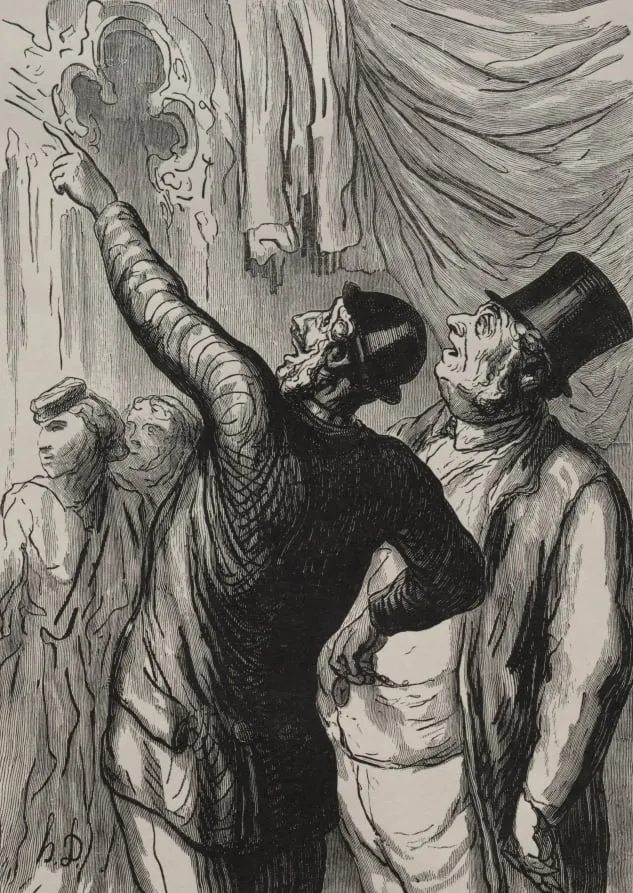
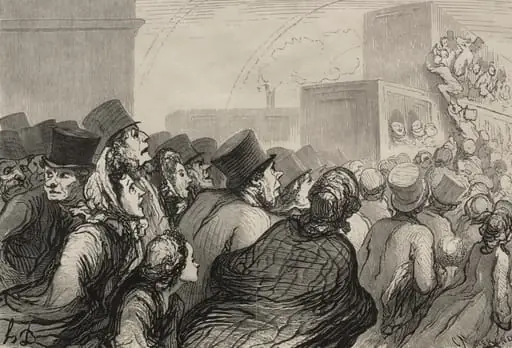
At the Universal Exhibition: The perfect guide is a print by the Impressionist artist Honoré Daumier. It dates from 1867 and is held in the collection of the Cleveland Museum of Art.
About this work
Overview
The piece resides in The Cleveland Museum of Art, part of a broader body of work documenting urban life in mid-19th-century France.
Created in 1867, this ink sketch by Honoré Daumier captures a moment at the Universal Exhibition in Paris. Rendered in rapid, expressive lines, the work conveys the energy and disarray of a public gathering. Its unfinished appearance suggests spontaneity, as if drawn on the spot. The piece resides in The Cleveland Museum of Art, part of a broader body of work documenting urban life in mid-19th-century France.
Subject & Meaning
The scene depicts a dense crowd at a public exhibition, with one central figure pointing upward, drawing the attention of those around him. Others gesture emphatically, their postures suggesting confusion, excitement, or disagreement. Daumier portrays the chaos of mass public experience, subtly critiquing the spectacle and disorientation inherent in large-scale exhibitions of the era.
Technique & Style
Daumier employed swift, bold ink strokes to convey motion and emotion without detail. The composition lacks refined contours, relying instead on overlapping figures and dynamic lines to suggest depth and agitation. Shadows are implied through dense hatching, while faces remain barely defined—emphasizing collective behavior over individual identity. The sketchlike quality reflects his background in caricature and journalistic illustration.
History & Provenance
The work was produced during Daumier’s prolific period of social observation, following his years as a political cartoonist. It entered The Cleveland Museum of Art’s collection in the 20th century, likely through a broader acquisition of 19th-century French drawings. Its provenance traces back to private collections in France, where Daumier’s sketches were preserved by contemporaries and later collectors.
Context
The 1867 Universal Exhibition in Paris showcased industrial and cultural achievements from around the world, drawing millions of visitors. Daumier, ever attentive to public behavior, used such events as settings to explore crowd psychology and social dynamics. His sketches from this period reflect a shift from overt satire to quieter, observational realism, capturing the rhythms of modern urban life.
Legacy
Daumier’s sketches like this one influenced later generations of artists interested in capturing everyday life with immediacy. His use of loose line work and emphasis on movement prefigured aspects of modern drawing and expressionist techniques. Though not widely exhibited in his lifetime, these works are now recognized as vital documents of 19th-century visual culture.
Artist & collection

Artist
Honoré-Victorin Daumier was a French painter, sculptor, and printmaker, whose many works offer commentary on the social and political life in France, from the Revolution of 1830 to the fall of the Second French Empire in 1870.