Artwork
The Railway: The Sunday Excursion
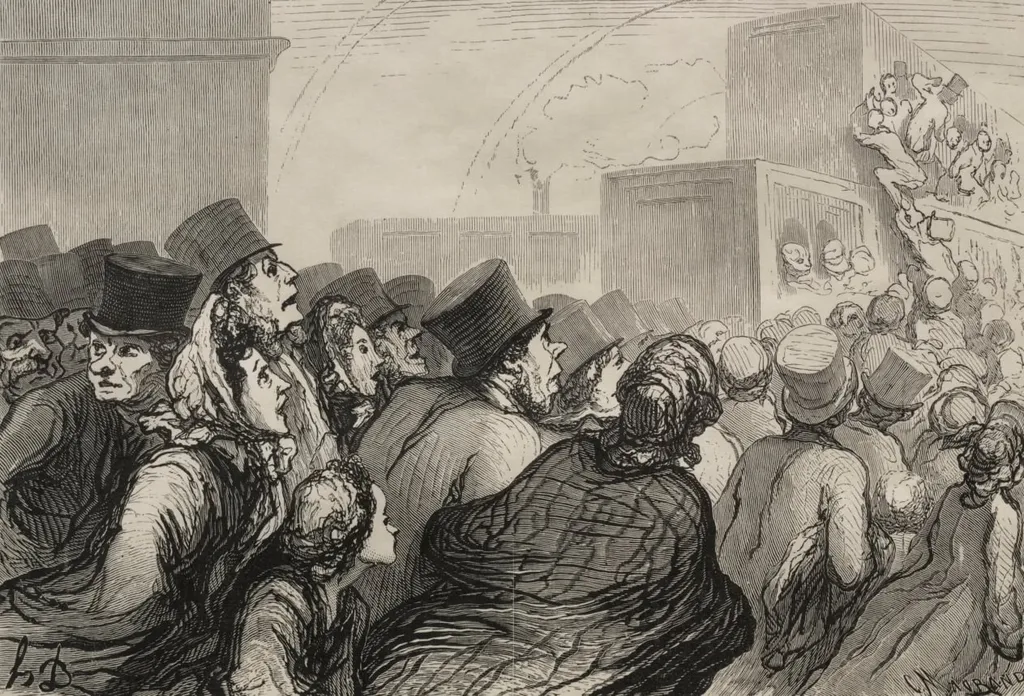
The Railway: The Sunday Excursion is a print by the Impressionist artist Honoré Daumier. It dates from 1862 and is held in the collection of the Cleveland Museum of Art.
About this work
Overview
Its informal, almost spontaneous quality reflects Daumier’s interest in everyday scenes rather than idealized subjects.
Created in 1862 by Honoré Daumier, this ink sketch captures a moment of urban transit during a Sunday outing. Executed in rapid, fluid lines, the work conveys the density and motion of a crowd gathered at a railway station. Its informal, almost spontaneous quality reflects Daumier’s interest in everyday scenes rather than idealized subjects. The piece resides in The Cleveland Museum of Art as part of its collection of 19th-century French graphic art.
Subject & Meaning
The scene depicts ordinary Parisians—men, women, and children—packed tightly in a waiting area, their attention directed outward, likely toward an arriving train. Their postures and expressions suggest exhaustion, anticipation, or resignation. Daumier portrays the working class not as romanticized figures but as individuals caught in the rhythms of modern life, revealing the quiet strain of urban mobility in industrializing France.
Technique & Style
Daumier employed swift, economical ink strokes to render movement and volume, avoiding detail in favor of suggestive form. The figures are loosely defined, their clothing and gestures implied rather than rendered precisely. Background elements like buildings and a tree are barely sketched, keeping focus on the human mass. This approach aligns with his journalistic roots, where speed and clarity were essential to capturing fleeting moments.
History & Provenance
The work was produced during Daumier’s prolific period as a caricaturist and social commentator, following his earlier career in lithography. It was likely made as a preparatory study or independent drawing, not intended for mass reproduction. Acquired by The Cleveland Museum of Art in the 20th century, it is now recognized as a key example of his graphic work outside of published satire.
Context
In 1860s France, the expansion of railways transformed daily life, enabling working-class citizens to travel for leisure for the first time. Daumier, attuned to social shifts, frequently depicted such scenes. Unlike academic painters who idealized travel, he focused on the physical crowding and emotional weight of these excursions, reflecting the realities of urbanization and class mobility.
Legacy
Daumier’s sketches like this one influenced later realist and modernist artists who valued observational immediacy over polished finish. His ability to convey human experience through minimal means helped redefine drawing as a serious medium for social commentary. Though not widely exhibited in his lifetime, such works are now central to understanding 19th-century visual culture beyond official art institutions.
Artist & collection

Artist
Honoré-Victorin Daumier was a French painter, sculptor, and printmaker, whose many works offer commentary on the social and political life in France, from the Revolution of 1830 to the fall of the Second French Empire in 1870.









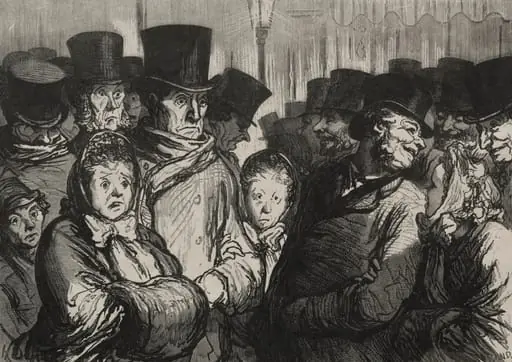 A Street at Midnight: Coming out of a drama. Coming out of a variety show
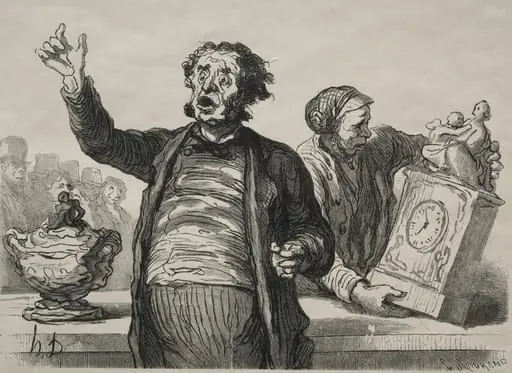 The Auction House: The Town Crier
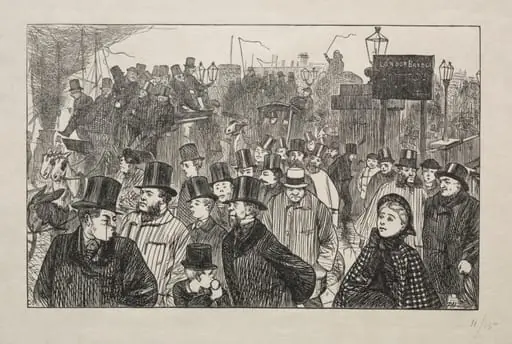 The Living Stream at London Bridge - On the Bridge
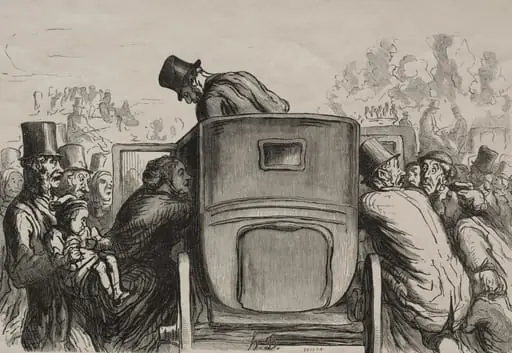 At the Universal Exhibition: The visitor will find all means of transportation desirable to return to his hotel.
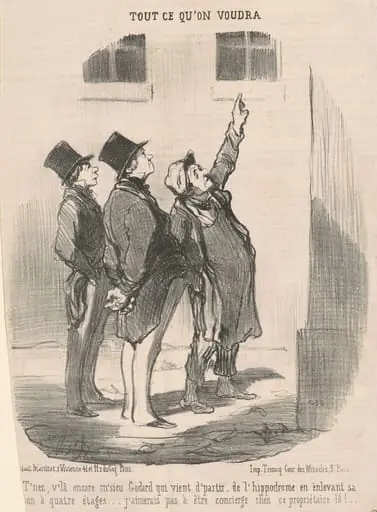 T'nez, v'la encore M'sieu Godard ...
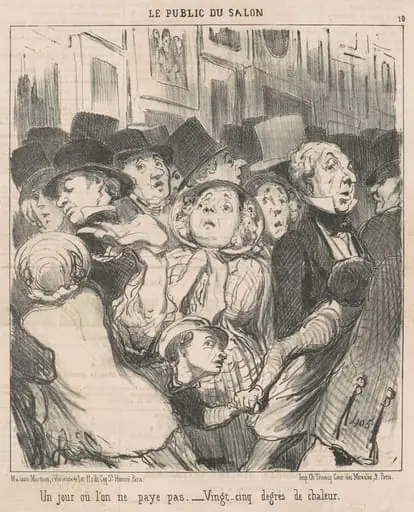 Un jour ou l'on ne paye pas
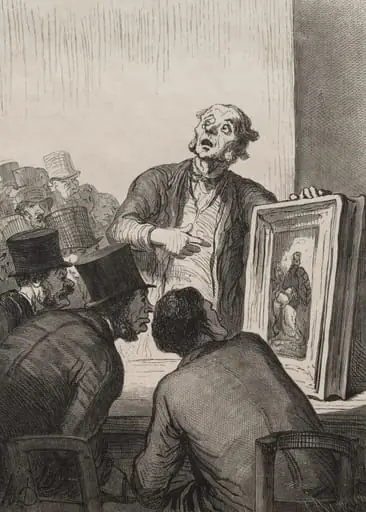 The Auction House: The Expert
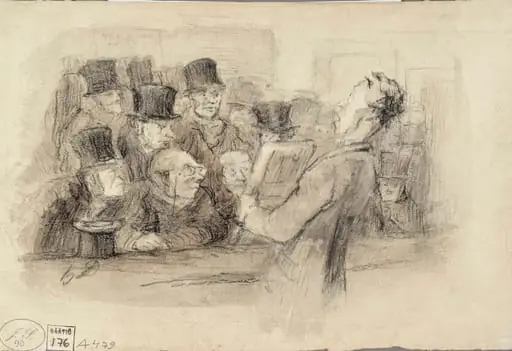 Tauluhuutokauppa
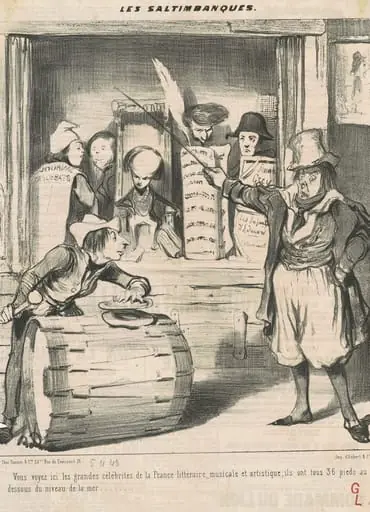 Vous yoyez ici les grandes célébrités...
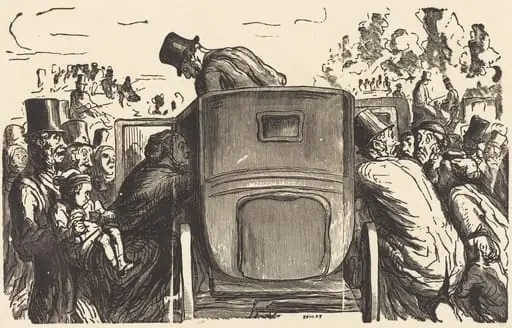 Exposition universelle: L'Etranger trouve toutes les facilites desirables...