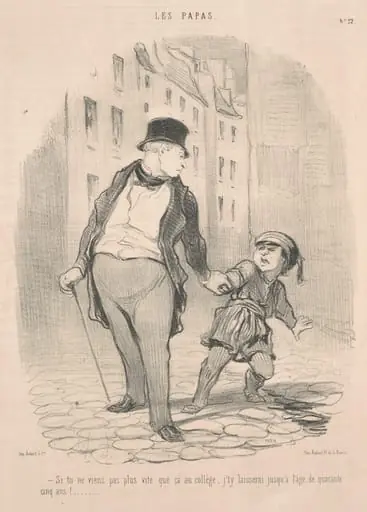
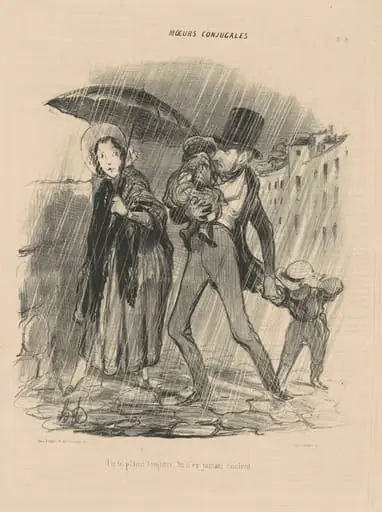
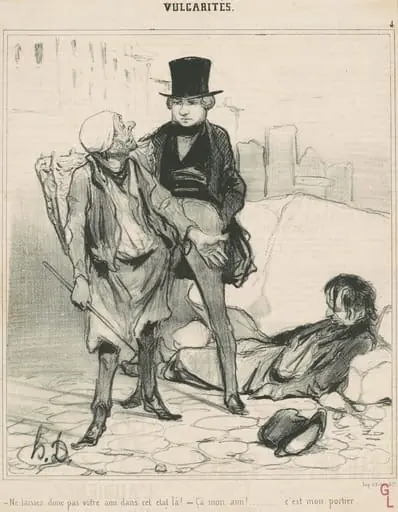
Artwork
Come along, dear...
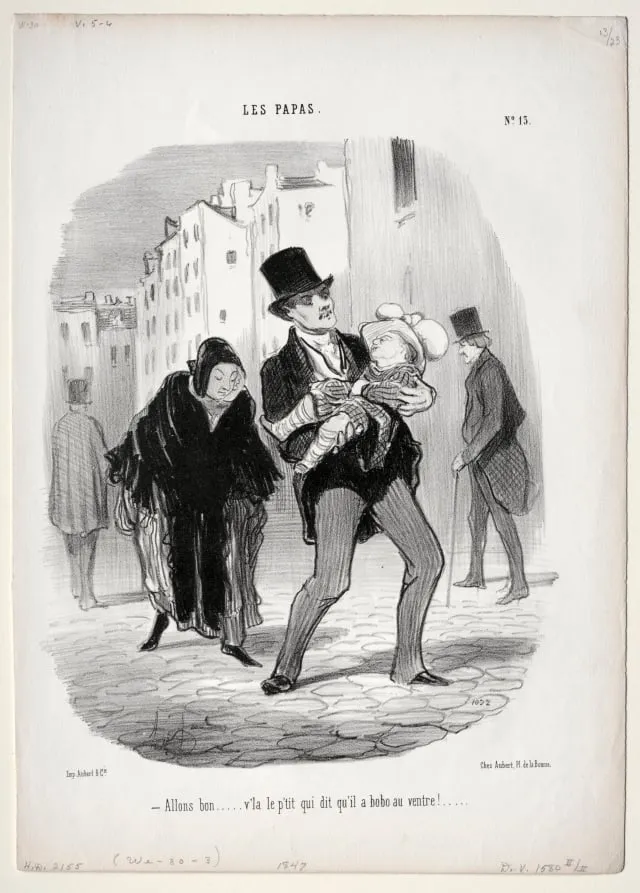
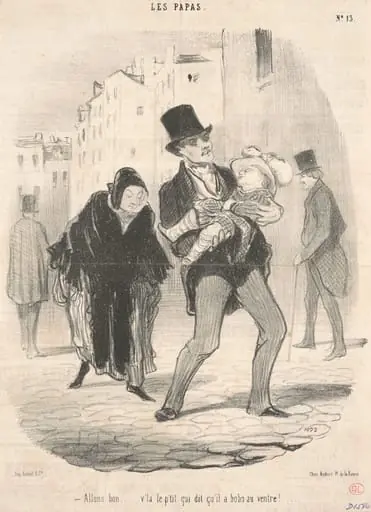
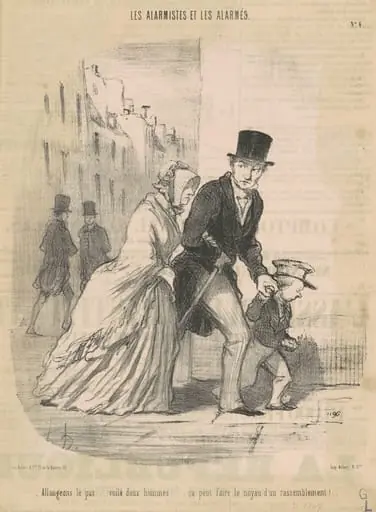
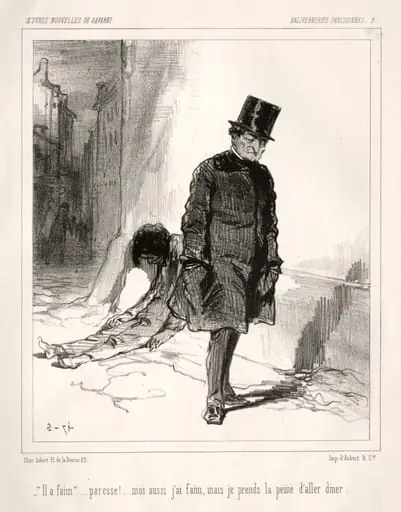
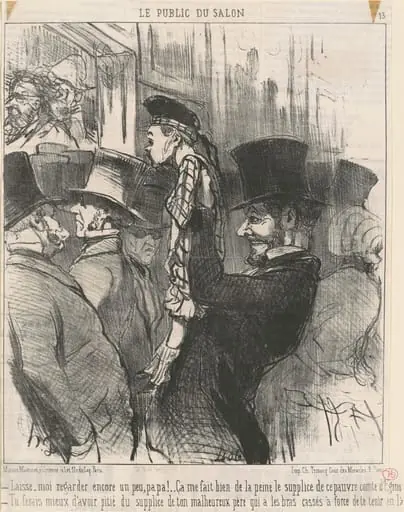
Come along, dear... is a print by the Romanticist artist Honoré Daumier. It dates from 1847 and is held in the collection of the Cleveland Museum of Art.
About this work
This painting shows a father and child walking together.
The father is holding the child's hand, and they seem to be on an outing. The detail that makes this work interesting is the way the father is looking down at the child, showing a sense of care and affection.
Check out the work of artist: Honoré Daumier (French, 1808–1879) for more scenes of everyday life.
Overview
This lithograph, published in Le Charivari on June 30, 1847, is the thirteenth plate in Honoré Daumier’s series titled Fathers. It captures a quiet moment between a man and his young child during an outing. Rendered in ink on paper, the work exemplifies Daumier’s focus on ordinary domestic scenes, avoiding idealization in favor of subtle emotional observation.
Subject & Meaning
The image depicts a father walking with his child, hand in hand, as they move through an urban environment. The father’s downward gaze conveys attentiveness rather than authority, suggesting tenderness in everyday care. Daumier avoids sentimentality, instead presenting a restrained, authentic interaction that reflects the quiet dignity of parental responsibility in mid-19th-century France.
Technique & Style
Background elements are suggested rather than rendered, directing focus to the intimate physical connection between parent and child.
Daumier employed lithography to achieve fluid, expressive lines with minimal detail. The figures are simplified yet emotionally resonant, their forms defined by economical contours and tonal contrasts. Background elements are suggested rather than rendered, directing focus to the intimate physical connection between parent and child. The technique aligns with his journalistic approach—rapid, incisive, and grounded in observation.
History & Provenance
Created for the satirical weekly Le Charivari, this print was part of a broader series examining familial roles during the July Monarchy. Daumier produced hundreds of lithographs for the publication between 1830 and 1860, often critiquing social norms through domestic vignettes. This piece, like others in the Fathers series, was widely distributed and later collected by institutions preserving 19th-century French graphic art.
Context
In 1847, France was under the July Monarchy, a period marked by growing middle-class values and increasing attention to domestic life. Daumier’s series responded to this cultural shift, portraying fathers not as distant patriarchs but as engaged caregivers. His work stood apart from academic art by elevating the mundane, reflecting the everyday realities of urban families in Paris.
Legacy
Daumier’s Fathers series influenced later artists who sought to depict social life with empathy and restraint. His use of lithography to convey psychological nuance in ordinary moments helped redefine printmaking as a vehicle for humanist observation. The work remains a touchstone in studies of 19th-century visual culture, valued for its unembellished portrayal of familial bonds.
Artist & collection

Artist
Honoré-Victorin Daumier was a French painter, sculptor, and printmaker, whose many works offer commentary on the social and political life in France, from the Revolution of 1830 to the fall of the Second French Empire in 1870.