Artwork
Compoziție suprarealistă
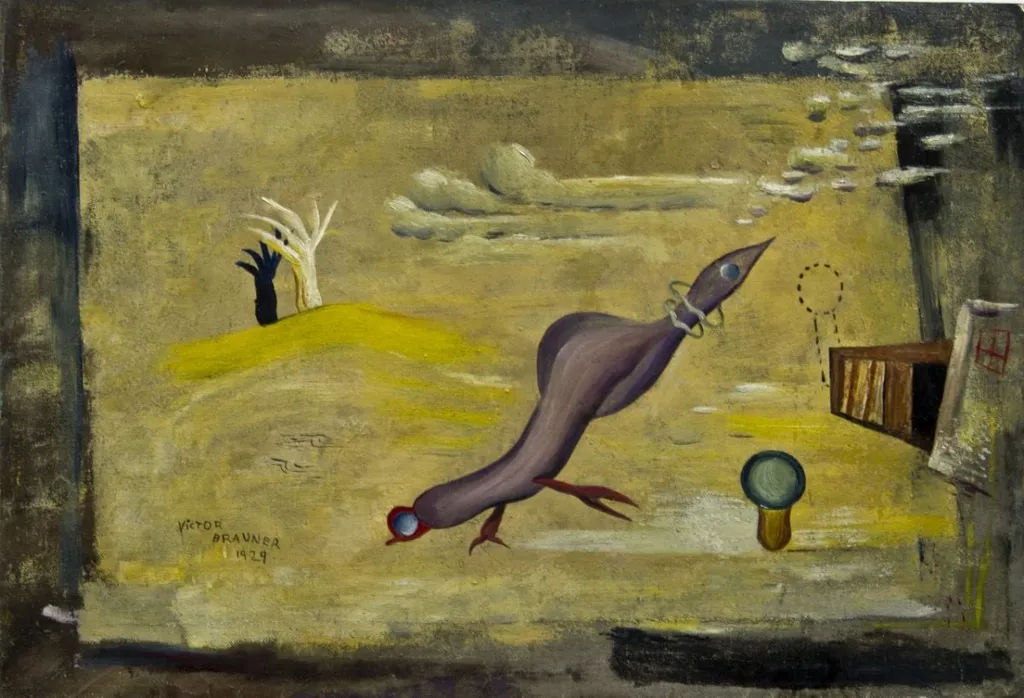
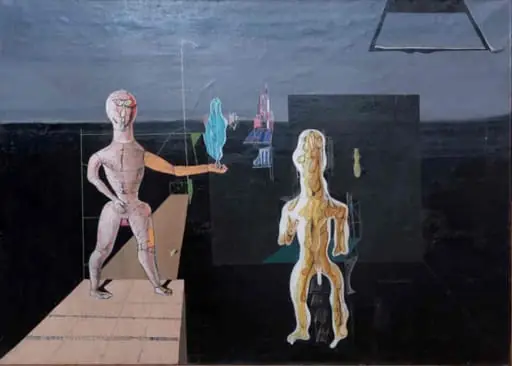
Compoziție suprarealistă is an unspecified painting by the Surrealist artist Victor Brauner. It dates from 1929 and is held in the collection of the National Museum of Art of Romania.
About this work
Overview
Its composition resists narrative clarity, instead evoking the subconscious through symbolic elements and an unsettling spatial arrangement.
Created in 1929 by Romanian artist Victor Brauner, Compoziție suprarealistă is an early example of his engagement with Surrealism. The painting presents a fragmented, dream-logic landscape populated by uncanny figures and disjointed objects. Its composition resists narrative clarity, instead evoking the subconscious through symbolic elements and an unsettling spatial arrangement. The work reflects Brauner’s interest in psychical automatism and the irrational.
Subject & Meaning
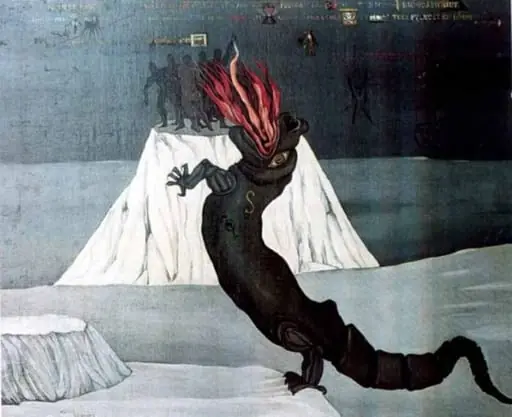
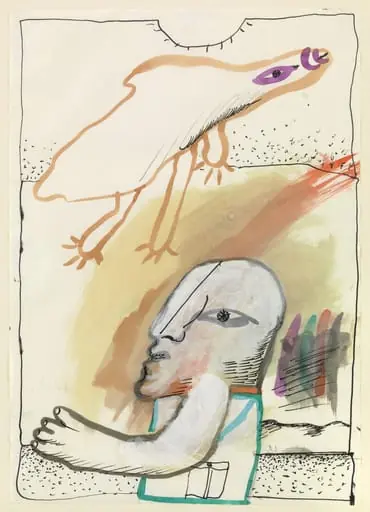
A bird-like figure with an elongated neck and bulbous head, adorned with a miniature hat, dominates the foreground. Its posture and exaggerated features suggest a hybrid creature, neither fully animal nor human. Behind it, a disembodied hand cradles a feather, while mundane items—a cup, a bucket, a small house—appear without logical context. These elements collectively evoke inner psychological states rather than external reality, aligning with Surrealist aims to access the unconscious.
Technique & Style
Brauner applied paint with thick, tactile brushstrokes, creating a rough, impasto surface that adds physicality to the dreamlike scene. Colors are restrained but intense: muted yellows, ochres, and blues dominate, grounding the surreal elements in earthy tones. The lack of smooth blending and the deliberate texture emphasize the raw, unpolished nature of the vision, reinforcing its psychological immediacy over aesthetic refinement.
History & Provenance
Painted in 1929, this work emerged during Brauner’s formative years in Paris, where he interacted with key Surrealist figures including André Breton. It predates his formal association with the Surrealist group but aligns with their early experiments. The painting remained in private collections for much of the 20th century, with limited public exposure until later scholarly attention to Eastern European Surrealism brought it into broader recognition.
Context
In late 1920s Europe, Surrealism was expanding beyond literary circles into visual art, drawing from Freudian theory and dream analysis. Brauner, influenced by both Eastern European folk motifs and Parisian avant-garde circles, developed a personal visual language that diverged from the more polished styles of his contemporaries. This work reflects a broader trend of artists using symbolic, irrational imagery to challenge rationalist norms.
Legacy
Compoziție suprarealistă stands as a significant early indicator of Brauner’s lifelong exploration of myth, identity, and the psyche. Its raw aesthetic and symbolic density influenced later generations of artists interested in psychological abstraction and non-Western Surrealist traditions. Though less known than French Surrealist works, it remains a vital testament to the movement’s diverse geographic and cultural reach.
Artist & collection
Artist
Victor Brauner mixed dreamlike scenes with sharp symbols, a style that wandered between painting and sculpture.