Artwork
Δικαιοσύνη
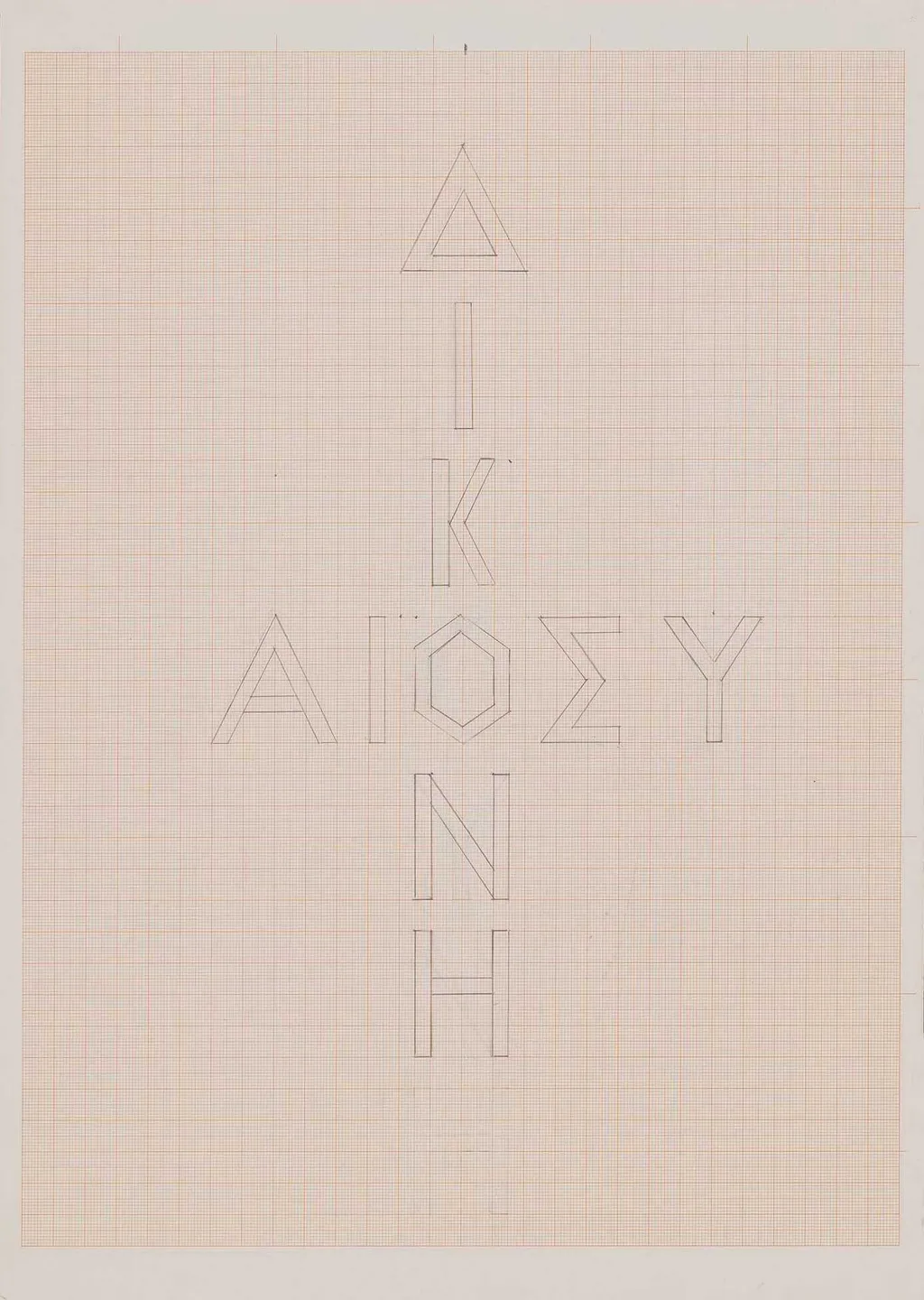
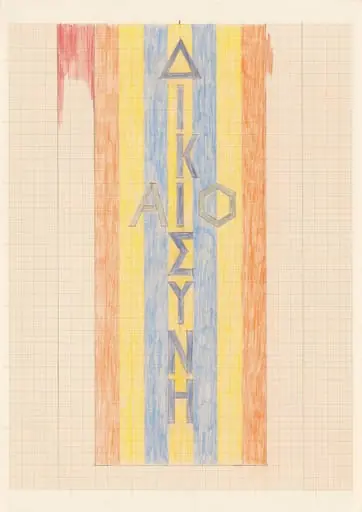
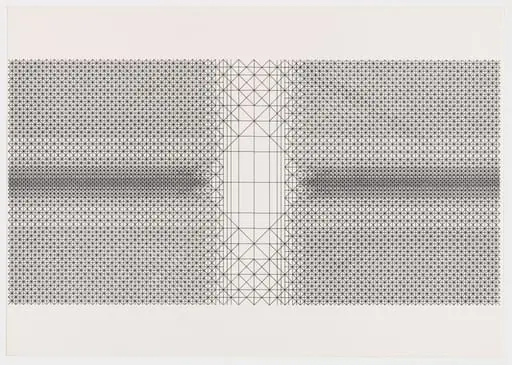
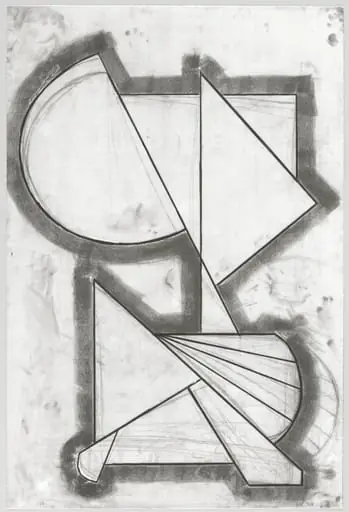
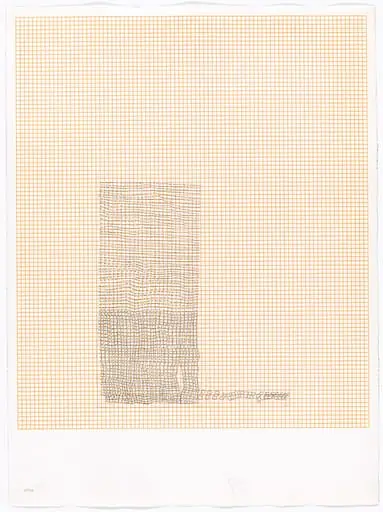
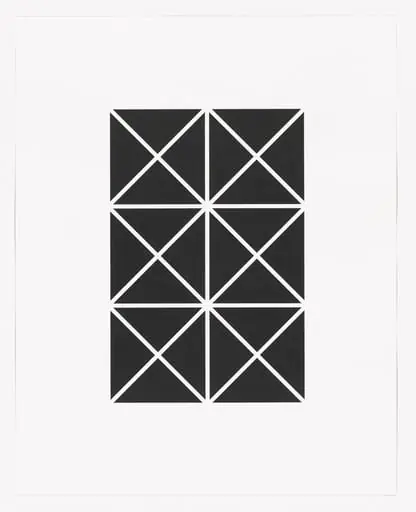
Δικαιοσύνη is a drawing by Mylona Alex. It dates from 1985 and is held in the collection of the Metropolitan Organisation of Museums of Visual Arts of Thessaloniki – MOMus. Alex Mylona’s 1980s drawing series explored the physical presence of abstract ethical concepts through letterform design.
About this work
Overview
This particular piece renders the Greek word for Justice in bold, block letters, with dense cross-hatching suggesting mass and volume.
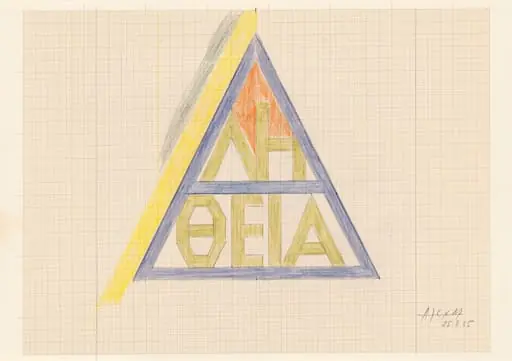
Alex Mylona’s 1980s drawing series explored the physical presence of abstract ethical concepts through letterform design. Focused on words like Justice, Love, and Truth, the works were preparatory studies for potential sculptures. This particular piece renders the Greek word for Justice in bold, block letters, with dense cross-hatching suggesting mass and volume. The plain white background isolates the word, emphasizing its sculptural potential over textual meaning.
Subject & Meaning
The drawing centers on the concept of Justice, rendered not as an allegorical figure but as a structural entity. Mylona treated the word as a carrier of societal values, seeking to give it tangible form. By isolating the term in its Greek script, she grounded the idea in cultural specificity while maintaining its universal resonance. The work reflects her belief that language itself could embody moral principles when given material weight.
Technique & Style
Mylona employed thick, uniform letterforms with tightly packed cross-hatching to simulate three-dimensionality on paper. Each stroke is deliberate, avoiding fluidity in favor of geometric rigidity. The absence of color or decorative elements directs attention to the letter shapes’ spatial occupation. The technique mimics industrial modeling, treating ink as if it were carved stone or cast metal, reinforcing the transition from drawing to planned sculpture.
History & Provenance
This drawing is part of a larger body of work developed between 1983 and 1986, during which Mylona refined proposals for public sculptures based on ethical keywords. Two of these concepts—Love and Justice—were later realized in isometric letterform installations at the Museum of Contemporary Art in Thessaloniki. The drawing serves as a critical step in that process, documenting the evolution from concept to built environment.
Context
Mylona’s work emerged during a period of renewed interest in conceptual art and language-based practices in Greece, following years of political repression. Her focus on foundational societal values coincided with broader cultural efforts to rebuild public discourse. By translating abstract ideals into visual form, she contributed to a post-dictatorship dialogue on ethics, identity, and civic space.
Legacy
The drawing remains a key reference in understanding Mylona’s contribution to Greek conceptual art. Her approach of treating words as architectural elements influenced later public art projects that integrate text into urban environments. Though few of her proposed sculptures were realized, this work exemplifies a quiet but persistent effort to make moral language visible and enduring in physical space.
Artist & collection
Artist
Museum
Metropolitan Organisation of Museums of Visual Arts of Thessaloniki – MOMus
Continue through works from the same source collection.