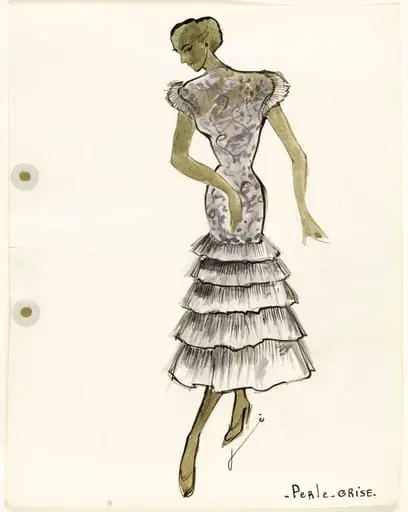
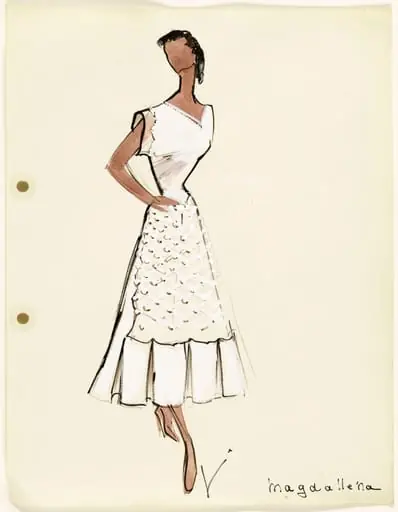
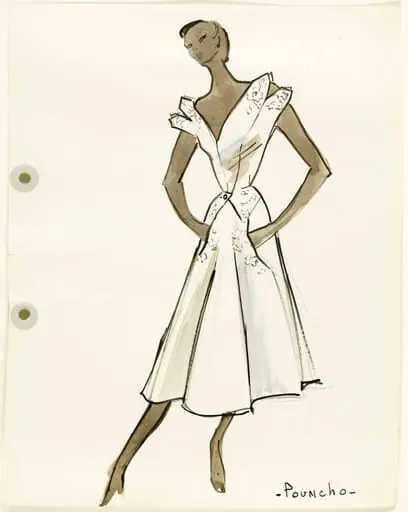
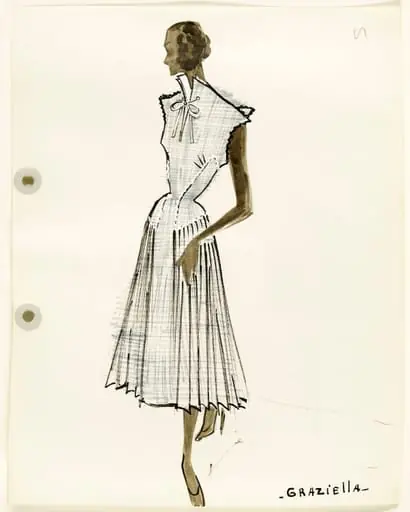
Artwork
'Manza'
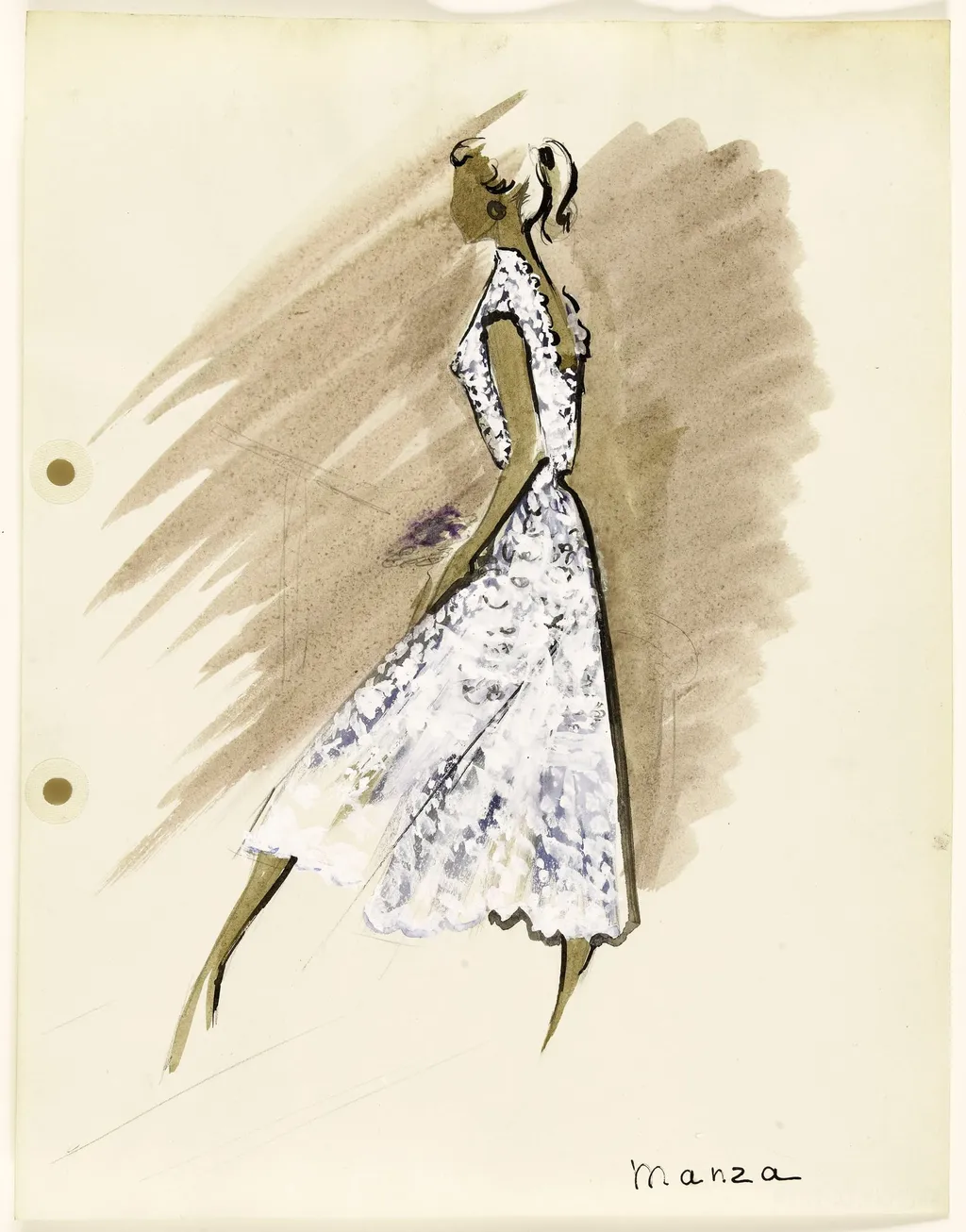
'Manza' is a drawing by Marie-Louise Carven. It dates from 1951 and is held in the collection of the Palais Galliera - Musée de la Mode de la Ville de Paris.
About this work
Overview
Created in 1951, *Manza* is a watercolor sketch by French designer Marie-Louise Carven, produced during her tenure as founder of the fashion house Carven.
Created in 1951, *Manza* is a watercolor sketch by French designer Marie-Louise Carven, produced during her tenure as founder of the fashion house Carven. Though primarily known for ready-to-wear garments, Carven also produced detailed design studies like this one. The work is part of the Museum of Ethnography’s collection, reflecting its significance as a document of mid-century fashion design practice rather than a finished garment.
Subject & Meaning
The sketch depicts a woman in a flowing, floral-print dress, standing sideways with one arm raised, suggesting movement or a moment of transition. Her hair is neatly pulled back, emphasizing simplicity and grace. The figure’s posture and the dress’s wide flare imply an emphasis on ease and natural motion, aligning with Carven’s focus on clothing designed for petite, active women. The signature 'Manza' may reference a personal or professional alias, hinting at the intimate nature of the study.
Technique & Style
Executed in loose watercolor washes, the sketch employs soft beige and gray tones for the background, allowing the floral dress to emerge with subtle contrast. Dark spots on the fabric suggest depth without heavy detail, while the lines defining the figure are fluid and economical. The technique prioritizes atmosphere and silhouette over precision, characteristic of fashion illustrators who captured the essence of a design rather than its exact construction.
History & Provenance
Marie-Louise Carven established her fashion house in 1945 and was among the earliest Parisian designers to embrace prêt-à-porter. *Manza* dates from the early years of this shift, when couture houses began documenting designs for mass production. The sketch’s presence in the Museum of Ethnography indicates its value as a cultural artifact, preserving the transition from haute couture to accessible fashion in postwar Europe.
Context
In the early 1950s, Parisian fashion was redefining itself after wartime austerity. Carven’s designs catered to women seeking practical elegance, and her sketches like *Manza* served as both creative tools and marketing aids. The emphasis on light fabrics and movement reflected broader societal changes—women’s increasing participation in public life demanded clothing that was both beautiful and functional.
Legacy
*Manza* exemplifies how fashion designers used personal illustration to bridge artistic vision and commercial production. While Carven’s garments reached a wide audience, her sketches remain rare artifacts of the design process. This work contributes to understanding how ready-to-wear fashion evolved from individual creativity, preserving the hand-drawn origins of mass-produced style.
Artist & collection
Artist
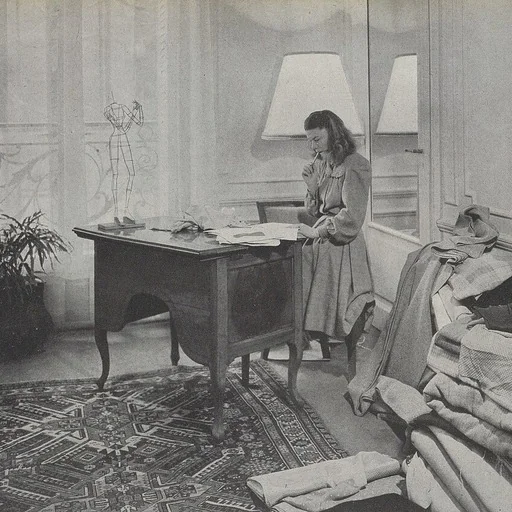
Marie-Louise Carven (31 August 1909 – 8 June 2015), born Carmen de Tommaso, was a French fashion designer who founded the house of Carven in 1945.
Museum
Palais Galliera - Musée de la Mode de la Ville de Paris
Continue through works from the same source collection.
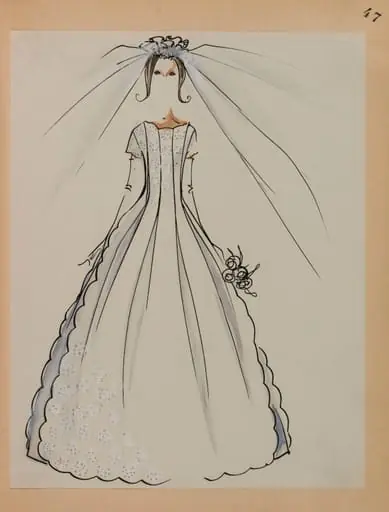 Robe de mariée festonnée et son voile
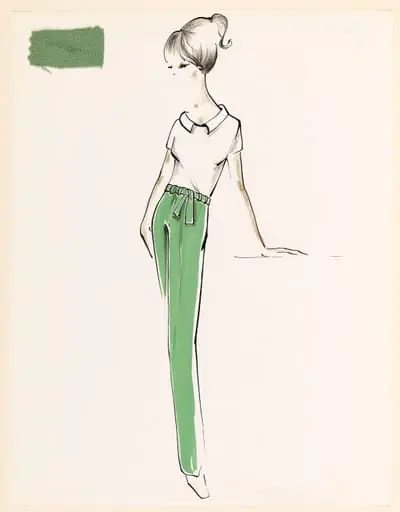 Haut blanc à manches courtes et pantalon vert à ceinture nouée
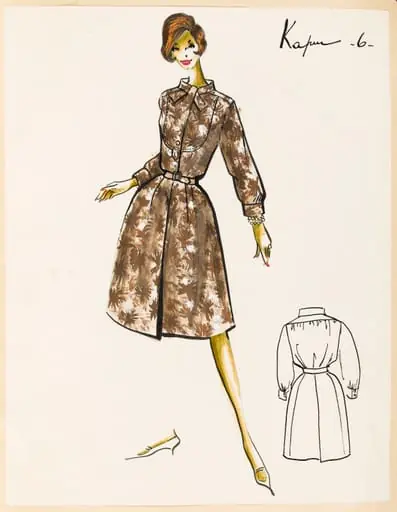 Kapur
Kapur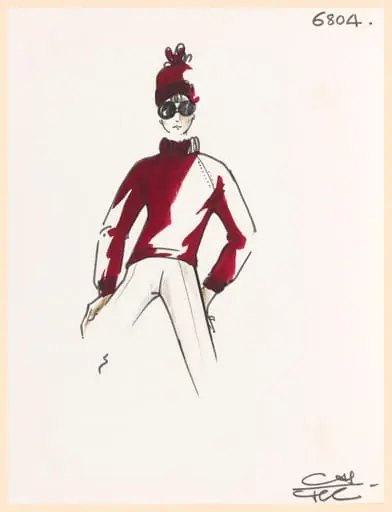 Pull-over à manches longues pourpre, bonnet assorti, pantalon et lunettes de soleil
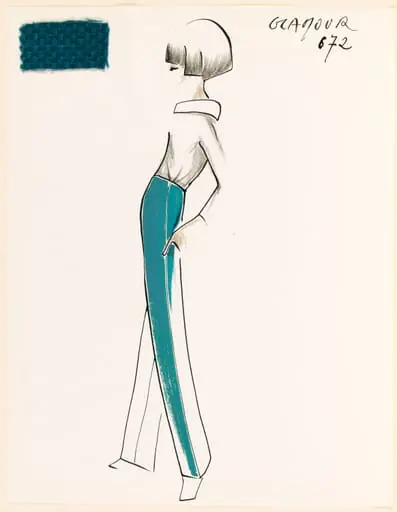 GLAMOUR
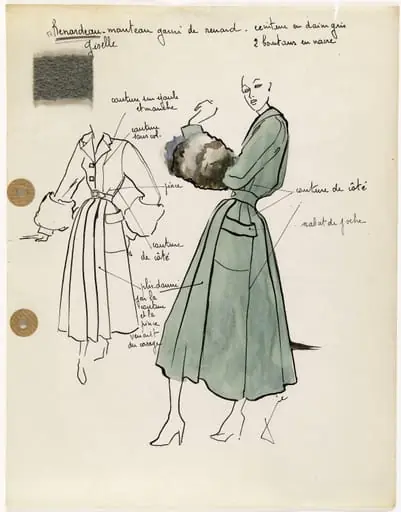 'Renardeau'
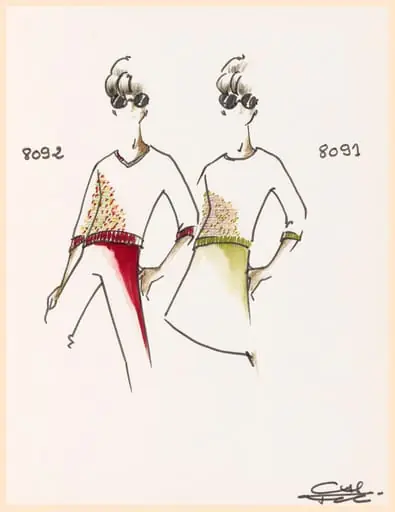 Pull-over à manches trois quarts et à encolure V à motifs multicolores, pantalon cerise et lunettes de soleil
 Béguinage