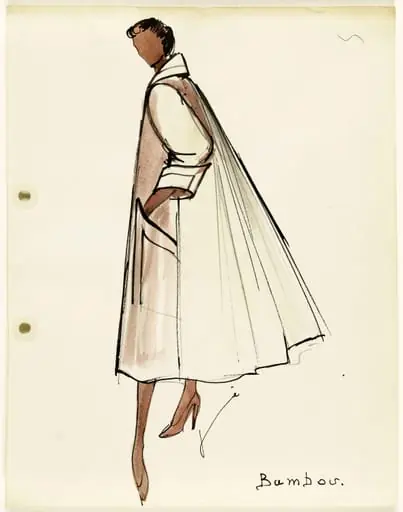
Artwork
'Nina'
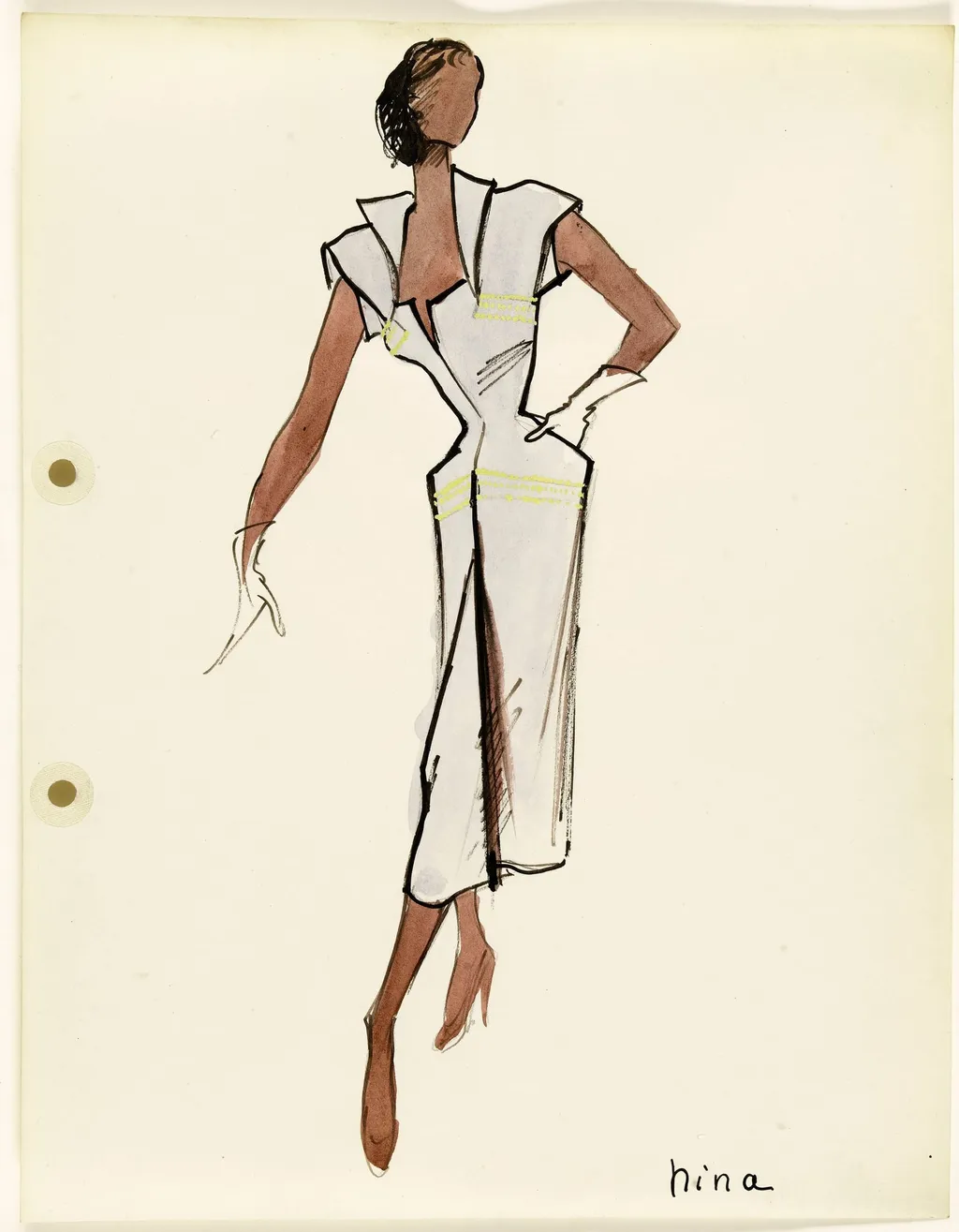
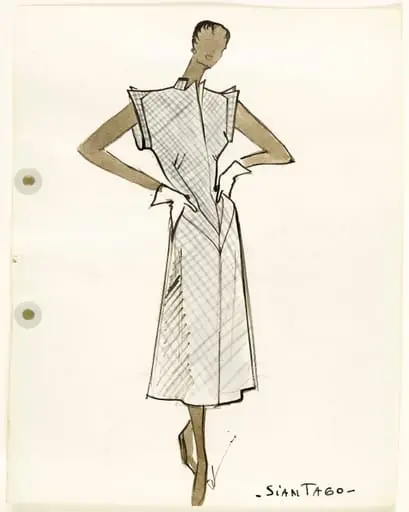
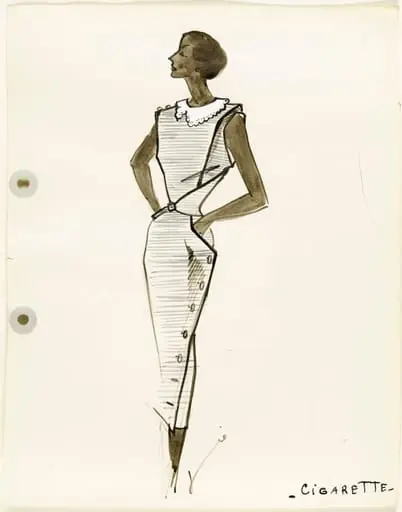
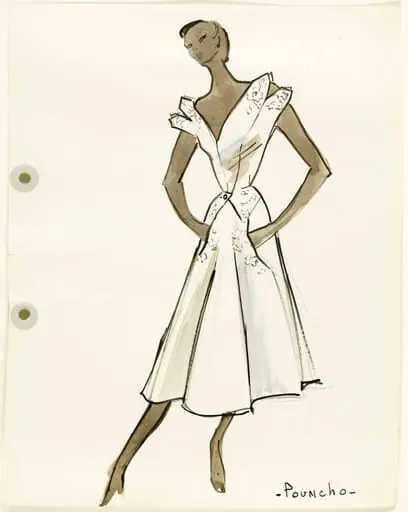
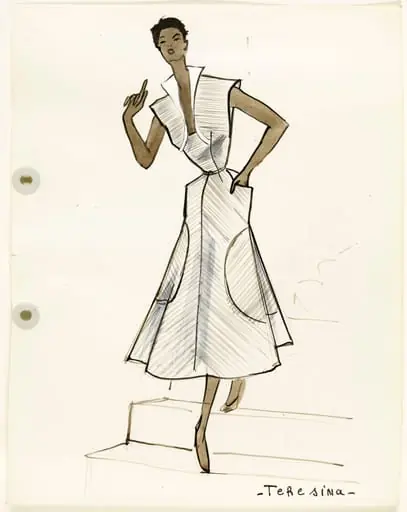
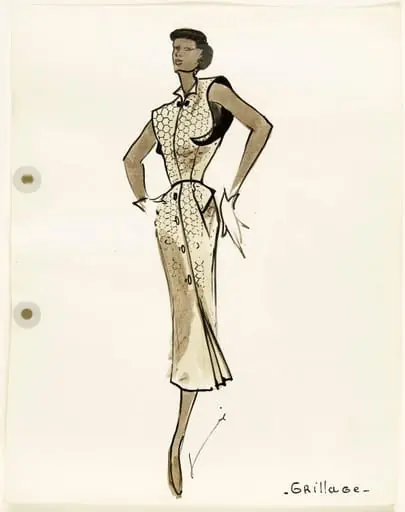
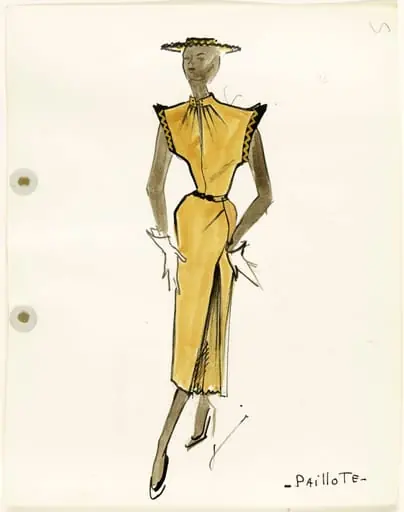
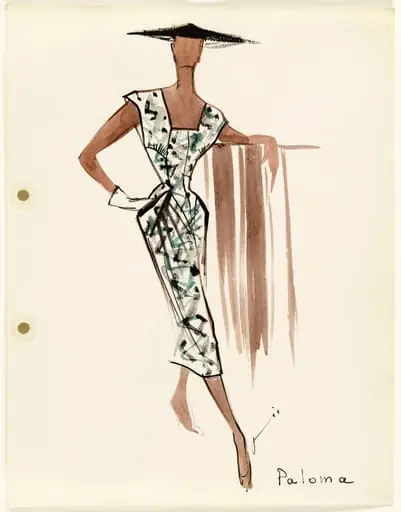
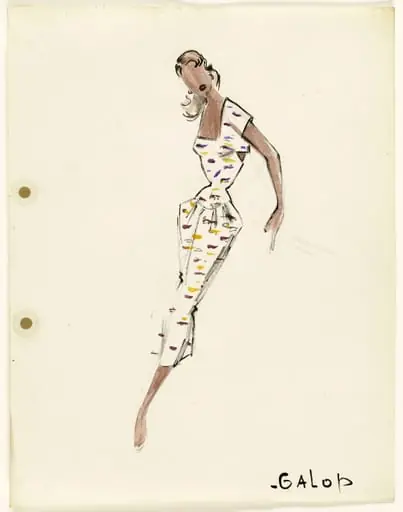
'Nina' is a drawing by Marie-Louise Carven. It dates from 1951 and is held in the collection of the Palais Galliera - Musée de la Mode de la Ville de Paris.
About this work
Overview
Unlike typical design studies, the sketch bears the signature 'Nina'—indicating it was made for a specific client rather than as a generic prototype.
Created in 1951, *Nina* is a fashion sketch by Marie-Louise Carven, founder of the Parisian label Carven established in 1945. Executed in watercolor and ink, it depicts a woman in a tailored ensemble characteristic of Carven’s minimalist aesthetic. Unlike typical design studies, the sketch bears the signature 'Nina'—indicating it was made for a specific client rather than as a generic prototype. The drawing resides in the Museum of Ethnography’s collection, reflecting its cultural significance beyond commercial fashion.
Subject & Meaning
The figure in *Nina* stands with poised confidence, one hand resting on her hip, suggesting self-assurance and ease. Her outfit—a fitted jacket with padded shoulders, a straight skirt, and a slender belt—embodies postwar French elegance refined for smaller frames. The personal signature 'Nina' implies the design was tailored to an individual, transforming the sketch from a commercial tool into a private artifact of identity and style, revealing fashion as an intimate act of self-expression.
Technique & Style
Carven rendered the figure with fluid, assured lines, combining ink outlines with soft watercolor washes to suggest volume and shadow. The loose brushwork conveys spontaneity, while the restrained palette emphasizes form over ornament. The absence of elaborate detail aligns with her modernist approach: clarity and proportion take precedence. The sketch’s immediacy reflects Carven’s belief in wearable simplicity, where structure and movement are communicated with minimal means.
History & Provenance
Marie-Louise Carven launched one of Paris’s earliest prêt-à-porter lines, making fashion accessible beyond haute couture clientele. *Nina* emerged during the early 1950s, a period when her designs gained recognition for their practicality and feminine precision. The drawing entered the Museum of Ethnography’s holdings, likely through donation or acquisition tied to its representation of everyday style in mid-century France, distinguishing it from archival fashion materials held in design-specific institutions.
Context
In postwar Paris, fashion was redefining itself around affordability and livability. Carven’s focus on petite proportions and lightweight textiles responded to the needs of women rebuilding daily life after conflict. *Nina* reflects this shift: its clean lines and functional silhouette contrast with the opulence of earlier decades. The sketch’s personal signature underscores a growing trend toward individualized design, even within ready-to-wear systems, signaling a quiet revolution in how clothing related to the body.
Legacy
Though Carven’s name is less prominent today, her influence endures in the normalization of size-inclusive, understated design. *Nina* exemplifies her philosophy: fashion as a quiet, personal dialogue between maker and wearer. The sketch’s preservation in an ethnographic context affirms its value not merely as a garment prototype, but as a cultural document of mid-century female identity, where simplicity carried social weight.
Artist & collection
Artist
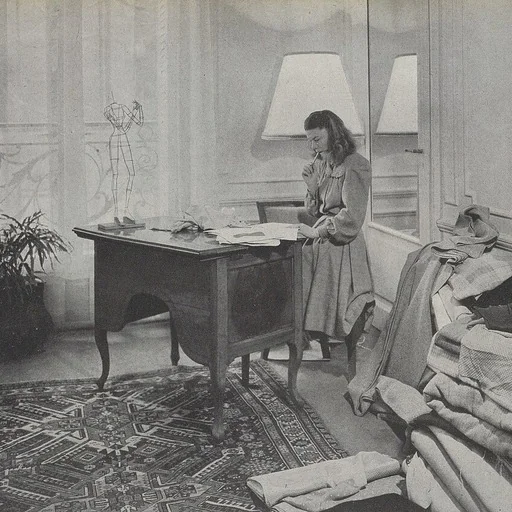
Marie-Louise Carven (31 August 1909 – 8 June 2015), born Carmen de Tommaso, was a French fashion designer who founded the house of Carven in 1945.
Museum
Palais Galliera - Musée de la Mode de la Ville de Paris
Continue through works from the same source collection.
 Robe de mariée festonnée et son voile
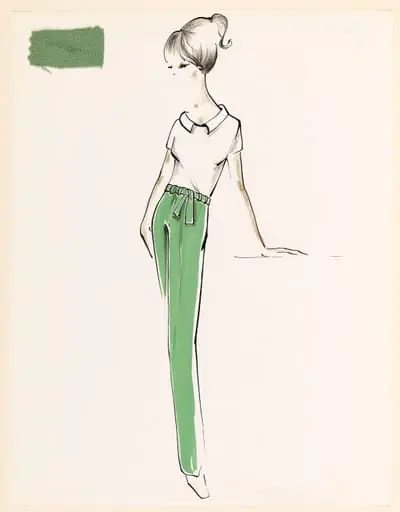 Haut blanc à manches courtes et pantalon vert à ceinture nouée
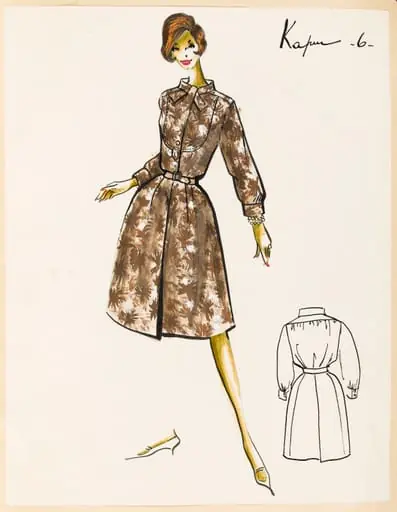 Kapur
Kapur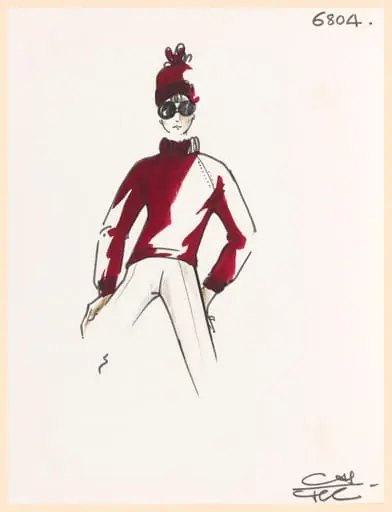 Pull-over à manches longues pourpre, bonnet assorti, pantalon et lunettes de soleil
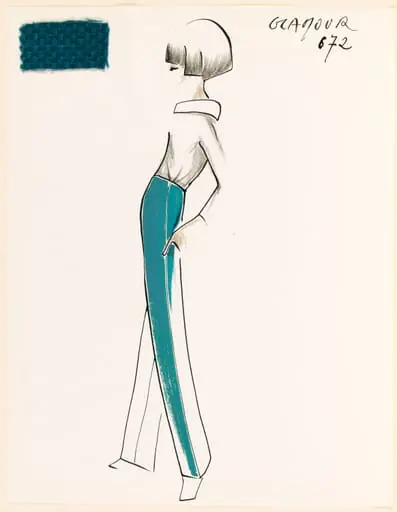 GLAMOUR
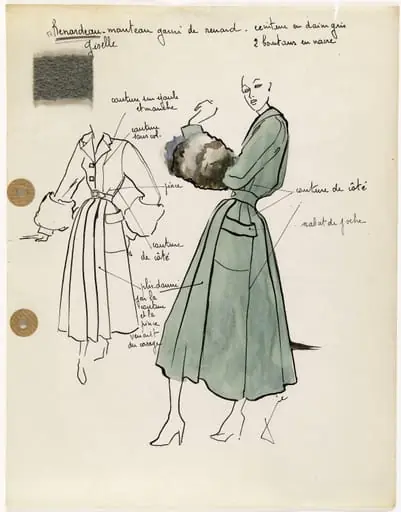 'Renardeau'
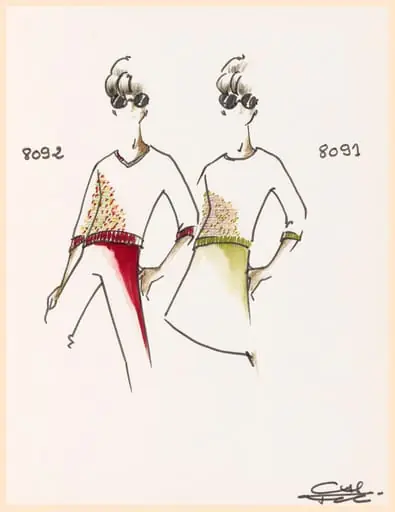 Pull-over à manches trois quarts et à encolure V à motifs multicolores, pantalon cerise et lunettes de soleil
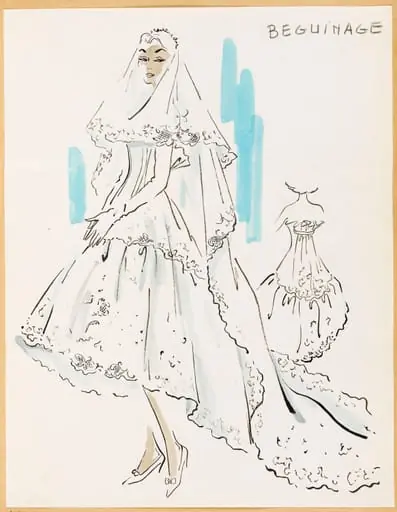 Béguinage