Artwork
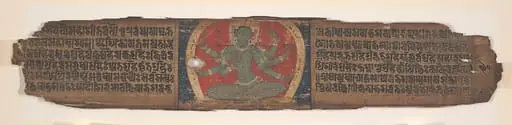
Bodhisattva Manjushri with two forms of Avalokiteshvara, folio 348 (recto) from a Gandavyuha-sutra (Scripture of the Supreme Array)

Bodhisattva Manjushri with two forms of Avalokiteshvara, folio 348 (recto) from a Gandavyuha-sutra (Scripture of the Supreme Array) is an unspecified painting. It dates from 1100 and is held in the collection of the Cleveland Museum of Art. This painting, folio 348 from a Gandavyuha-sutra, depicts three prominent Buddhist figures.
About this work
Overview
The artwork features Bodhisattva Manjushri flanked by two manifestations of Avalokiteshvara, all rendered in a seated, cross-legged posture.
This painting, folio 348 from a Gandavyuha-sutra, depicts three prominent Buddhist figures. The artwork features Bodhisattva Manjushri flanked by two manifestations of Avalokiteshvara, all rendered in a seated, cross-legged posture. This folio served as an illustrated page within the larger "Scripture of the Supreme Array," a significant text in Buddhist tradition. Its presence highlights the visual storytelling employed in religious manuscripts.
Subject & Meaning
The central figure is identified as Bodhisattva Manjushri, a revered figure symbolizing wisdom, while he is accompanied by two forms of Avalokiteshvara, the bodhisattva of compassion. Each deity is depicted with a halo, signifying their enlightened status. The specific arrangement of these figures underscores their interconnected roles within Buddhist cosmology, presenting a visual representation of key spiritual principles from the Gandavyuha-sutra.
Technique & Style
The composition arranges the three figures in a linear sequence, each seated with legs crossed. They are uniformly adorned in red robes, contrasting with the beige background. Distinctive circular forms frame each figure's head: red for the male bodhisattvas and blue for the female manifestation of Avalokiteshvara, which also features a blue border. These stylistic choices emphasize the individual identities while maintaining a cohesive visual narrative.
Artist & collection

 Folio 348 from a Gandavyuha-sutra (Scripture of the Supreme Array): Bodhisattva Manjushri with two forms of Avalokiteshvara (recto); Bodhisattva Samantabhadra purifies the path to enlightenment, with Manjushri (verso)
 Folio 20 from a Gandavyuha-sutra (Scripture of the Supreme Array): Sudhana and a parrot (recto); Text (verso)
 Folio 73 from a Gandavyuha-sutra (Scripture of the Supreme Array): Sudhana and an antelope (recto); text (verso)
 Folio 22 from a Gandavyuha-sutra (Scripture of the Supreme Array): Samantabhadra spinning clouds of things (recto); Text (verso)
 Samantabhadra spinning clouds of things, folio 22 (recto) from a Gandavyuha-sutra (Scripture of the Supreme Array)
 Sudhana and a parrot, folio 20 (recto) from a Gandavyuha-sutra (Scripture of the Supreme Array)
 Sudhana and an antelope, folio 73 (recto) from a Gandavyuha-sutra (Scripture of the Supreme Array)
 Sudhana and the rishi Bhishmottaranirgosha, folio 94 (recto) from a Gandavyuha-sutra (Scripture of the Supreme Array)
 Sudhana and a pair of antelopes, folio 37 (recto) from a Gandavyuha-sutra (Scripture of the Supreme Array)
 Folio 94 from a Gandavyuha-sutra (Scripture of the Supreme Array): Sudhana and the rishi Bhishmottaranirgosha (recto); text (verso)
 Prajnaparamita flanked by a white female figure and a white bodhisattva, folio 90 (recto), from a Manuscript of the Perfection of Wisdom in Eight Thousand Lines (Ashtasahasrika Prajnaparamita-sutra)
 Untitled
 Manuscript of the Perfection of Wisdom in Eight Thousand Lines (Ashtasahasrika Prajnaparamita-sutra)
 Perfection of Wisdom in Eight Thousand Lines: Ashtasahasrika Prajnaparamita: Back Cover