Artwork
Two Wings of a Triptych with the Portraits of Julien de Brouckere and his Wife Elisabeth Canneel
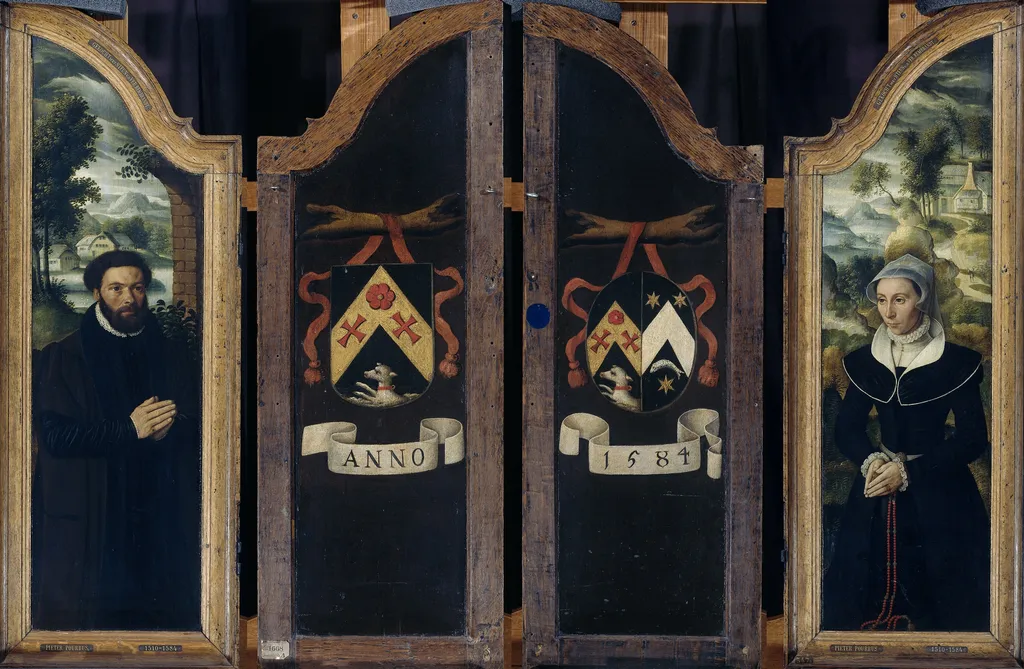
Two Wings of a Triptych with the Portraits of Julien de Brouckere and his Wife Elisabeth Canneel is an oil painting. It dates from 1592 and is held in the collection of the Rijksmuseum. Two painted panels form the side wings of a 1584 triptych, each depicting a member of a Flemish couple.
About this work
The wooden panels around the portraits look old and worn, with carvings at the top.
This painting shows two people standing in front of dark panels. The man on the left wears a black coat and a white ruff collar. The woman on the right has a white cap and a dark dress with a string of beads. Between them is a shield with symbols and the year "1584" written on a scroll.
The dark background behind them frames a landscape with houses and trees. The wooden panels around the portraits look old and worn, with carvings at the top.
Look up Rijksmuseum to see where this painting is kept.
Overview
Two painted panels form the side wings of a 1584 triptych, each depicting a member of a Flemish couple. Julien de Brouckere stands on the left in a black coat with a white ruff, while his wife Elisabeth Canneel appears on the right, wearing a dark dress, a white cap and a string of beads. Both figures are set against a muted landscape of houses and trees, framed by aged wooden panels with carved tops.
Subject & Meaning
The portraits present the husband and wife as a unified pair, their placement flanking a central shield that bears heraldic symbols and the date of commission. The inclusion of the coat of arms underscores the family's social standing and the importance of lineage, while the modest landscape background situates the sitters within a recognizable, domestic world.
Technique & Style
Executed in oil on wood, the work displays the fine brushwork typical of late 16th‑century Flemish portraiture. The contrast between the dark, weathered panels and the illuminated figures creates a subtle three‑dimensional effect. Attention to textile texture—particularly the sheen of the ruff and the beadwork—demonstrates the artist’s skill in rendering materiality.
History & Provenance
The panels were created in 1584 for Julien de Brouckere and Elisabeth Canneel, likely as part of a private devotional or commemorative triptych. Over the centuries the work entered various collections before being acquired by the Rijksmuseum in Amsterdam, where it is now displayed as part of the museum’s Flemish painting holdings.
Context
The painting belongs to a period when portraiture served both personal and genealogical functions among the burgeoning bourgeoisie of the Low Countries. The use of a heraldic shield reflects contemporary practices of asserting family identity, while the modest interior setting aligns with the era’s preference for realistic, unidealized depictions of patrons.
Artist & collection

![Hans Roth [reverse], by Bernhard Strigel](https://artifactworldgallery.com/img/bernhard-strigel--hans-roth-reverse--9e98efc46bbdf23c-w320.webp)
![Margarethe Vöhlin [reverse], by Bernhard Strigel](https://artifactworldgallery.com/img/bernhard-strigel--margarethe-vohlin-reverse--01f4c80425fbb8fe-w320.webp)