Artwork
Heraldic panel with family shields of the couple Hortensia del Prado and second husband Peter Courten, 1625
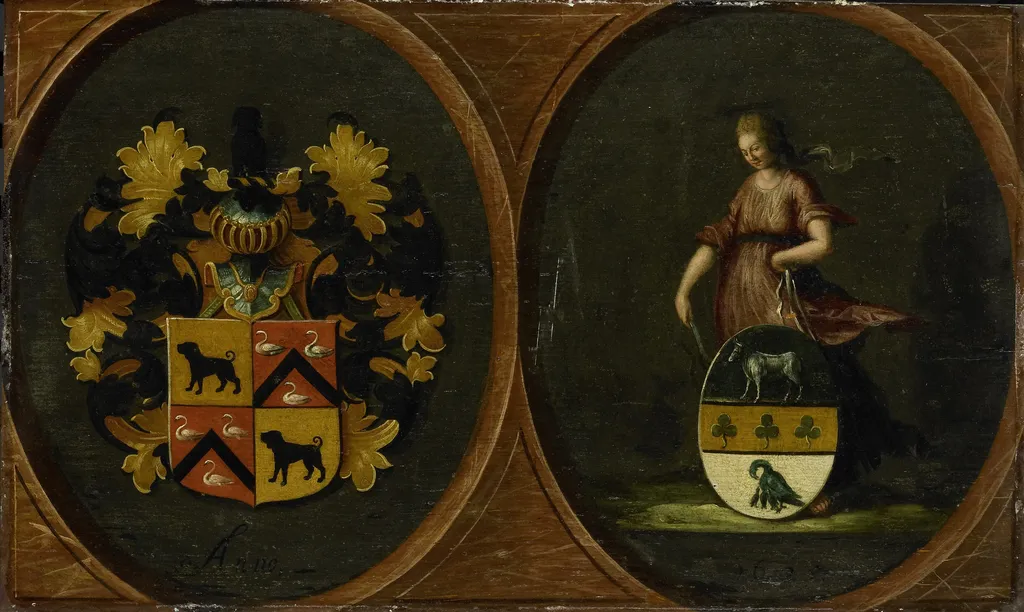
Heraldic panel with family shields of the couple Hortensia del Prado and second husband Peter Courten, 1625 is an oil painting. It dates from 1625 and is held in the collection of the Rijksmuseum. The work consists of two adjacent circular panels painted in oil in 1625.
About this work
Overview
Together the images function as a visual record of the marital alliance between Hortensia del Prado and her second husband, Peter Courten.
The work consists of two adjacent circular panels painted in oil in 1625. The left panel displays a heraldic achievement in vivid yellow, red and black, incorporating a lion, a ram and ornamental foliage. The right panel presents a seated woman in a brown gown, holding a shield bearing a dog and three green trefoils. Together the images function as a visual record of the marital alliance between Hortensia del Prado and her second husband, Peter Courten.
Subject & Meaning
The composition juxtaposes the male and female heraldic symbols, underscoring the union of two noble lineages. The lion and ram on the left represent the Courten arms, while the dog and trefoils on the woman's shield echo the del Prado family. By presenting both emblems side by side, the painting celebrates the couple’s shared ancestry and the continuity of their dynastic identity.
Technique & Style
Executed in oil on canvas, the panels employ a flat, decorative approach typical of early‑17th‑century Spanish heraldic portraiture. Bold, saturated pigments render the colors of the arms, while the figure is rendered with modest modeling, emphasizing the symbolic rather than the naturalistic. The composition relies on clear outlines and stylized foliage to convey status and lineage.
History & Provenance
Created in 1625, the piece was likely commissioned to mark Hortensia del Prado’s second marriage to Peter Courten. The work remained in the family’s private collection for several generations before entering a public museum collection in the late 20th century, where it is now displayed as an example of marital heraldic art.
Context
Heraldic panels such as this were common in Iberian noble households, serving both decorative and documentary purposes. The inclusion of specific charges—lion, ram, dog, trefoils—reflects the codified language of arms that communicated lineage, alliances and property rights within the social hierarchy of the period.
Artist & collection

![Crested Coat of Arms [reverse]](https://artifactworldgallery.com/img/crested-coat-of-arms-reverse--635f462b0f763a94-w320.webp)