Artwork
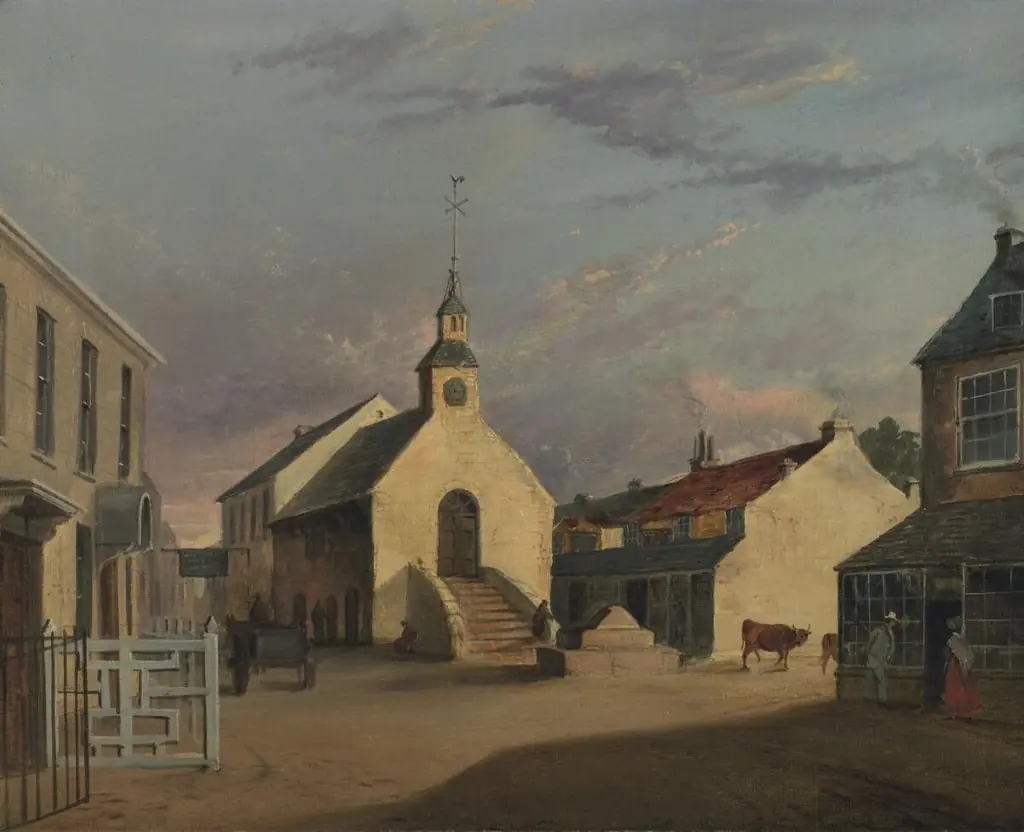
Llantwit market hall
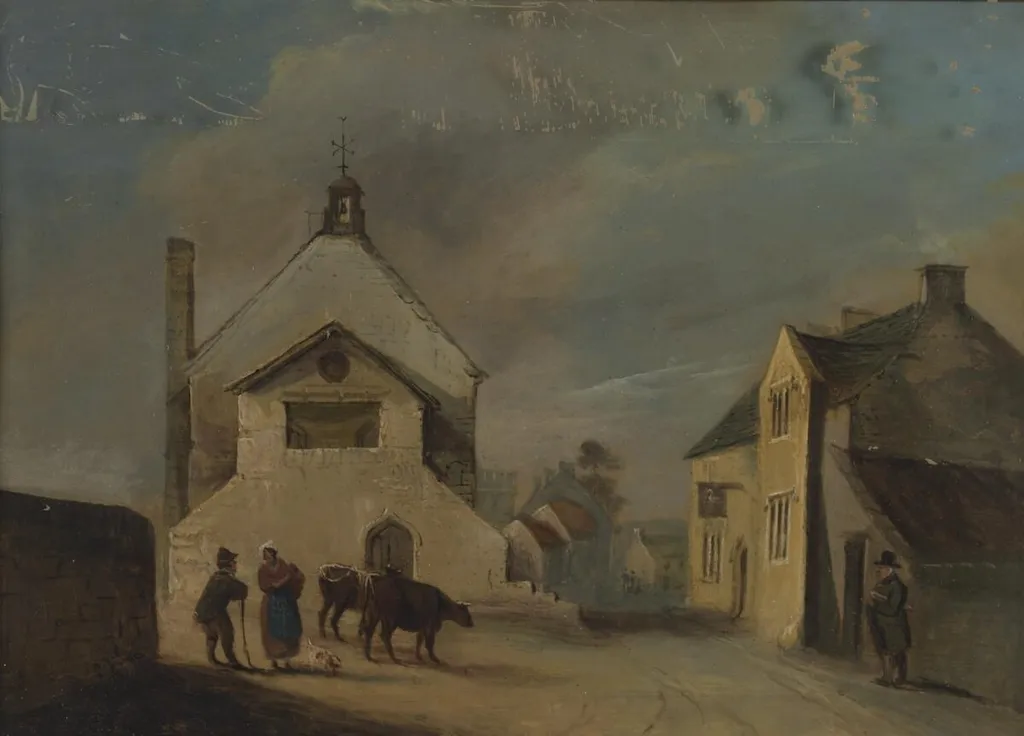
Llantwit market hall is an oil painting by the British Romanticist artist Unknown. It dates from 1820 and is held in the collection of the National Library of Wales.
About this work
Overview
This oil painting depicts a modest rural marketplace in Llantwit, centered on a substantial two-story structure with a steep roof and prominent chimney.
This oil painting depicts a modest rural marketplace in Llantwit, centered on a substantial two-story structure with a steep roof and prominent chimney. Surrounding the building, a small group of figures engage in routine activities, suggesting a quiet, everyday scene. The composition is restrained, with no dramatic focal point, emphasizing the ordinary rhythm of village life through stillness and subtle detail.
Subject & Meaning
The scene captures a moment of unremarkable commerce or social exchange in a Welsh village. Figures—a woman in a long dress, a man wearing a hat—are present but not engaged in overt interaction, reinforcing a sense of quiet routine. The building likely served as a market hall, a civic anchor for local trade, and its prominence in the frame suggests its importance to community life, rendered without idealization.
Technique & Style
The artist employs a muted palette dominated by earthy browns and grays, avoiding bright contrasts to sustain a subdued, atmospheric tone. Brushwork is controlled and observational, with soft transitions between forms. Light is diffused, suggesting overcast conditions, and architectural details are rendered with precision but without flourish, aligning with a documentary approach to rural life.
History & Provenance
The painting’s origins are tied to the village of Llantwit in Wales, likely created in the 19th century by a local or regional artist. Its survival suggests it was kept within the community or by a private collector with ties to the area. No major exhibitions or documented ownership changes are recorded, indicating a modest, localized reception rather than public acclaim.
Context
During the 19th century, rural market halls like the one depicted were vital hubs for trade and social interaction in Welsh villages. As industrialization reshaped urban centers, such scenes became increasingly rare, making this painting a quiet record of a fading way of life. Its unembellished style reflects a broader trend among regional painters who documented everyday environments without romanticism.
Legacy
The painting remains a modest but valuable record of vernacular architecture and rural social patterns in Wales. It contributes to regional art history by preserving the visual character of a specific place and time, offering insight into the ordinary rhythms of village existence. Though not widely known, it holds significance for local heritage and the study of non-urban British painting.
Artist & collection

 Domestic Scene
 Giacomo and Cardinal Marco, investing Andrea, Abbot of San Zeno, with his Benefice
 The Nymph of Fontainebleau
 Portrait of a Woman
 Madonna and Child with Saints in the Enclosed Garden
 Venus and Minerva
 Family Group of Four on Sofa
 Wall painting from Room H of the Villa of P. Fannius Synistor at Boscoreale
 Water Gate, Lower Close, Norwich
 Pembrokeshire church
 entrance to Llangollen, North Wales
 Waltham Abbey
 Looking down the High Street at Conway
 Street in an Italian Village
 Manstone, near Ramsgate, Kent
 Owen Glendower's Parliament House, Dolgellau
 A Wayside Inn
 Bauernwirtschaft
 Cottages in a landscape
 Cowbridge market hall and High Street