Artwork
The Month of Vaisakha (April-May), from a manuscript of the Barahmasa ("Twelve Months")
The Month of Vaisakha (April-May), from a manuscript of the Barahmasa ("Twelve Months") is an unspecified painting by the Mughal Painting artist Unknown. It is held in the collection of the Detroit Institute of Arts.
About this work
Overview
This illuminated page depicts the month of Vaisakha, corresponding to April‑May, as part of a Barahmasa manuscript—a traditional Indian cycle describing the twelve months. Rendered as a miniature painting, the scene combines figures and architecture to convey seasonal activities. The work is housed in the Detroit Institute of Arts, though its precise date and creator remain unidentified.
Subject & Meaning
The composition illustrates everyday life during Vaisakha, a period associated with the onset of the monsoon and agricultural renewal in northern India. Human figures engage in tasks such as market trade and ritual observance, while surrounding structures suggest a village setting, reflecting the month’s cultural and economic significance within the Barahmasa narrative.
Technique & Style
Executed in the miniature painting tradition of Indian manuscript art, the image employs fine brushwork and a limited palette to delineate figures and architectural forms. The style emphasizes linear clarity and decorative detailing, characteristic of courtly and religious texts, allowing narrative elements to be read alongside accompanying verses.
History & Provenance
The page is part of a larger Barahmasa codex, a genre that flourished from the medieval period onward. Though the manuscript’s origin and date are not recorded, it entered the Detroit Institute of Arts collection through acquisition in the 20th century, joining other South Asian works that illustrate regional manuscript practices.
Context
Barahmasa texts served both literary and didactic purposes, guiding readers through seasonal cycles with poetry and illustration. This particular illustration of Vaisakha aligns with the broader Indian tradition of linking visual art to agrarian calendars, offering insight into how seasonal change was perceived and celebrated in pre‑modern societies.
Artist & collection

 Domestic Scene
 Giacomo and Cardinal Marco, investing Andrea, Abbot of San Zeno, with his Benefice
 The Nymph of Fontainebleau
 Portrait of a Woman
 Madonna and Child with Saints in the Enclosed Garden
 Venus and Minerva
 Family Group of Four on Sofa
 Wall painting from Room H of the Villa of P. Fannius Synistor at Boscoreale
 The Month of Jyeshtha (May-June), from a manuscript of the Barahmasa ("Twelve Months")
 The Month of Asadha (June-July), from a manuscript of the Barahmasa ("Twelve Months")
 The Month of Kartik (October-November), from a manuscript of the Barahmasa ("Twelve Months")
 The Month of Shravana (July-August), from a manuscript of the Barahmasa ("Twelve Months")
 The Month of Aghan (November-December), from a manuscript of the Barahmasa ("Twelve Months")
 The Month of Chaitra (March-April), from a manuscript of the Barahmasa ("Twelve Months")
 The Month of Pusa (December-January), from a manuscript of the Barahmasa ("Twelve Months")
 The Month of Bhado (August-September), from a manuscript of the Barahmasa ("Twelve Months")
 The Month of Ashvin (September-October), from a manuscript of the Barahmasa ("Twelve Months")
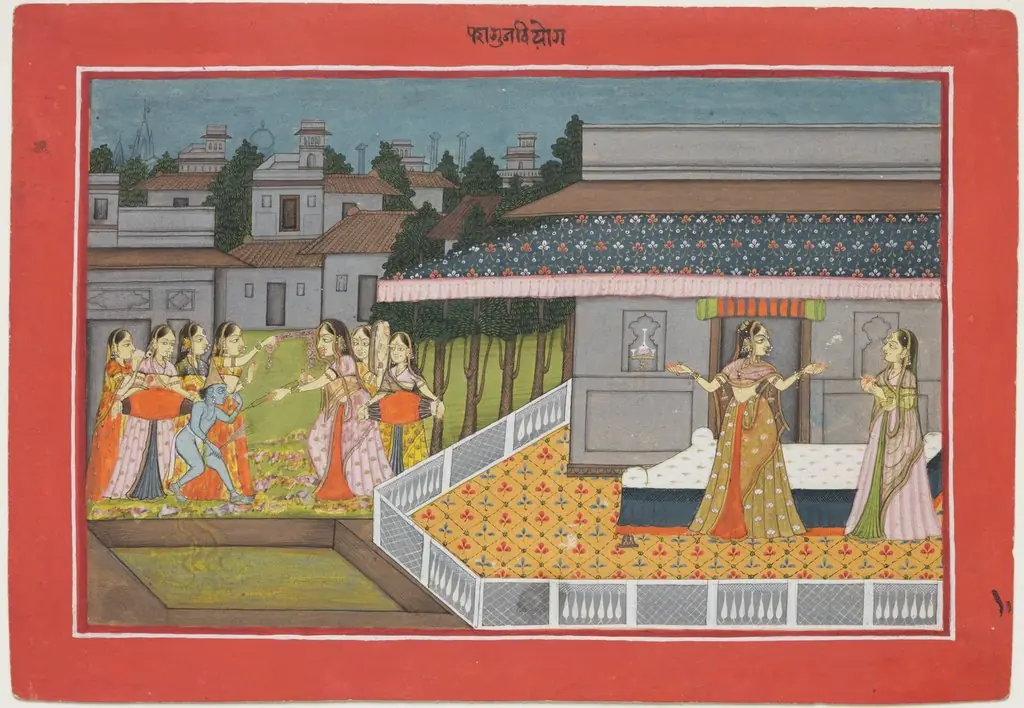 The Month of Phalguna (February-March), from a manuscript of the Barahmasa ("Twelve Months")