Artwork
Crucifixion with Saints Cosmas and Damian
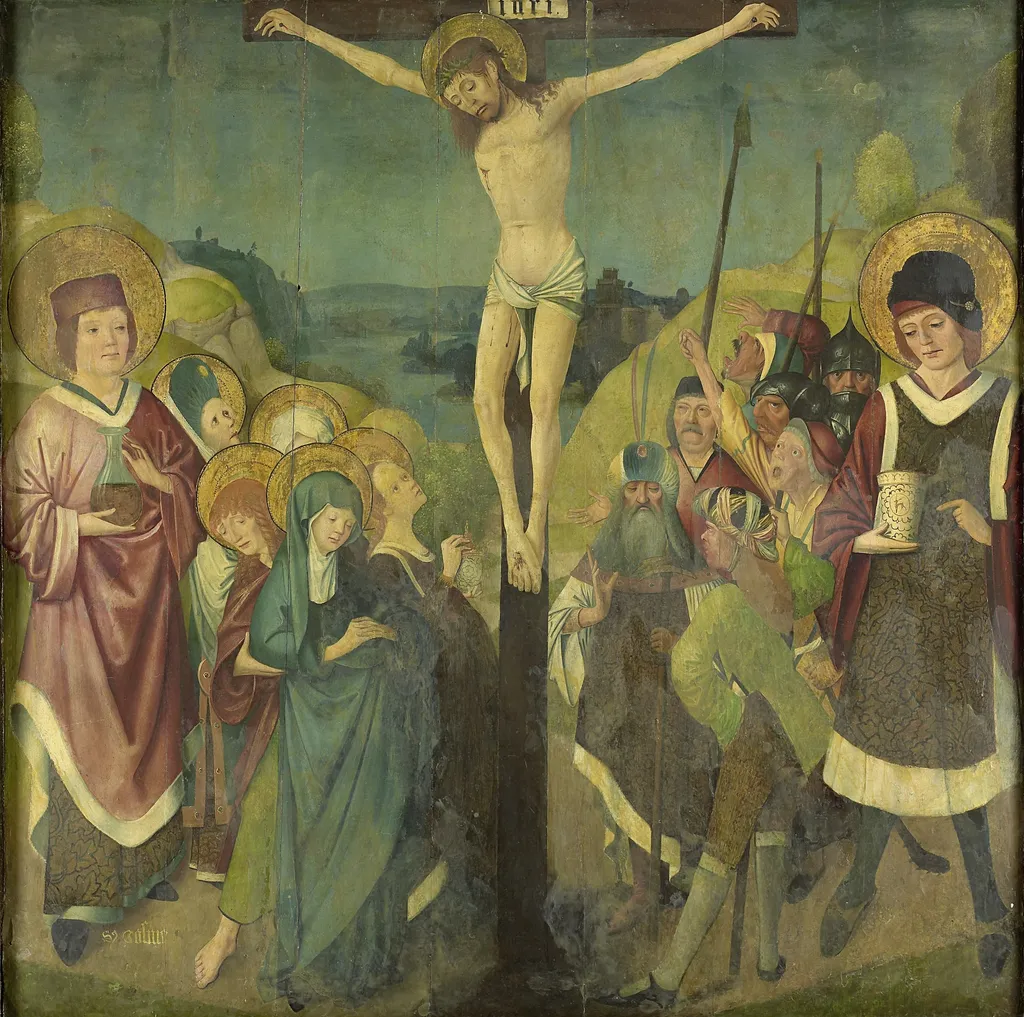
Crucifixion with Saints Cosmas and Damian is an oil painting. It dates from 1437 and is held in the collection of the Rijksmuseum. The work depicts the crucifixion of Christ, centrally positioned on a cross, encircled by a varied assembly of onlookers.
About this work
Overview
To the left, two women in red garments with white trim clutch a jar and a cloth, while on the right, armored soldiers with spears and cups stand as witnesses.
The work depicts the crucifixion of Christ, centrally positioned on a cross, encircled by a varied assembly of onlookers. To the left, two women in red garments with white trim clutch a jar and a cloth, while on the right, armored soldiers with spears and cups stand as witnesses. A muted green hill rises in the background, punctuated by a distant building, and the figures are marked by gold halos.
Subject & Meaning
The composition presents the biblical moment of Christ’s death, accompanied by saints Cosmas and Damian, whose presence is signaled by the women’s offerings. The calm, averted gazes of the crowd suggest a contemplative response to the sacrifice, emphasizing themes of devotion, martyrdom, and the intercession of the saints.
Technique & Style
Executed in oil on canvas, the painting employs flat, vivid coloration with limited modeling, creating a decorative surface rather than naturalistic depth. Simple geometric shapes define the figures, and the use of gold halos reinforces their sanctity. Over time, some pigments have faded, softening the original brightness.
Context
The work reflects a tradition of devotional imagery common in post‑Byzantine and early Baroque religious art, where narrative clarity and symbolic color were prioritized over illusionistic space. The inclusion of saints Cosmas and Damian aligns the piece with churches dedicated to healing and charity.
Legacy
Although the painting’s authorship remains uncertain, its straightforward visual language and emphasis on saintly intercession have informed later ecclesiastical commissions that favor didactic clarity over dramatic chiaroscuro.
Artist & collection