Artwork
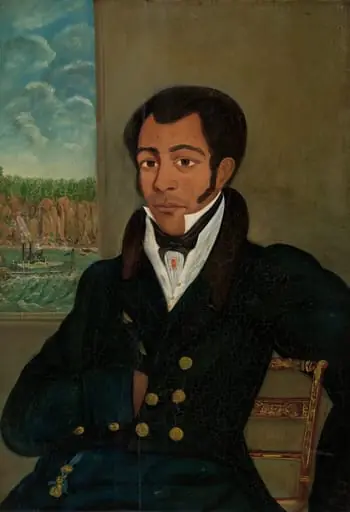
Newport Sea Captain at Green Desk
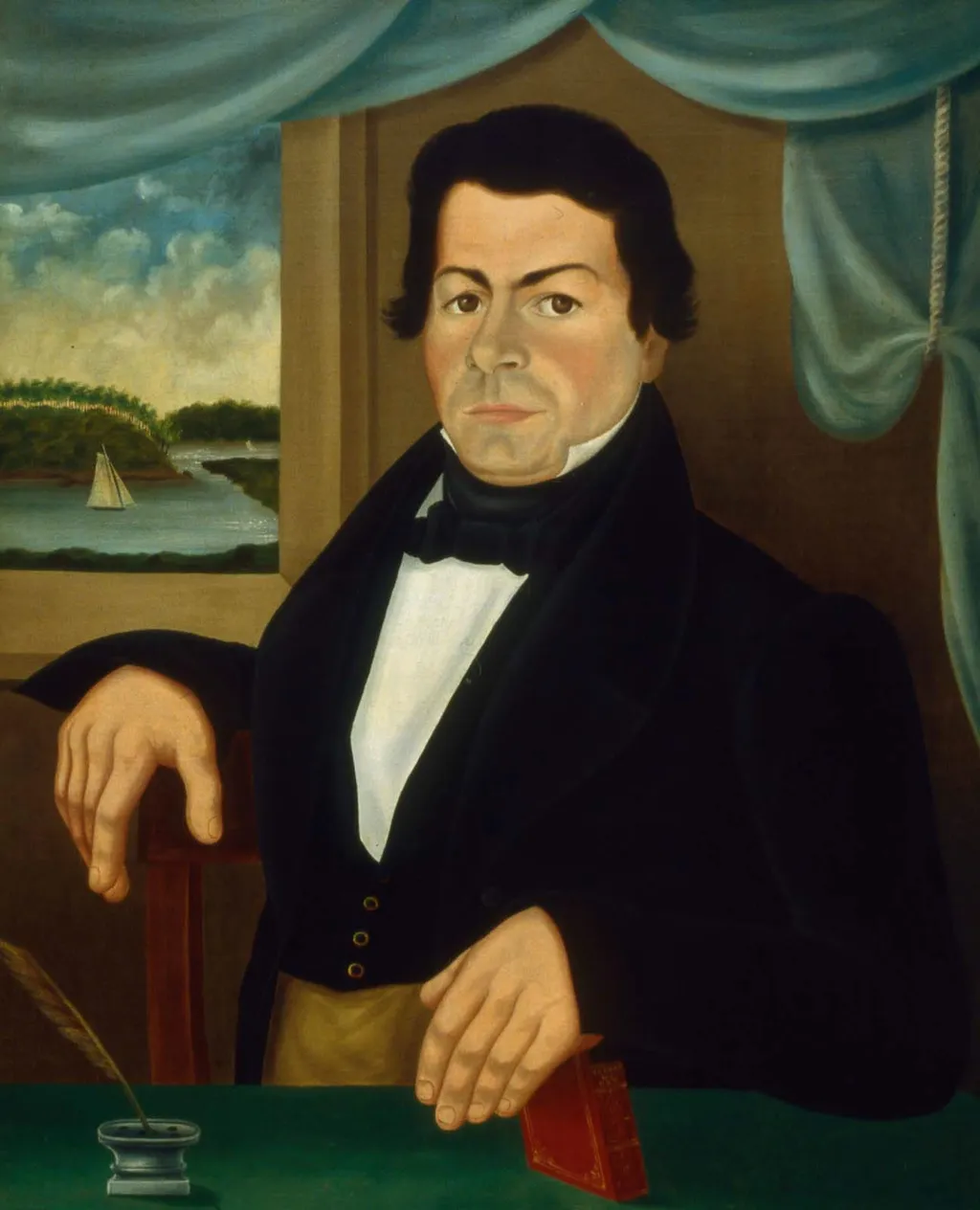
Newport Sea Captain at Green Desk is an oil painting by the American Folk Art artist Unknown. It dates from 1840 and is held in the collection of the Museum of Fine Arts Boston.
About this work
Overview
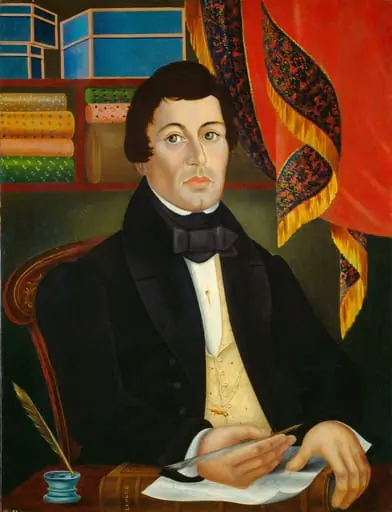
This oil painting portrays a Newport sea captain standing behind a green desk, dressed in formal black attire with a white shirt and black bow tie.
This oil painting portrays a Newport sea captain standing behind a green desk, dressed in formal black attire with a white shirt and black bow tie. His direct gaze and composed posture convey quiet authority. The setting includes a window revealing water, trees, and a distant sailboat, suggesting a maritime context. A red book and quill pen on the desk hint at record-keeping and commerce, reinforcing his professional identity.
Subject & Meaning
The subject is a merchant captain, likely engaged in transatlantic trade, whose presence is marked by stillness rather than action. The red book may represent a logbook or ledger, while the quill implies documentation essential to his profession. The open window and sailboat subtly connect him to his seafaring life, framing his authority not through symbols of power, but through quiet competence and control.
Technique & Style
Chiaroscuro is used to model the figure with subtle light and shadow, lending volume and presence to the form. The dark coat contrasts with the pale shirt and the green desk, creating visual anchors. The background is rendered with soft focus, guiding attention to the figure. Brushwork is precise in the clothing and face, while the landscape beyond remains loosely suggested, enhancing the sense of depth.
History & Provenance
The painting originates from Newport, Rhode Island, a major 18th-century port town known for its merchant class. It likely dates to the late 1700s or early 1800s, when such portraits were commissioned to affirm social standing. The work remained in local collections, possibly within the captain’s family, before entering institutional care. Its survival reflects Newport’s enduring maritime heritage.
Context
During the late colonial and early national periods, Newport’s captains were central to regional economy and identity. Portraits like this served to assert status, blending professional pride with genteel refinement. The inclusion of a desk and writing tools reflects the shift toward literate commerce, where maritime success depended on documentation as much as navigation.
Legacy
This portrait exemplifies the quiet dignity of American merchant class portraiture, distinct from aristocratic grandeur. It preserves the visual language of a profession that shaped early U.S. trade networks. Its restrained composition and attention to everyday objects offer insight into the values of a self-made elite, whose influence extended beyond the sea into civic and cultural life.
Artist & collection

 Domestic Scene
 Giacomo and Cardinal Marco, investing Andrea, Abbot of San Zeno, with his Benefice
 The Nymph of Fontainebleau
 Portrait of a Woman
 Madonna and Child with Saints in the Enclosed Garden
 Venus and Minerva
 Family Group of Four on Sofa
 Wall painting from Room H of the Villa of P. Fannius Synistor at Boscoreale