Artwork
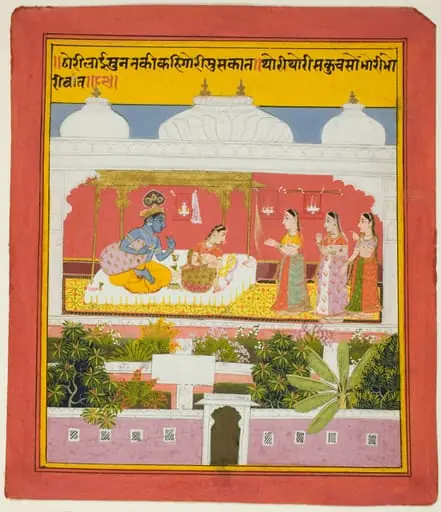
Krishna and Radha in a Pavilion, page from a copy of the Sat Sai Seven Hundred Verses)
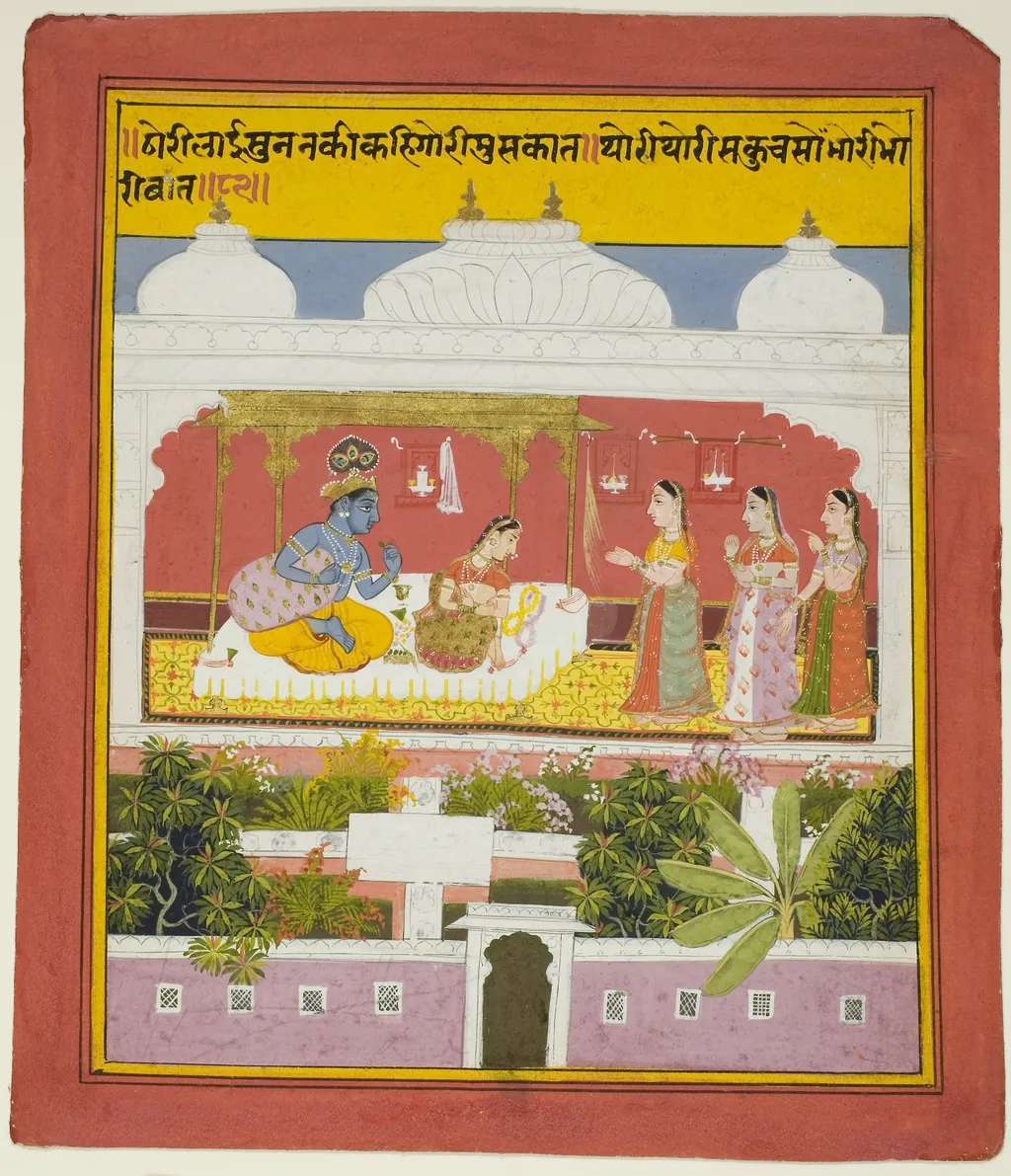
Krishna and Radha in a Pavilion, page from a copy of the Sat Sai Seven Hundred Verses) is an unspecified painting by the Mughal Painting artist Unknown. It dates from 1719 and is held in the collection of the Art Institute of Chicago.
About this work
Overview
The scene is framed by white domed structures and a vivid yellow border bearing red script.
The illustration depicts a blue‑skinned deity seated on a red platform, crowned and playing a flute, accompanied by a woman in a pale pink sari who leans forward to listen. Three additional women in brightly patterned saris stand nearby, some holding objects, while a garden with green foliage and pink blossoms appears behind a white fence. The scene is framed by white domed structures and a vivid yellow border bearing red script.
Subject & Meaning
The central figure is Krishna, a principal deity in Hindu tradition, often portrayed with blue skin and a flute, symbolizing divine love and music. The attendant woman is identified as Radha, his beloved, whose attentive posture emphasizes the devotional relationship between the divine and the devotee.
Technique & Style
Executed with hand‑drawn precision, the work employs bright pigments and intricate patterning to render clothing, architecture, and foliage. The use of a flat, decorative border and stylized figures reflects the manuscript illustration conventions of the period, emphasizing narrative clarity over naturalistic depth.
History & Provenance
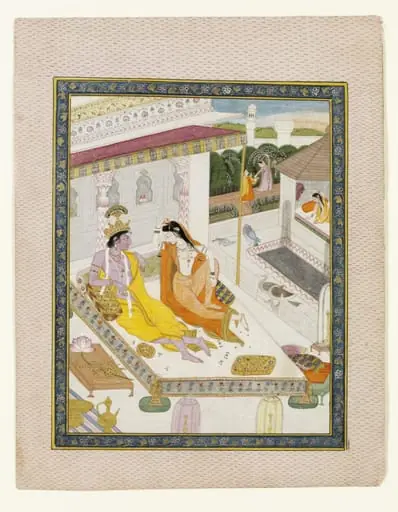
The image forms part of a copy of the *Sat Sai Seven Hundred Verses*, a devotional text that compiles verses praising Krishna. Its inclusion in this manuscript indicates it was produced for religious or instructional purposes, likely within a workshop that specialized in illustrated sacred literature.
Context
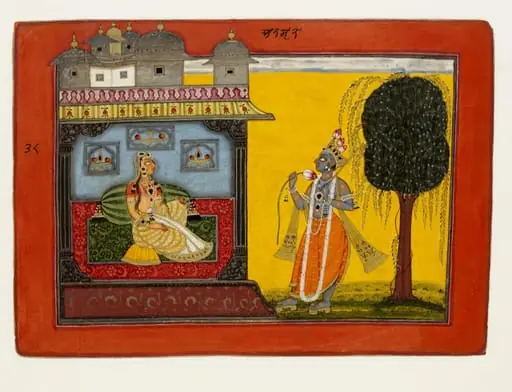
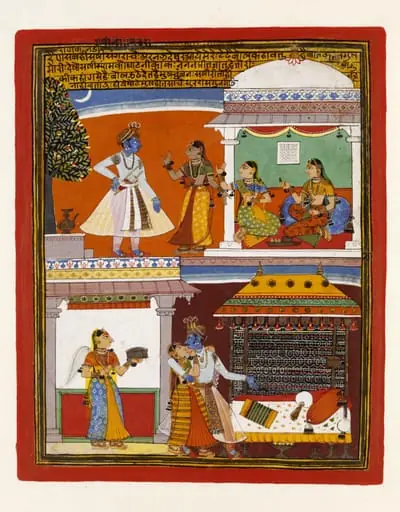
The composition aligns with the broader tradition of Krishna‑Radha iconography in Indian art, where the deity is frequently shown in pastoral or courtly settings, surrounded by female companions. The architectural backdrop of domed structures situates the scene within an idealized, timeless realm rather than a specific historical locale.
Artist & collection

 Domestic Scene
 Giacomo and Cardinal Marco, investing Andrea, Abbot of San Zeno, with his Benefice
 The Nymph of Fontainebleau
 Portrait of a Woman
 Madonna and Child with Saints in the Enclosed Garden
 Venus and Minerva
 Family Group of Four on Sofa
 Wall painting from Room H of the Villa of P. Fannius Synistor at Boscoreale