Artwork
Krishna and Radha
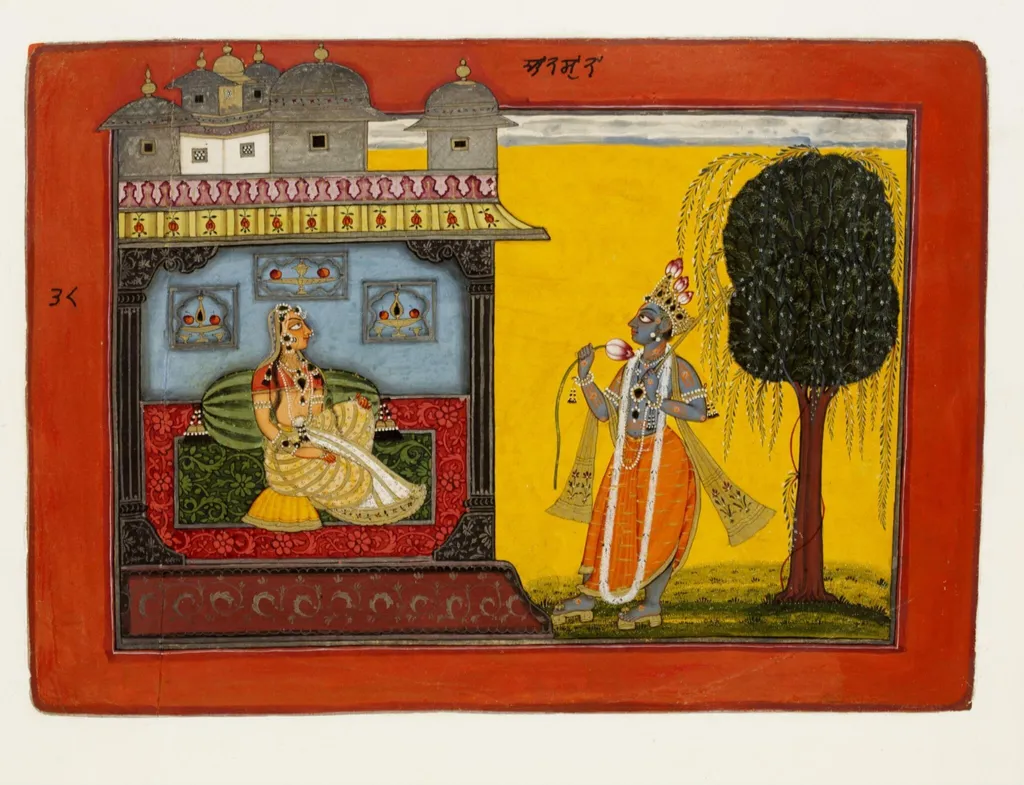
Krishna and Radha is a paint painting by the Baroque artist Unknown. It dates from 1660 and is held in the collection of the Victoria and Albert Museum.
About this work
Overview
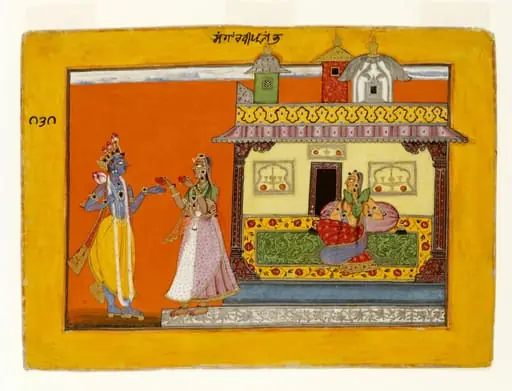
This painting portrays a quiet moment between Krishna and Radha at daybreak, capturing their emotional connection through stillness rather than action.
This painting portrays a quiet moment between Krishna and Radha at daybreak, capturing their emotional connection through stillness rather than action. Set against a vivid yellow background, the figures are framed by architectural elements and a dark tree, their forms rendered in flat, saturated hues. The composition emphasizes spatial depth through layered structures and contrasting tones, drawing attention to the figures’ poised interaction.
Subject & Meaning
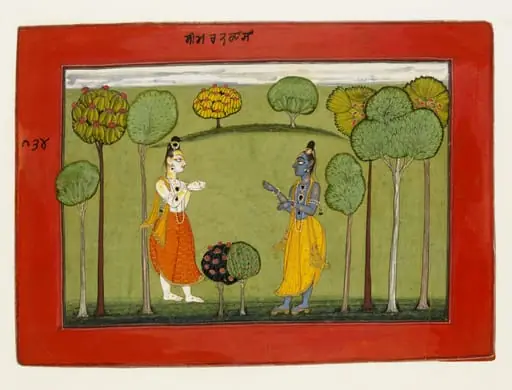
Radha, seated with a fan, faces away as if lost in longing, while Krishna, standing beneath a tree with a flute, gazes toward her. The scene evokes the devotional theme of separation and yearning central to their mythic relationship. The lotus in Krishna’s hand and the architectural setting suggest divine presence and sacred space, reinforcing the spiritual dimension of their bond beyond mere romance.
Technique & Style
The painting employs flat, unmodulated colors with sharp outlines, typical of Pahari miniature traditions. Details like the intricate pavilion, textured tree foliage, and decorative alcoves are rendered with precision despite the lack of perspective. The red border frames the scene like a sacred border, enhancing the intensity of the palette—yellow, crimson, and deep green—against the luminous background.
History & Provenance
Though exact origins are unrecorded, the style aligns with late 18th-century Pahari school works from the Himalayan foothills, likely commissioned by a regional court or temple patron. Similar compositions appear in collections at the Victoria and Albert Museum and other institutions, suggesting a shared visual language among devotional artists in North India during this period.
Context
This work emerges from a tradition where Krishna’s love for Radha symbolized the soul’s devotion to the divine. Paintings like this were used in private worship or as illustrations for poetic texts. The architectural elements reflect local hillside palaces, blending earthly settings with celestial narratives, making the divine feel immediate and tangible to viewers.
Legacy
The painting exemplifies how regional Indian artists adapted spiritual themes into intimate visual forms. Its emphasis on emotional expression through posture and color influenced later miniature traditions and continues to inform contemporary interpretations of Bhakti poetry. Collections preserving such works help sustain awareness of pre-colonial Indian aesthetic values.
Artist & collection

 Domestic Scene
 Giacomo and Cardinal Marco, investing Andrea, Abbot of San Zeno, with his Benefice
 The Nymph of Fontainebleau
 Portrait of a Woman
 Madonna and Child with Saints in the Enclosed Garden
 Venus and Minerva
 Family Group of Four on Sofa
 Wall painting from Room H of the Villa of P. Fannius Synistor at Boscoreale