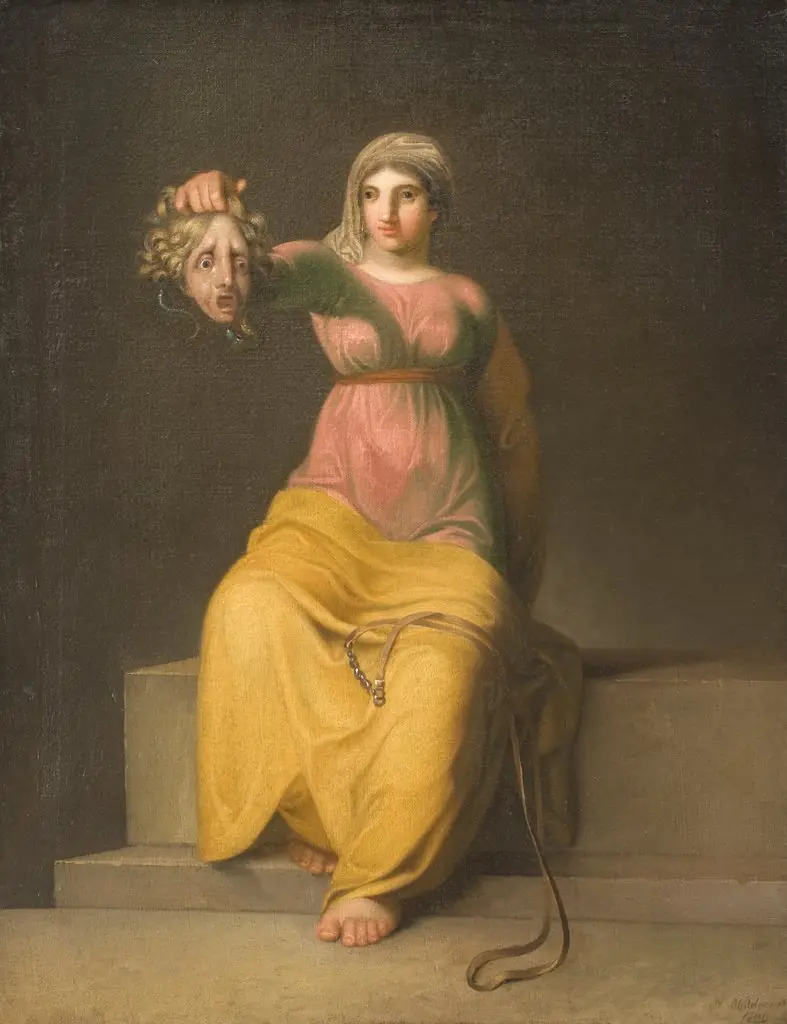
Artwork
Head of Medusa
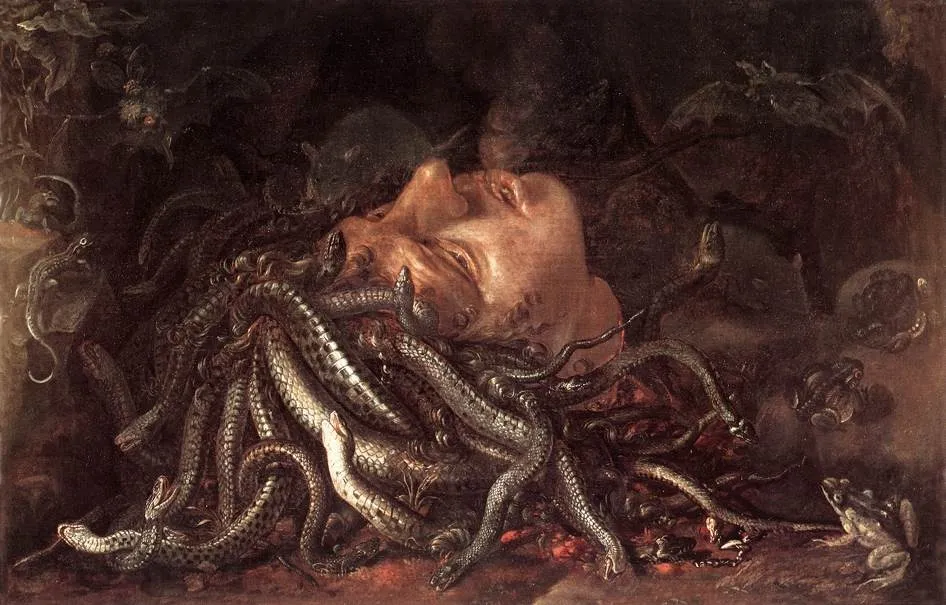
Head of Medusa is an oil painting by the High Renaissance artist Unknown. It dates from 1600 and is held in the collection of the Uffizi Gallery.
About this work
Overview
This oil painting presents a severed head of Medusa, rendered with somber tones and precise detail. The head is tilted backward, eyes shut, mouth agape, surrounded by a tangle of serpents. The palette is restrained—dominated by grays, browns, and muted shadows—emphasizing a sense of stillness and decay rather than dramatic violence.
Subject & Meaning
The image draws from Greek myth, depicting Medusa after her decapitation by Perseus. Her expression suggests finality, not terror, as the snakes—once living hair—now coil around her corpse. The work confronts the viewer with the grotesque transformation of beauty into monstrosity, and life into inert matter.
Technique & Style
Oil paint is applied with controlled brushwork to model the pallor of skin and the slick texture of scales. Shadows deepen the hollows of the face and the crevices between snakes, enhancing tactile realism. The composition is tightly framed, eliminating context to focus solely on the head and its writhing burden.
History & Provenance
The painting is attributed to Caravaggio, created around 1597–1598. It was likely commissioned by Cardinal Francesco Maria del Monte, a known patron of the artist. The work entered the Medici collection by 1631 and remains in the Uffizi Gallery in Florence.
Context
In late 16th-century Italy, depictions of Medusa were common in armor and decorative arts, often symbolizing protection through terror. Caravaggio’s version departs from idealized forms, instead embracing visceral realism. This aligns with his broader shift toward naturalism and psychological intensity in religious and mythological subjects.
Legacy
The painting influenced later artists through its unflinching portrayal of mortality and its rejection of mythological idealism. Its psychological weight and technical precision helped redefine how mythological subjects could be rendered in Baroque art, emphasizing human vulnerability over divine spectacle.
Artist & collection

 Domestic Scene
 Giacomo and Cardinal Marco, investing Andrea, Abbot of San Zeno, with his Benefice
 The Nymph of Fontainebleau
 Portrait of a Woman
 Madonna and Child with Saints in the Enclosed Garden
 Venus and Minerva
 Family Group of Four on Sofa
 Wall painting from Room H of the Villa of P. Fannius Synistor at Boscoreale